Difference between revisions of "Quantum"
| Line 13: | Line 13: | ||
* [http://blogs.scientificamerican.com/cross-check/quantum-computing-for-english-majors/ Quantum Computing for English Majors | John Horgan - Scientific American] | * [http://blogs.scientificamerican.com/cross-check/quantum-computing-for-english-majors/ Quantum Computing for English Majors | John Horgan - Scientific American] | ||
* [http://arxiv.org/pdf/1804.03719.pdf Quantum Algorithm Implementations for Beginners | P. Coles, S. Eidenbenz, S. Pakin, A. Adedoyin, J. Ambrosiano, P. Anisimov, W. Casper, G. Chennupati, C. Coffrin, H. Djidjev, D. Gunter, S. Karra, N. Lemons, S. Lin, A. Lokhov, A. Malyzhenkov, D. Mascarenas, S. Mniszewski, B. Nadiga, D. O'Malley, D. Oyen, L. Prasad, R. Roberts, P. Romero, N. Santhi, N. Sinitsyn, P. Swart, M. Vuffray, J. Wendelberger, B. Yoon, R. Zamora, and W. Zhu] | * [http://arxiv.org/pdf/1804.03719.pdf Quantum Algorithm Implementations for Beginners | P. Coles, S. Eidenbenz, S. Pakin, A. Adedoyin, J. Ambrosiano, P. Anisimov, W. Casper, G. Chennupati, C. Coffrin, H. Djidjev, D. Gunter, S. Karra, N. Lemons, S. Lin, A. Lokhov, A. Malyzhenkov, D. Mascarenas, S. Mniszewski, B. Nadiga, D. O'Malley, D. Oyen, L. Prasad, R. Roberts, P. Romero, N. Santhi, N. Sinitsyn, P. Swart, M. Vuffray, J. Wendelberger, B. Yoon, R. Zamora, and W. Zhu] | ||
| − | |||
| − | + | Machine learning techniques have so far proved to be very promising for the analysis of data in several fields, with many potential applications. However, researchers have found that applying these methods to quantum physics problems is far more challenging due to the exponential complexity of many-body systems.... "One of the objectives of the present work was to generalize a specific, well-known machine learning architecture called convolutional neural network (CNN) for a compact quantum circuit, and demonstrate its capabilities with simplistic but meaningful examples." In their study, Choi and his colleagues assumed that CNNs owe their great success to two important features. Firstly, the fact that they are made out of smaller local units (i.e., multiple layers of quasi-local quantum gates). Secondly, their ability to process input data in a hierarchical fashion. The researchers found a connection between these two characteristics and two renowned physics concepts known as locality and renormalization. "Locality is natural in physics because we believe that the law of nature is fundamentally local," Choi said. "Renormalization, on the other hand, is a very interesting concept. In physics, certain universal features of a quantum many-body system, such as the phase (e.g., liquid, gas, solid, etc.) of materials do not depend on (or are not sensitive to) microscopically detailed information of the system, but rather governed by only a few important hidden parameters. Renormalization is a theory technique to identify those important parameters starting from microscopic description of a quantum system." The researchers observed that renormalization processes share some similarities with pattern recognition applications, particularly those in which machine learning is used to identify objects in pictures. For instance, when a CNN trained for pattern recognition tasks analyzes pictures of animals, it focuses on a universal feature (i.e., trying to identify what animal is portrayed in the image), regardless of whether individual animals of the same type (e.g., cats) look slightly different. This process is somewhat similar to renormalization techniques in theoretical physics, which can also help to distill universal information....quantum convolutional neural network (QCNN), on a quantum physics-specific problem that involved recognizing quantum states associated with a 1-D symmetry protected topological phase. Remarkably, their technique was able to recognize these quantum states, outperforming existing approaches. As it is fairly compact, the QCNN could also potentially be implemented in small quantum computers. [http://phys.org/news/2019-09-quantum-convolutional-neural-networks.html Introducing Quantum Convolutional Neural Networks (QCNN) | Ingrid Fadelli] | |
| + | |||
| + | |||
| + | http://scx1.b-cdn.net/csz/news/800/2019/1-introducingq.jpg | ||
| + | |||
<youtube>LhtnECml-KI</youtube> | <youtube>LhtnECml-KI</youtube> | ||
<youtube>DmzWsvb-Un4</youtube> | <youtube>DmzWsvb-Un4</youtube> | ||
Revision as of 20:48, 11 September 2019
YouTube search... ...Google search
- Quantum Computing for English Majors | John Horgan - Scientific American
- Quantum Algorithm Implementations for Beginners | P. Coles, S. Eidenbenz, S. Pakin, A. Adedoyin, J. Ambrosiano, P. Anisimov, W. Casper, G. Chennupati, C. Coffrin, H. Djidjev, D. Gunter, S. Karra, N. Lemons, S. Lin, A. Lokhov, A. Malyzhenkov, D. Mascarenas, S. Mniszewski, B. Nadiga, D. O'Malley, D. Oyen, L. Prasad, R. Roberts, P. Romero, N. Santhi, N. Sinitsyn, P. Swart, M. Vuffray, J. Wendelberger, B. Yoon, R. Zamora, and W. Zhu
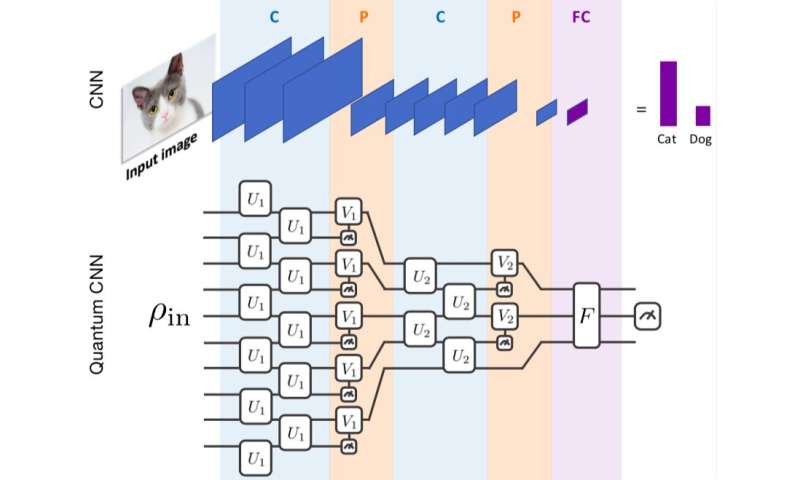
Machine learning techniques have so far proved to be very promising for the analysis of data in several fields, with many potential applications. However, researchers have found that applying these methods to quantum physics problems is far more challenging due to the exponential complexity of many-body systems.... "One of the objectives of the present work was to generalize a specific, well-known machine learning architecture called convolutional neural network (CNN) for a compact quantum circuit, and demonstrate its capabilities with simplistic but meaningful examples." In their study, Choi and his colleagues assumed that CNNs owe their great success to two important features. Firstly, the fact that they are made out of smaller local units (i.e., multiple layers of quasi-local quantum gates). Secondly, their ability to process input data in a hierarchical fashion. The researchers found a connection between these two characteristics and two renowned physics concepts known as locality and renormalization. "Locality is natural in physics because we believe that the law of nature is fundamentally local," Choi said. "Renormalization, on the other hand, is a very interesting concept. In physics, certain universal features of a quantum many-body system, such as the phase (e.g., liquid, gas, solid, etc.) of materials do not depend on (or are not sensitive to) microscopically detailed information of the system, but rather governed by only a few important hidden parameters. Renormalization is a theory technique to identify those important parameters starting from microscopic description of a quantum system." The researchers observed that renormalization processes share some similarities with pattern recognition applications, particularly those in which machine learning is used to identify objects in pictures. For instance, when a CNN trained for pattern recognition tasks analyzes pictures of animals, it focuses on a universal feature (i.e., trying to identify what animal is portrayed in the image), regardless of whether individual animals of the same type (e.g., cats) look slightly different. This process is somewhat similar to renormalization techniques in theoretical physics, which can also help to distill universal information....quantum convolutional neural network (QCNN), on a quantum physics-specific problem that involved recognizing quantum states associated with a 1-D symmetry protected topological phase. Remarkably, their technique was able to recognize these quantum states, outperforming existing approaches. As it is fairly compact, the QCNN could also potentially be implemented in small quantum computers. Introducing Quantum Convolutional Neural Networks (QCNN) | Ingrid Fadelli