Difference between revisions of "Connecting Brains"
m (→Movies) |
m |
||
| (12 intermediate revisions by the same user not shown) | |||
| Line 18: | Line 18: | ||
* [[Symbiotic Intelligence]] ... [[Bio-inspired Computing]] ... [[Neuroscience]] ... [[Connecting Brains]] ... [[Nanobots#Brain Interface using AI and Nanobots|Nanobots]] ... [[Molecular Artificial Intelligence (AI)|Molecular]] ... [[Neuromorphic Computing|Neuromorphic]] ... [[Evolutionary Computation / Genetic Algorithms| Evolutionary/Genetic]] | * [[Symbiotic Intelligence]] ... [[Bio-inspired Computing]] ... [[Neuroscience]] ... [[Connecting Brains]] ... [[Nanobots#Brain Interface using AI and Nanobots|Nanobots]] ... [[Molecular Artificial Intelligence (AI)|Molecular]] ... [[Neuromorphic Computing|Neuromorphic]] ... [[Evolutionary Computation / Genetic Algorithms| Evolutionary/Genetic]] | ||
| − | |||
* [[Apprenticeship Learning - Inverse Reinforcement Learning (IRL)]] | * [[Apprenticeship Learning - Inverse Reinforcement Learning (IRL)]] | ||
* [[Healthcare#Brain and Spine|Healthcare ...Brain and Spine]] | * [[Healthcare#Brain and Spine|Healthcare ...Brain and Spine]] | ||
* [[What is Artificial Intelligence (AI)? | Artificial Intelligence (AI)]] ... [[Generative AI]] ... [[Machine Learning (ML)]] ... [[Deep Learning]] ... [[Neural Network]] ... [[Reinforcement Learning (RL)|Reinforcement]] ... [[Learning Techniques]] | * [[What is Artificial Intelligence (AI)? | Artificial Intelligence (AI)]] ... [[Generative AI]] ... [[Machine Learning (ML)]] ... [[Deep Learning]] ... [[Neural Network]] ... [[Reinforcement Learning (RL)|Reinforcement]] ... [[Learning Techniques]] | ||
| + | * [[Life~Meaning]] ... [[Consciousness]] ... [[Loop#Feedback Loop - Creating Consciousness|Creating Consciousness]] ... [[Quantum#Quantum Biology|Quantum Biology]] ... [[Orch-OR]] ... [[TAME]] ... [[Protein Folding & Discovery|Proteins]] | ||
* [[Collective Animal Intelligence]] ... [[Animal Ecology]] ... [[Animal Language]] ... [[Bird Identification]] | * [[Collective Animal Intelligence]] ... [[Animal Ecology]] ... [[Animal Language]] ... [[Bird Identification]] | ||
| + | * [[Gaming]] ... [[Game-Based Learning (GBL)]] ... [[Games - Security|Security]] ... [[Game Development with Generative AI|Generative AI]] ... [[Metaverse#Games - Metaverse|Games - Metaverse]] ... [[Games - Quantum Theme|Quantum]] ... [[Game Theory]] ... [[Game Design | Design]] | ||
* [https://neurosciencenews.com/neuroscience-terms/brain-computer-interface/ Neuroscience News - Bain Computer Interface] | * [https://neurosciencenews.com/neuroscience-terms/brain-computer-interface/ Neuroscience News - Bain Computer Interface] | ||
* [https://www.sciencemag.org/news/2019/01/artificial-intelligence-turns-brain-activity-speech Artificial intelligence turns brain activity into speech | Kelly Servick] | * [https://www.sciencemag.org/news/2019/01/artificial-intelligence-turns-brain-activity-speech Artificial intelligence turns brain activity into speech | Kelly Servick] | ||
| Line 305: | Line 306: | ||
<youtube>SObhSqYglvQ</youtube> | <youtube>SObhSqYglvQ</youtube> | ||
<b>Mind Melds and Brain Beams: The Dawn of Brain-to-Brain Communication | <b>Mind Melds and Brain Beams: The Dawn of Brain-to-Brain Communication | ||
| − | </b><br>Music students download the technique of their favorite pianist or singer directly into their brains. Medical students download the skills of a seasoned surgeon or diagnostician. And each one of us routinely uploads our thoughts and memories to the digital cloud. While these scenarios still lie in the future, rudimentary versions of the necessary brain-to-brain technology exist today. But the ability to directly influence another person’s brain raises serious questions about human rights and individual freedoms. This program will present the latest technology and explore how the ethical implications of enhanced thinking go to the heart of consciousness itself. | + | </b><br>Music students download the technique of their favorite pianist or singer directly into their brains. Medical students download the skills of a seasoned surgeon or diagnostician. And each one of us routinely uploads our thoughts and memories to the digital cloud. While these scenarios still lie in the future, rudimentary versions of the necessary brain-to-brain technology exist today. But the ability to directly influence another person’s brain raises serious questions about human rights and individual freedoms. This program will present the latest technology and explore how the ethical implications of enhanced thinking go to the heart of [[consciousness]] itself. |
|} | |} | ||
|<!-- M --> | |<!-- M --> | ||
| Line 369: | Line 370: | ||
= Mapping the Brain = | = Mapping the Brain = | ||
| + | * [https://www.humancellatlas.org/ Human Cell Atlas] | ||
| + | |||
Mapping the brain is an ambitious scientific endeavor that seeks to understand the structure and function of this complex organ. Researchers are employing a variety of techniques to achieve this goal, including: | Mapping the brain is an ambitious scientific endeavor that seeks to understand the structure and function of this complex organ. Researchers are employing a variety of techniques to achieve this goal, including: | ||
* Functional and structural neuroimaging: These techniques create detailed images of the brain, allowing scientists to observe how different brain regions are activated during various tasks and to identify structural abnormalities. | * Functional and structural neuroimaging: These techniques create detailed images of the brain, allowing scientists to observe how different brain regions are activated during various tasks and to identify structural abnormalities. | ||
| − | * Connectomics: This field focuses on mapping the connections between neurons, with the goal of creating a comprehensive "wiring diagram" of the brain. | + | * [https://en.wikipedia.org/wiki/Connectomics Connectomics]: This field focuses on mapping the connections between neurons, with the goal of creating a comprehensive "wiring diagram" of the brain. |
* Cell atlas projects: These initiatives aim to identify and characterize all the different cell types in the brain, creating a detailed census of the brain's cellular makeup. | * Cell atlas projects: These initiatives aim to identify and characterize all the different cell types in the brain, creating a detailed census of the brain's cellular makeup. | ||
| Line 379: | Line 382: | ||
* The BRAIN Initiative: Launched by the National Institutes of Health (NIH) in 2013, the BRAIN Initiative is a large-scale project that supports a wide range of brain mapping research efforts. One key component is the Brain Research Through Advancing Innovative Neurotechnologies® (BRAIN Initiative®) [National Institute of Mental Health (NIMH)] which has played a role in funding projects like the BICCN. | * The BRAIN Initiative: Launched by the National Institutes of Health (NIH) in 2013, the BRAIN Initiative is a large-scale project that supports a wide range of brain mapping research efforts. One key component is the Brain Research Through Advancing Innovative Neurotechnologies® (BRAIN Initiative®) [National Institute of Mental Health (NIMH)] which has played a role in funding projects like the BICCN. | ||
* The Cell Census Network (BICCN): Established in 2017, the BICCN is a global collaboration of scientists working to create a comprehensive atlas of brain cell types in mice, monkeys, and humans. Their recent achievement of detailed cell maps of the human and nonhuman primate brain is a significant milestone [National Institute of Mental Health (NIMH)]. | * The Cell Census Network (BICCN): Established in 2017, the BICCN is a global collaboration of scientists working to create a comprehensive atlas of brain cell types in mice, monkeys, and humans. Their recent achievement of detailed cell maps of the human and nonhuman primate brain is a significant milestone [National Institute of Mental Health (NIMH)]. | ||
| + | * Allen Brain Atlas: A 3D, web-based map of gene expression in the mouse brain, which details over 21,000 genes at the cellular level. Since humans share over 90% of their genes with mice, this atlas can help scientists understand human diseases like Alzheimer's, Parkinson's, and epilepsy. | ||
| + | * Brain Energy Atlas Project: A collaboration between Yale University and Fudan University to create a 3D energy map of the human brain. This map is based on neuropil density and is intended to help scientists understand the microscopic anatomy of the brain. | ||
| + | * BigBrain: A human brain atlas based on MRI images of over 7,000 brain slices. | ||
| + | Human Brain Atlas: Links MRI-based reference spaces to the microscopic BigBrain model. The Human Brain Project (HBP) has developed a 3D interactive viewer to explore brain atlases. | ||
| + | * BrainSpan: Atlas of the Developing Human Brain: A project supported by the National Institute of Mental Health. | ||
[[Google]] has been actively involved in brain mapping research for over a decade, contributing through various projects and collaborations. Here's a breakdown of their key areas of focus: | [[Google]] has been actively involved in brain mapping research for over a decade, contributing through various projects and collaborations. Here's a breakdown of their key areas of focus: | ||
| − | 1. Artificial Intelligence (AI) and Data Analysis: Google's strength lies in its expertise in AI and computational power. This has been instrumental in: | + | 1. Artificial Intelligence (AI) and Data Analysis: [[Google]]'s strength lies in its expertise in AI and computational power. This has been instrumental in: |
| − | + | * Automating data processing: Large-scale brain mapping projects generate massive datasets. [[Google]]'s AI tools assist in automating tasks like segmentation (identifying individual neurons) and reconstruction (creating 3D models), significantly speeding up the process. | |
| − | * Automating data processing: Large-scale brain mapping projects generate massive datasets. Google's AI tools assist in automating tasks like segmentation (identifying individual neurons) and reconstruction (creating 3D models), significantly speeding up the process | ||
* Extracting insights: AI algorithms can analyze complex brain data to identify patterns and connections that might be missed by human researchers. This helps us understand how different brain regions interact and function. | * Extracting insights: AI algorithms can analyze complex brain data to identify patterns and connections that might be missed by human researchers. This helps us understand how different brain regions interact and function. | ||
| − | 2. Collaborations: Google partners with other research institutions to leverage their expertise and datasets. Examples include: | + | 2. Collaborations: [[Google]] partners with other research institutions to leverage their expertise and datasets. Examples include: |
| − | + | * Mapping the Mouse Brain: [[Google]] collaborated with several institutions on a project funded by the [https://www.nih.gov/ National Institutes of Health (NIH)] to create a connectome (map of connections) of the mouse hippocampus, a region crucial for memory and navigation [blog.research.google]. This is a stepping stone towards mapping the entire mouse brain. | |
| − | * Mapping the Mouse Brain: Google collaborated with several institutions on a project funded by the National Institutes of Health (NIH) to create a connectome (map of connections) of the mouse hippocampus, a region crucial for memory and navigation [blog.research.google]. This is a stepping stone towards mapping the entire mouse brain. | + | * 3D Human Brain Mapping: [[Google]] AI partnered with [https://www.med.harvard.edu/aanlib/home.html Harvard Medical School] to create a detailed 3D map of a tiny human brain tissue sample. This collaboration used AI to analyze vast amounts of electron microscope data, revealing intricate structures like "axon whorls" - previously unknown formations [blog.google]. |
| − | * 3D Human Brain Mapping: Google AI partnered with Harvard Medical School to create a detailed 3D map of a tiny human brain tissue sample. This collaboration used AI to analyze vast amounts of electron microscope data, revealing intricate structures like "axon whorls" - previously unknown formations [blog.google]. | ||
| − | 3. Focus on Resolution: Google's projects aim to achieve high-resolution brain maps, capturing details down to the level of individual synapses (connection points between neurons). This fine-grained approach provides a deeper understanding of brain circuitry. | + | 3. Focus on Resolution: [[Google]]'s projects aim to achieve high-resolution brain maps, capturing details down to the level of individual synapses (connection points between neurons). This fine-grained approach provides a deeper understanding of brain circuitry. |
| − | 4. Long-term Vision: While current efforts focus on small brain regions, Google's ultimate goal might be to contribute to a comprehensive map of the entire human brain. This would be a revolutionary advancement in our understanding of this complex organ. | + | 4. Long-term Vision: While current efforts focus on small brain regions, [[Google]]'s ultimate goal might be to contribute to a comprehensive map of the entire human brain. This would be a revolutionary advancement in our understanding of this complex organ. |
<youtube>VSG3_JvnCkU</youtube> | <youtube>VSG3_JvnCkU</youtube> | ||
<youtube>9qOaII_PzGY</youtube> | <youtube>9qOaII_PzGY</youtube> | ||
Latest revision as of 15:12, 5 January 2026
YouTube search... ...Google search
- Symbiotic Intelligence ... Bio-inspired Computing ... Neuroscience ... Connecting Brains ... Nanobots ... Molecular ... Neuromorphic ... Evolutionary/Genetic
- Apprenticeship Learning - Inverse Reinforcement Learning (IRL)
- Healthcare ...Brain and Spine
- Artificial Intelligence (AI) ... Generative AI ... Machine Learning (ML) ... Deep Learning ... Neural Network ... Reinforcement ... Learning Techniques
- Life~Meaning ... Consciousness ... Creating Consciousness ... Quantum Biology ... Orch-OR ... TAME ... Proteins
- Collective Animal Intelligence ... Animal Ecology ... Animal Language ... Bird Identification
- Gaming ... Game-Based Learning (GBL) ... Security ... Generative AI ... Games - Metaverse ... Quantum ... Game Theory ... Design
- Neuroscience News - Bain Computer Interface
- Artificial intelligence turns brain activity into speech | Kelly Servick
- 29 Neurotech Companies Interfacing With Your Brain | Nanalyze
- CTRL-labs Uses AI for Brain-Computer Interface | Nanalyze
- Synchron – A Brain Computer Interface Using Stentrodes | Nanalyze
- Researchers translate brain waves into scarily accurate images using Stable Diffusion AI | Katie Wickens - PC Gamer ... Researchers have been able to use Stable Diffusion models to reconstruct images from human brain waves.
- Scientists recorded a Pink Floyd song from patients’ brain waves. The tech could eventually allow for communication without words | Erin Prater - Fortune Well ... While receiving surgery they hoped would cure intractable seizures, Pink Floyd’s 1979 single “Another Brick in the Wall, Part 1” played in the operating room. Using artificial intelligence, Bellier was able to reconstruct the song from that electrical activity in each patient’s brain
- ‘Biocomputer’ combines lab-grown brain tissue with electronic hardware | Lilly Tozer - Nature ... A system that integrates brain cells into a hybrid machine can recognize voices.
Contents
Brain Machine Interface (BMI) / Brain Computer Interface (BCI)
YouTube search... ...Google search
- Kernel ...Neuroscience as a Service (NaaS)
- Brain-Computer Interfaces (BCI) | Singularity Hub
- Latest Research Introduces Brain-Computer-Interface That Changes Robot Manipulator’s Motion Trajectories Using Inverse Reinforcement Learning (IRL) | Tanushree Shenwai - MarkTechPost

Researchers say they’ve built a system that can translate brain signals directly into text — a promising step toward a “speech prosthesis” that could effectively allow you to think text directly into a computer. Machine translation of cortical activity to text with an encoder–decoder framework | J. Makin, D. Moses, and E. Chang - Nature Neuroscience ...Scientists Debut System To Translate Thoughts Directly Into Text | Victor Tangermann - The Byte
|
|
|
|
|
|
|
|
|
|
|
|
|
|
|
|
|
|
Brain Machine Interface (BMI) via Generative AI
- Semantic reconstruction of continuous language from non-invasive brain recordings | J. Tang, A. LeBel, S. Jain & A. Huth
- Scientists in Texas developed a GPT-like AI system that reads minds | Tristan Greene - CoinTelegraph ... A new study demonstrates how the tech underlining ChatGPT can decode brain scans; recent AI progress indicates this could have implications for blockchain and Web3
|
|
Neuralink
YouTube search... ...Google search
- Neuralink Homepage
- Neuralink | Wikipedia
- Neuralink Progress Update: What To Know About Elon Musk's Major Event | Inverse
Neuralink Corporation is an American neurotechnology company founded by Elon Musk and others, developing implantable brain–machine interfaces.
Demo involved several live pigs, one of which had the data-transmitting, coin-sized implant in its brain. A screen showed the electrical brain activity of the pig, named Gertrude, as it was registered on the device. Musk called the device "a Fitbit in your skull." The wires contain electrodes that can theoretically read or write based on brain activity. The data is transmitted for analysis via radio waves.
|
|
|
|
|
|
Brain to Brain Interface (BBI)
YouTube search... ...Google search
- Scientists Demonstrate Direct Brain-to-Brain Communication in Humans | Robert Martone - Scientific American ...Work on an “Internet of brains” takes another step
|
|
|
|
|
|
PEDOT
- PEDOT:PSS Interfaces Support the Development of Neuronal Synaptic Networks with Reduced Neuroglia Response In vitro | G. Cellot, P. Lagonegro, G. Tarabella, D. Scaini, F. Fabbri, S. Iannotta, M. Prato, G. Salviati, and L. Ballerini
- Chronic Intracortical Neural Recordings Using Microelectrode Arrays Coated With PEDOT-TFB | NeuroNexus
- Improving the performance of poly(3,4-ethylenedioxythiophene) for brain–machine interface applications | H.Mandala, G. Knaack, H. Charkhkar, D. McHail, J. Kastee, Theodore Dumas, N. Peixoto, J. Rubinson, and J. Pancrazio - ScienceDirect
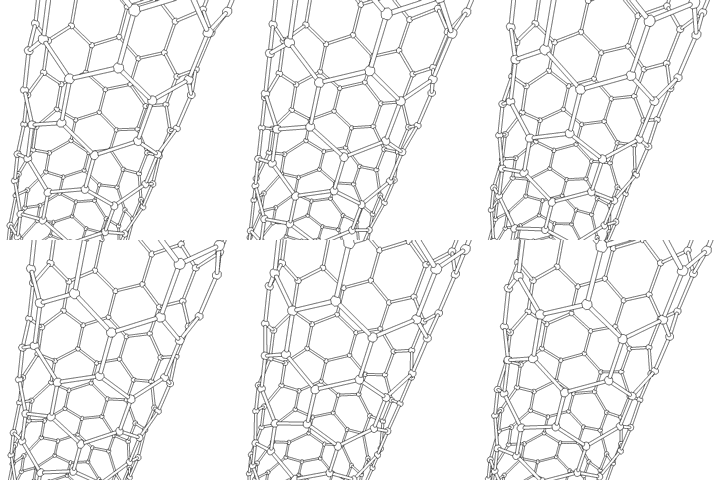
- Carbon Nanotube (CNT) | Wikipedia ...a molecular-scale structure consisting of carbon atoms arranged in one or more cylindrical layers, joined by covalent bonds in a hexagonal tiling pattern within each layer, so as to form a hollow tube
Connecting electronics to human tissue has been a major challenge due to traditional materials like gold, silicon and steel causing scarring when implanted....The polymer, known as a Pedot, has exactly the properties needed to interface electronic hardware with human tissue without causing scarring while also dramatically improving the performance of medical implants. ...The latest research used a Pedot film with an antibody that stimulates blood vessel growth after injury and could be used to detect early stages of tumour growth in the body. Pedot polymers could also be used to help sense or treat brain or nervous system disorders, while versions could theoretically attach peptides, antibodies and DNA. "Name your favorite biomolecule, and you can in principle make a Pedot film that has whatever biofunctional group you might be interested in," Dr. David Martin said. The researchers made a polymer with dopamine, which plays a role in addictive behaviors. Several companies and research institutions are already working on technology to connect brains to computers, with Elon Musk's Neuralink perhaps the closest to achieving a commercial product. The startup plans to reveal more details about its brain chips later this month, which could one day provide "full-bandwidth data streaming" to the brain through a USB-C cable.Groundbreaking New Material 'Could Allow Artificial Intelligence To Merge With The Human Brain' | Anthony Cuthbertson - Independent ...Technology could enable new health diagnostics and achieve Elon Musk's goal of integrating with artificial intelligence
poly(3,4-ethylenedioxythiophene) polystyrene sulfonate (PEDOT:PSS) is a polymer mixture of two ionomers. One component in this mixture is made up of sodium polystyrene sulfonate which is a sulfonated polystyrene. Part of the sulfonyl groups are deprotonated and carry a negative charge. The other component poly(3,4-ethylenedioxythiophene) (PEDOT) is a conjugated polymer and carries positive charges and is based on polythiophene. Together the charged macromolecules form a macromolecular salt. Wikipedia

Mapping the Brain
Mapping the brain is an ambitious scientific endeavor that seeks to understand the structure and function of this complex organ. Researchers are employing a variety of techniques to achieve this goal, including:
- Functional and structural neuroimaging: These techniques create detailed images of the brain, allowing scientists to observe how different brain regions are activated during various tasks and to identify structural abnormalities.
- Connectomics: This field focuses on mapping the connections between neurons, with the goal of creating a comprehensive "wiring diagram" of the brain.
- Cell atlas projects: These initiatives aim to identify and characterize all the different cell types in the brain, creating a detailed census of the brain's cellular makeup.
Here are some of the ongoing efforts in brain mapping:
- The BRAIN Initiative: Launched by the National Institutes of Health (NIH) in 2013, the BRAIN Initiative is a large-scale project that supports a wide range of brain mapping research efforts. One key component is the Brain Research Through Advancing Innovative Neurotechnologies® (BRAIN Initiative®) [National Institute of Mental Health (NIMH)] which has played a role in funding projects like the BICCN.
- The Cell Census Network (BICCN): Established in 2017, the BICCN is a global collaboration of scientists working to create a comprehensive atlas of brain cell types in mice, monkeys, and humans. Their recent achievement of detailed cell maps of the human and nonhuman primate brain is a significant milestone [National Institute of Mental Health (NIMH)].
- Allen Brain Atlas: A 3D, web-based map of gene expression in the mouse brain, which details over 21,000 genes at the cellular level. Since humans share over 90% of their genes with mice, this atlas can help scientists understand human diseases like Alzheimer's, Parkinson's, and epilepsy.
- Brain Energy Atlas Project: A collaboration between Yale University and Fudan University to create a 3D energy map of the human brain. This map is based on neuropil density and is intended to help scientists understand the microscopic anatomy of the brain.
- BigBrain: A human brain atlas based on MRI images of over 7,000 brain slices.
Human Brain Atlas: Links MRI-based reference spaces to the microscopic BigBrain model. The Human Brain Project (HBP) has developed a 3D interactive viewer to explore brain atlases.
- BrainSpan: Atlas of the Developing Human Brain: A project supported by the National Institute of Mental Health.
Google has been actively involved in brain mapping research for over a decade, contributing through various projects and collaborations. Here's a breakdown of their key areas of focus:
1. Artificial Intelligence (AI) and Data Analysis: Google's strength lies in its expertise in AI and computational power. This has been instrumental in:
- Automating data processing: Large-scale brain mapping projects generate massive datasets. Google's AI tools assist in automating tasks like segmentation (identifying individual neurons) and reconstruction (creating 3D models), significantly speeding up the process.
- Extracting insights: AI algorithms can analyze complex brain data to identify patterns and connections that might be missed by human researchers. This helps us understand how different brain regions interact and function.
2. Collaborations: Google partners with other research institutions to leverage their expertise and datasets. Examples include:
- Mapping the Mouse Brain: Google collaborated with several institutions on a project funded by the National Institutes of Health (NIH) to create a connectome (map of connections) of the mouse hippocampus, a region crucial for memory and navigation [blog.research.google]. This is a stepping stone towards mapping the entire mouse brain.
- 3D Human Brain Mapping: Google AI partnered with Harvard Medical School to create a detailed 3D map of a tiny human brain tissue sample. This collaboration used AI to analyze vast amounts of electron microscope data, revealing intricate structures like "axon whorls" - previously unknown formations [blog.google].
3. Focus on Resolution: Google's projects aim to achieve high-resolution brain maps, capturing details down to the level of individual synapses (connection points between neurons). This fine-grained approach provides a deeper understanding of brain circuitry.
4. Long-term Vision: While current efforts focus on small brain regions, Google's ultimate goal might be to contribute to a comprehensive map of the entire human brain. This would be a revolutionary advancement in our understanding of this complex organ.
