Difference between revisions of "Deep Reinforcement Learning (DRL)"
| Line 47: | Line 47: | ||
<youtube>w33Lplx49_A</youtube> | <youtube>w33Lplx49_A</youtube> | ||
<youtube>eYlJsDH7ggE</youtube> | <youtube>eYlJsDH7ggE</youtube> | ||
| + | |||
| + | == IMPALA (Importance Weighted Actor-Learner Architecture) == | ||
| + | [http://www.youtube.com/results?search_query=Impala+AGI+machine+artificial+intelligence+deep+learning+simple YouTube search...] | ||
| + | [http://www.google.com/search?q=Impala+AGIb+deep+machine+learning+ML ...Google search] | ||
| + | |||
| + | * [http://www.extremetech.com/extreme/275768-artificial-general-intelligence-is-here-and-impala-is-its-nameDeepMind Artificial General Intelligence Is Here, and Impala Is Its Name | Aaron Krumins] | ||
| + | * [http://deepmind.com/blog/open-sourcing-deepmind-lab/ DeepMind Lab] | ||
| + | * [http://deepmind.com/research/publications/impala-scalable-distributed-deep-rl-importance-weighted-actor-learner-architectures/ IMPALA: Scalable Distributed Deep-RL with Importance Weighted Actor-Learner Architectures] | ||
| + | * [http://deepmind.com/blog/impala-scalable-distributed-deeprl-dmlab-30/ Importance Weighted Actor-Learner Architectures: Scalable Distributed DeepRL in DMLab-30] | ||
| + | |||
| + | uses resources more efficiently in single-machine training but also scales to thousands of machines without sacrificing data efficiency or resource utilisation. We achieve stable learning at high throughput by combining decoupled acting and learning with a novel off-policy correction method called V-trace. IMPALA is able to achieve better performance than previous agents with less data, and crucially exhibits positive transfer between tasks as a result of its multi-task approach. | ||
| + | |||
| + | http://ai2-s2-public.s3.amazonaws.com/figures/2017-08-08/cbddc41e5b07ad8e3f7982e232bafba84c8419cc/5-Figure3-1.png | ||
| + | |||
| + | |||
| + | <youtube>u4hf4uZnZlI</youtube> | ||
| + | |||
| + | |||
| + | http://storage.googleapis.com/deepmind-live-cms/images/Impala-Figures-180206-r01-03%2520%25281%2529.width-1500.png | ||
Revision as of 17:40, 1 September 2019
Youtube search... ...Google search
- IMPALA (Importance Weighted Actor-Learner Architecture)
- OpenAI Gym
- Reinforcement Learning (RL)
- Monte Carlo (MC) Method - Model Free Reinforcement Learning
- Markov Decision Process (MDP)
- Q Learning
- State-Action-Reward-State-Action (SARSA)
- Distributed Deep Reinforcement Learning (DDRL)
- Deep Q Network (DQN)
- Evolutionary Computation / Genetic Algorithms
- Asynchronous Advantage Actor Critic (A3C)
- Hierarchical Reinforcement Learning (HRL)
- MERLIN
OTHER: Policy Gradient Methods
_______________________________________________________________________________________
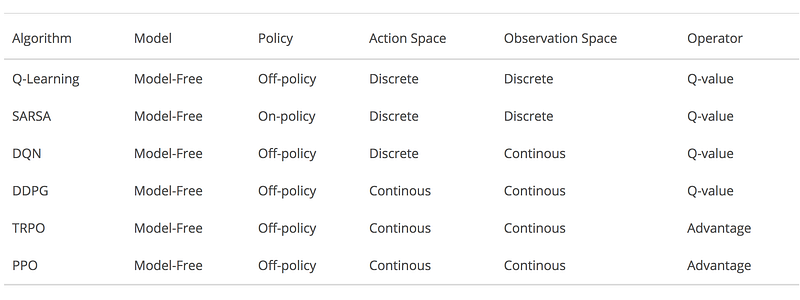
- Introduction to Various Reinforcement Learning Algorithms. Part I (Q-Learning, SARSA, DQN, DDPG) | Steeve Huang
- Introduction to Various Reinforcement Learning Algorithms. Part II (TRPO, PPO) | Steeve Huang
- Guide
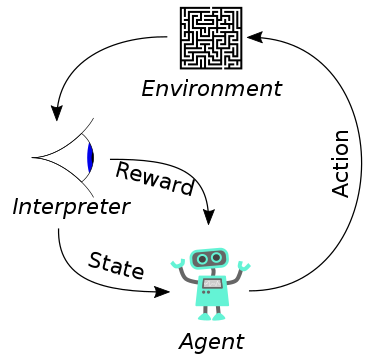
Goal-oriented algorithms, which learn how to attain a complex objective (goal) or maximize along a particular dimension over many steps; for example, maximize the points won in a game over many moves. Reinforcement learning solves the difficult problem of correlating immediate actions with the delayed returns they produce. Like humans, reinforcement learning algorithms sometimes have to wait a while to see the fruit of their decisions. They operate in a delayed return environment, where it can be difficult to understand which action leads to which outcome over many time steps.
IMPALA (Importance Weighted Actor-Learner Architecture)
YouTube search... ...Google search
- Artificial General Intelligence Is Here, and Impala Is Its Name | Aaron Krumins
- DeepMind Lab
- IMPALA: Scalable Distributed Deep-RL with Importance Weighted Actor-Learner Architectures
- Importance Weighted Actor-Learner Architectures: Scalable Distributed DeepRL in DMLab-30
uses resources more efficiently in single-machine training but also scales to thousands of machines without sacrificing data efficiency or resource utilisation. We achieve stable learning at high throughput by combining decoupled acting and learning with a novel off-policy correction method called V-trace. IMPALA is able to achieve better performance than previous agents with less data, and crucially exhibits positive transfer between tasks as a result of its multi-task approach.


