Difference between revisions of "Deep Reinforcement Learning (DRL)"
| Line 35: | Line 35: | ||
Goal-oriented algorithms, which learn how to attain a complex objective (goal) or maximize along a particular dimension over many steps; for example, maximize the points won in a game over many moves. Reinforcement learning solves the difficult problem of correlating immediate actions with the delayed returns they produce. Like humans, reinforcement learning algorithms sometimes have to wait a while to see the fruit of their decisions. They operate in a delayed return environment, where it can be difficult to understand which action leads to which outcome over many time steps. | Goal-oriented algorithms, which learn how to attain a complex objective (goal) or maximize along a particular dimension over many steps; for example, maximize the points won in a game over many moves. Reinforcement learning solves the difficult problem of correlating immediate actions with the delayed returns they produce. Like humans, reinforcement learning algorithms sometimes have to wait a while to see the fruit of their decisions. They operate in a delayed return environment, where it can be difficult to understand which action leads to which outcome over many time steps. | ||
| − | |||
<youtube>e3Jy2vShroE</youtube> | <youtube>e3Jy2vShroE</youtube> | ||
<youtube>lvoHnicueoE</youtube> | <youtube>lvoHnicueoE</youtube> | ||
Revision as of 13:33, 1 September 2019
Youtube search... ...Google search
OTHER: Learning; MDP, Q, and SARSA
- Markov Decision Process (MDP)
- Deep Q Learning (DQN)
- Neural Coreference
- State-Action-Reward-State-Action (SARSA)
OTHER: Policy Gradient Methods
_______________________________________________________________________________________
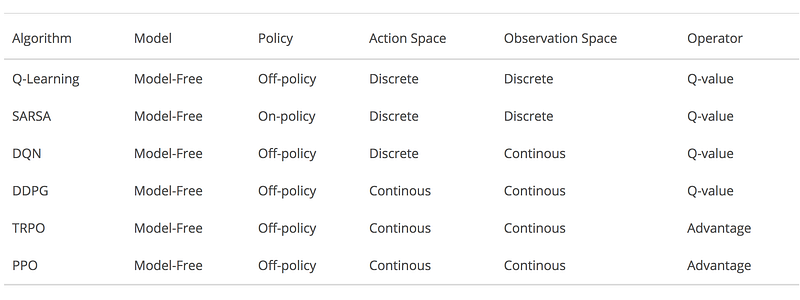
- Introduction to Various Reinforcement Learning Algorithms. Part I (Q-Learning, SARSA, DQN, DDPG) | Steeve Huang
- Introduction to Various Reinforcement Learning Algorithms. Part II (TRPO, PPO) | Steeve Huang
- Guide
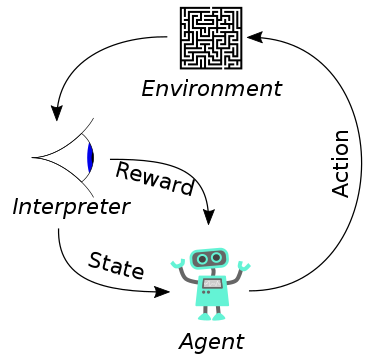
Goal-oriented algorithms, which learn how to attain a complex objective (goal) or maximize along a particular dimension over many steps; for example, maximize the points won in a game over many moves. Reinforcement learning solves the difficult problem of correlating immediate actions with the delayed returns they produce. Like humans, reinforcement learning algorithms sometimes have to wait a while to see the fruit of their decisions. They operate in a delayed return environment, where it can be difficult to understand which action leads to which outcome over many time steps.
