Difference between revisions of "Transformer-XL"
| Line 19: | Line 19: | ||
Combines the two leading architectures for language modeling: | Combines the two leading architectures for language modeling: | ||
| − | # [[ | + | # [[Recurrent Neural Network (RNN)]] to handles the input tokens — words or characters — one by one to learn the relationship between them |
# [[Attention]] Mechanism/[[Transformer]] Model to receive a segment of tokens and learns the dependencies between at once them using an attention mechanism. | # [[Attention]] Mechanism/[[Transformer]] Model to receive a segment of tokens and learns the dependencies between at once them using an attention mechanism. | ||
Revision as of 07:14, 30 June 2019
YouTube search... ...Google search
- Bidirectional Encoder Representations from Transformers (BERT)
- A Light Introduction to Transformer-XL | Elvis - Medium
- Transformer-XL Explained: Combining Transformers and RNNs into a State-of-the-art Language Model | Rani Horev - Towards Data Science
- Transformer-XL: Language Modeling with Longer-Term Dependency | Z. Dai, Z. Yang, Y. Yang, W.W. Cohen, J. Carbonell, Quoc V. Le, ad R. Salakhutdinov
- Natural Language Processing (NLP)
- Memory Networks
- Autoencoder (AE) / Encoder-Decoder
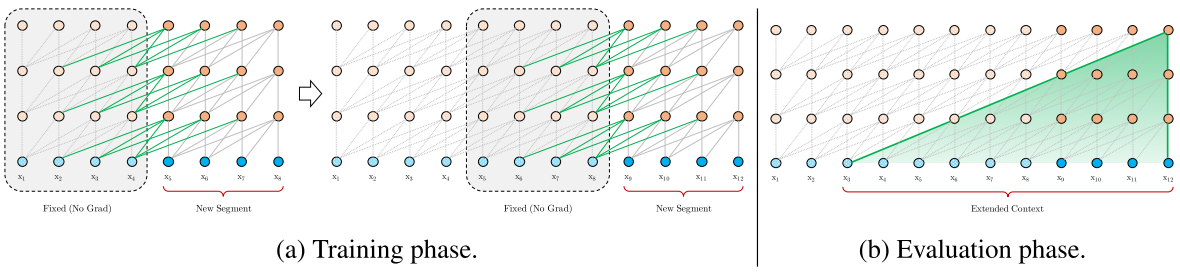
Combines the two leading architectures for language modeling:
- Recurrent Neural Network (RNN) to handles the input tokens — words or characters — one by one to learn the relationship between them
- Attention Mechanism/Transformer Model to receive a segment of tokens and learns the dependencies between at once them using an attention mechanism.