Difference between revisions of "Negotiation"
m |
m |
||
| Line 10: | Line 10: | ||
* [[Assistants]] ..[[Hybrid Assistants]] | * [[Assistants]] ..[[Hybrid Assistants]] | ||
* [[Agents]] | * [[Agents]] | ||
| − | |||
| − | |||
| − | |||
| − | |||
| − | |||
| − | |||
| − | |||
| − | |||
| − | |||
| − | |||
| − | |||
| − | |||
| − | |||
| − | |||
| − | |||
| − | |||
| − | |||
| − | |||
| − | |||
| − | |||
| − | |||
* [[ChatGPT]] | [[OpenAI]] | * [[ChatGPT]] | [[OpenAI]] | ||
* [[Gaming]] | * [[Gaming]] | ||
Revision as of 22:45, 11 February 2023
YouTube search... ...Google search
- Assistants ..Hybrid Assistants
- Agents
- ChatGPT | OpenAI
- Gaming
- How artificial intelligence could negotiate better deals for humans | Matthew Hutson - Science
- Negotiation and honesty in artificial intelligence methods for the board game of Diplomacy | J. Kramár, T. Eccles, I. Gemp, A. Tacchetti, K. McKee, M. Malinowski, T. Graepel & Y. Bachrach - Nature Communications
- Companies Are Adopting AI For Supplier Negotiations, But Which Ones Should The Machines Handle? | Martin Rand - Forbes
- The Contract Negotiation Process Streamlined by AI - Gary Sangha - LexCheck
- AI enabled Negotiations: Are we on board yet? | Kiran Huthanahalli Manjunath - Infosys BPM
Meta
- Cicero from meta may foreshadow hybrid AI future architectures | Ajit Jaokar - Data Science Central
- DeepMind vs CICERO: How Meta Defeated Alphabet at its Own Game | Anirudh Vk - AIM
“An agent that can play at the level of humans in a game as strategically complex as Diplomacy is a true breakthrough for cooperative AI.” - Yann LeCun
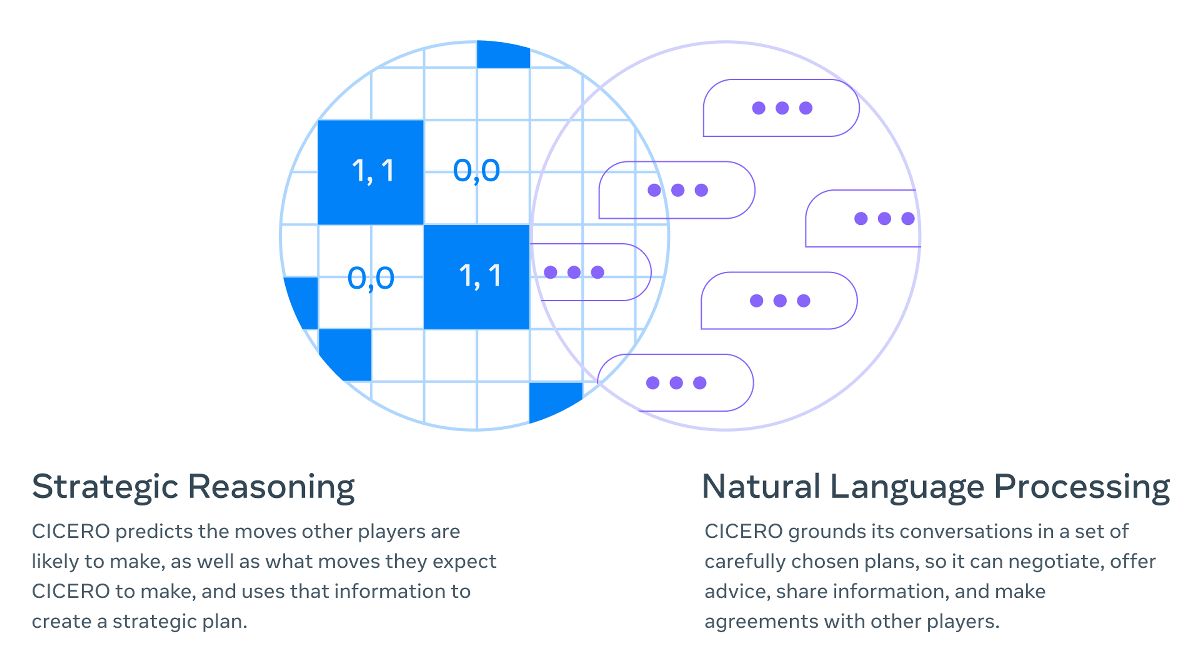
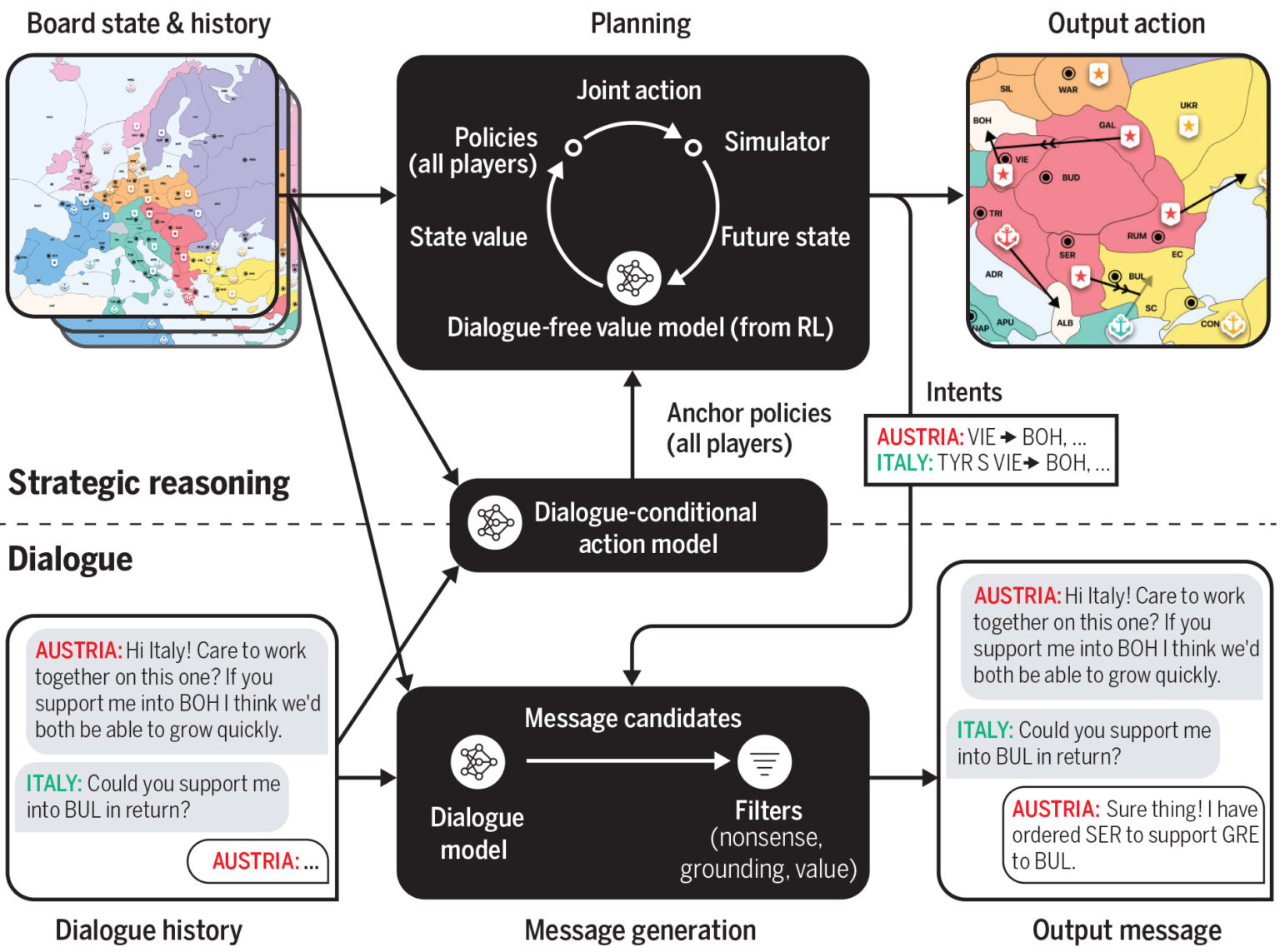
Cicero couples a dialogue module with a strategic reasoning engine. Each turn, CICERO models the other players’ policies based on the game state and shared dialogue. It forms a plan, and the dialogue module generates messages conditional on the plan. Diplomacy is a game whose main element is negotiation. For this reason, in order for AI to play Diplomacy and win, ``talk with other players without discomfort and call for cooperation, ``interpret strategies from other players' negotiations, ``see other players' lies and It is necessary to perform difficult processing for existing AI, such as 'laying a lie to the player of'. In order to solve these problems, Meta uses both 'strategic reasoning' used in the strongest Go AI 'AlphaGo' and 'natural language processing' used in sentence generation AI 'GPT-3'. Meta develops AI ` Cicero ' that manipulates ` lies ' to deceive humans and bites into the top 10% of the friendship destruction game ` Diplomacy ' | Maxime Bonzi - Gigazine
Meta's new AI can beat human players at Diplomacy | Matt Cox - Rock Paper Shotgun ... It never "intentionally" lies
Google DeepMind
- AI for the board game Diplomacy | DeepMind
- GitHub Google Diplomacy
- Learning to Play No-Press Diplomacy with Best Response Policy Iteration | T. Anthony, T. Eccles, A. Tacchetti, J. Kramár, I. Gemp, T. Hudson, N. Porcel, M. Lanctot, J. Pérolat, R. Everett, R. Werpachowski, S. Singh, T. Graepel & Y. Bachrach - Deepmind
- Negotiation and honesty in artificial intelligence methods for the board game of Diplomacy | J. Kramár, T. Eccles, I. Gemp, A. Tacchetti, K. McKee, M. Malinowski, T. Graepel & Y. Bachrach - Nature Communications DeepMind
