Difference between revisions of "Graph"
m |
m |
||
| Line 5: | Line 5: | ||
|description=Helpful resources for your journey with artificial intelligence; videos, articles, techniques, courses, profiles, and tools | |description=Helpful resources for your journey with artificial intelligence; videos, articles, techniques, courses, profiles, and tools | ||
}} | }} | ||
| − | [ | + | [https://www.youtube.com/results?search_query=Knowledge+Graph+AI Youtube search...] |
| − | [ | + | [https://www.google.com/search?q=Knowledge+Graph+AI ...Google search] |
* [[Framing Context]] | * [[Framing Context]] | ||
| Line 15: | Line 15: | ||
* [[Graph Convolutional Network (GCN), Graph Neural Networks (Graph Nets), Geometric Deep Learning]] | * [[Graph Convolutional Network (GCN), Graph Neural Networks (Graph Nets), Geometric Deep Learning]] | ||
* [[Papers Search#Connected Papers | Connected Papers]] using [[Papers Search#Semantic Scholar| Semantic Scholar]] to explore connected papers in a visual graph | * [[Papers Search#Connected Papers | Connected Papers]] using [[Papers Search#Semantic Scholar| Semantic Scholar]] to explore connected papers in a visual graph | ||
| − | * [ | + | * [https://pathmind.com/wiki/graph-analysis A Beginner's Guide to Graph Analytics and Deep Learning | Chris Nicholson - A.I. Wiki pathmind] |
| − | * [ | + | * [https://neo4j.com/blog/7-ways-data-is-graph/ 7 Ways Your Data Is Telling You It’s a Graph | Karen Lopez - InfoAdvisors - Neo4j] |
| − | * [ | + | * [https://patterns.dataincubator.org/book/linked-data-patterns.pdf Linked Data Patterns book | leigh Dodds and Ian Davis] |
| + | * [https://www.topbots.com/guide-to-knowledge-graphs/ A Guide To Knowledge Graphs | Mohit Mayank - TOPBOTS] | ||
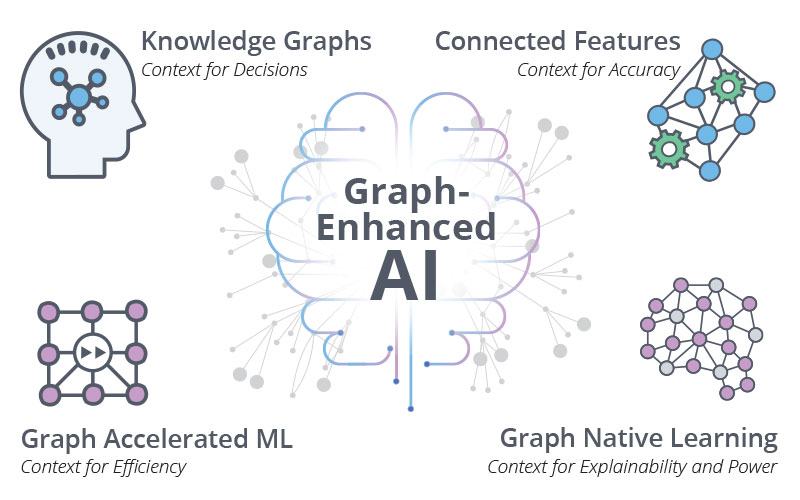
| − | [ | + | [https://www.comparethecloud.net/articles/adding-context-will-take-ai-to-the-next-level/ Adding Context Will Take AI to the Next Level | Neo4j] |
| − | <img src=" | + | <img src="https://www.comparethecloud.net/wp-content/uploads/2019/09/AIGraphic.jpg" width="600"> |
{|<!-- T --> | {|<!-- T --> | ||
| Line 30: | Line 31: | ||
<youtube>Np768VAe_7I</youtube> | <youtube>Np768VAe_7I</youtube> | ||
<b>Knowledge Graphs and Deep Learning 102 | <b>Knowledge Graphs and Deep Learning 102 | ||
| − | </b><br>In this video, we are going to look into not so exciting developments that connect Deep Learning with Knowledge Graph and GANs… let’s just hope it’s more fun than “Machine Learning Memes for Convolutional Teens”. [ | + | </b><br>In this video, we are going to look into not so exciting developments that connect Deep Learning with Knowledge Graph and GANs… let’s just hope it’s more fun than “Machine Learning Memes for Convolutional Teens”. [https://www.youtube.com/watch?v=hQv8FNaJHEA GAN Explained Link] |
| − | The bot in the video is R2D2, which comes after OB1's 2nd gen in Star Wars. Audio change was a bit tricky. Topics Covered in the video 1. Graph Convolutional Networks 2. Semi-supervised Learning 3. Knowledge Graphs and Ontology 4. Embedding in Knowledge Graphs 5. Adversarial Learning in Knowledge Graphs (KBGANs) Please contribute to the initiative by donating to us via Patreon because we need the money to scale up our efforts and bring creative weirdos and nerdy dreamers together. Patreon Link: https://www.patreon.com/crazymuse Even something as small as 1$ per creation can make a collective difference. Join us on slack if you want to contribute to the scripts that we write for the video. Slack Link : | + | The bot in the video is R2D2, which comes after OB1's 2nd gen in Star Wars. Audio change was a bit tricky. Topics Covered in the video 1. Graph Convolutional Networks 2. Semi-supervised Learning 3. Knowledge Graphs and Ontology 4. Embedding in Knowledge Graphs 5. Adversarial Learning in Knowledge Graphs (KBGANs) Please contribute to the initiative by donating to us via Patreon because we need the money to scale up our efforts and bring creative weirdos and nerdy dreamers together. Patreon Link: https://www.patreon.com/crazymuse Even something as small as 1$ per creation can make a collective difference. Join us on slack if you want to contribute to the scripts that we write for the video. Slack Link : https://goo.gl/GFW2My |
| − | Contributors for the Video 1. Script Writer : Jaley Dholakiya 2. Reviewers : Arjun Shetty, Sidharth Aiyar, Saikat Paul 3. Animator and Moderator : Jaley Dholakiya Trans-D embedding : | + | Contributors for the Video 1. Script Writer : Jaley Dholakiya 2. Reviewers : Arjun Shetty, Sidharth Aiyar, Saikat Paul 3. Animator and Moderator : Jaley Dholakiya Trans-D embedding : https://www.aclweb.org/anthology/P15-1067 KBGANs : https://arxiv.org/pdf/1711.04071.pdf |
|} | |} | ||
|<!-- M --> | |<!-- M --> | ||
| Line 58: | Line 59: | ||
<youtube>2ZzGMzitNgo</youtube> | <youtube>2ZzGMzitNgo</youtube> | ||
<b>Graph databases: The best kept secret for effective AI | <b>Graph databases: The best kept secret for effective AI | ||
| − | </b><br>Emil Eifrem, Neo4j Co-Founder and CEO explains why connected data is the key to more accurate, efficient and credible learning systems. Using real world use cases ranging from space engineering to investigative journalism, he will outline how a relationships-first approach adds context to data - the key to explainable, well-informed predictions. Wish you were here? Sign up for 2 for 1 discount code for #WebSummit 2019 now: | + | </b><br>Emil Eifrem, Neo4j Co-Founder and CEO explains why connected data is the key to more accurate, efficient and credible learning systems. Using real world use cases ranging from space engineering to investigative journalism, he will outline how a relationships-first approach adds context to data - the key to explainable, well-informed predictions. Wish you were here? Sign up for 2 for 1 discount code for #WebSummit 2019 now: https://news.websummit.com/live-stream |
|} | |} | ||
|}<!-- B --> | |}<!-- B --> | ||
| Line 84: | Line 85: | ||
<youtube>3vleFxDGoEs</youtube> | <youtube>3vleFxDGoEs</youtube> | ||
<b>Graph Databases Will Change Your Freakin' Life (Best Intro Into Graph Databases) | <b>Graph Databases Will Change Your Freakin' Life (Best Intro Into Graph Databases) | ||
| − | </b><br>Ed Finkler | + | </b><br>Ed Finkler https://nodevember.org/talk/Ed%20Finkler ## WTF is a graph database - Euler and Graph Theory - Math -- it's hard, let's skip it - It's about data -- lots of it - But let's zoom in and look at the basics ## Relational model vs graph model - How do we represent THINGS in DBs - Relational vs Graph - Nodes and Relationships ## Why use a graph over a relational DB or other NoSQL? |
- Very simple compared to RDBMS, and much more flexible - The real power is in relationship-focused data (most NoSQL dbs don't treat relationships as first-order) - As related-ness and amount of data increases, so does advantage of Graph DBs - Much closer to our whiteboard model - Answering questions you didn't expect ## Let's look at some examples * A bit o' live code * Based on OSMI mental health in tech survey graph ## How do we use this from a programming lang? * Neo4j 3.x uses a RESTful API and a native protocol (BOLT) * All client libraries are wrappers for this * Show a couple code examples with popular wrappers ## Resources * Graph Story | - Very simple compared to RDBMS, and much more flexible - The real power is in relationship-focused data (most NoSQL dbs don't treat relationships as first-order) - As related-ness and amount of data increases, so does advantage of Graph DBs - Much closer to our whiteboard model - Answering questions you didn't expect ## Let's look at some examples * A bit o' live code * Based on OSMI mental health in tech survey graph ## How do we use this from a programming lang? * Neo4j 3.x uses a RESTful API and a native protocol (BOLT) * All client libraries are wrappers for this * Show a couple code examples with popular wrappers ## Resources * Graph Story | ||
| − | * OSMI Graph Blog * Neo4j docs # [ | + | * OSMI Graph Blog * Neo4j docs # [https://neo4j.com/blog/7-ways-data-is-graph/ More Resources] |
|} | |} | ||
|<!-- M --> | |<!-- M --> | ||
| Line 94: | Line 95: | ||
<youtube>zCEYiCxrL_0</youtube> | <youtube>zCEYiCxrL_0</youtube> | ||
<b>An Introduction to Graph Neural Networks: Models and Applications | <b>An Introduction to Graph Neural Networks: Models and Applications | ||
| − | </b><br>MSR Cambridge, AI Residency Advanced Lecture Series An Introduction to Graph Neural Networks: Models and Applications Got it now: "Graph Neural Networks (GNN) are a general class of networks that work over graphs. By representing a problem as a graph — encoding the information of individual elements as nodes and their relationships as edges — GNNs learn to capture patterns within the graph. These networks have been successfully used in applications such as chemistry and program analysis. In this introductory talk, I will do a deep dive in the neural message-passing GNNs, and show how to create a simple GNN implementation. Finally, I will illustrate how GNNs have been used in applications. [ | + | </b><br>MSR Cambridge, AI Residency Advanced Lecture Series An Introduction to Graph Neural Networks: Models and Applications Got it now: "Graph Neural Networks (GNN) are a general class of networks that work over graphs. By representing a problem as a graph — encoding the information of individual elements as nodes and their relationships as edges — GNNs learn to capture patterns within the graph. These networks have been successfully used in applications such as chemistry and program analysis. In this introductory talk, I will do a deep dive in the neural message-passing GNNs, and show how to create a simple GNN implementation. Finally, I will illustrate how GNNs have been used in applications. [https://www.microsoft.com/en-us/research/video/msr-cambridge-lecture-series-an-introduction-to-graph-neural-networks-models-and-applications/ More info] |
|} | |} | ||
|}<!-- B --> | |}<!-- B --> | ||
| Line 111: | Line 112: | ||
<youtube>YrhBZUtgG4E</youtube> | <youtube>YrhBZUtgG4E</youtube> | ||
<b>Graph Representation Learning (Stanford University) | <b>Graph Representation Learning (Stanford University) | ||
| − | </b><br>Machine Learning TV [ | + | </b><br>Machine Learning TV [https://snap.stanford.edu/class/cs224w-2018/handouts/09-node2vec.pdf Slide link] |
|} | |} | ||
|}<!-- B --> | |}<!-- B --> | ||
| Line 128: | Line 129: | ||
<youtube>yOYodfN84N4</youtube> | <youtube>yOYodfN84N4</youtube> | ||
<b>A Skeptics Guide to Graph Databases - David Bechberger | <b>A Skeptics Guide to Graph Databases - David Bechberger | ||
| − | </b><br>Graph databases are one of the hottest trends in tech, but is it hype or can they actually solve real problems? Well, the answer is both. In this talk, Dave will pull back the covers and show you the good, the bad, and the ugly of solving real problems with graph databases. He will demonstrate how you can leverage the power of graph databases to solve difficult problems or existing problems differently. He will then discuss when to avoid them and just use your favorite RDBMS. We will then examine a few of his failures so that we can all learn from his mistakes. By the end of this talk, you will either be excited to use a graph database or run away screaming, either way, you will be armed with the information you need to cut through the hype and know when to use one and when to avoid them. Check out more of our talks in the following links! NDC Conferences | + | </b><br>Graph databases are one of the hottest trends in tech, but is it hype or can they actually solve real problems? Well, the answer is both. In this talk, Dave will pull back the covers and show you the good, the bad, and the ugly of solving real problems with graph databases. He will demonstrate how you can leverage the power of graph databases to solve difficult problems or existing problems differently. He will then discuss when to avoid them and just use your favorite RDBMS. We will then examine a few of his failures so that we can all learn from his mistakes. By the end of this talk, you will either be excited to use a graph database or run away screaming, either way, you will be armed with the information you need to cut through the hype and know when to use one and when to avoid them. Check out more of our talks in the following links! NDC Conferences https://ndcoslo.com https://ndcconferences.com |
|} | |} | ||
|}<!-- B --> | |}<!-- B --> | ||
| Line 138: | Line 139: | ||
<youtube>8XJes6XFjxM</youtube> | <youtube>8XJes6XFjxM</youtube> | ||
<b>The Unreasonable Effectiveness of Spectral Graph Theory: A Confluence of Algorithms, Geometry, and Physics | <b>The Unreasonable Effectiveness of Spectral Graph Theory: A Confluence of Algorithms, Geometry, and Physics | ||
| − | </b><br>James R. Lee, University of Washington [ | + | </b><br>James R. Lee, University of Washington [https://simons.berkeley.edu/events/openlectures2014-fall-4 Simons Institute Open Lectures] Spectral geometry has long been a powerful tool in many areas of mathematics and physics. In a similar way, spectral graph theory has played an important role in algorithms. But the last decade has seen a revolution of sorts: Fueled by fundamental computational questions, spectral methods have been challenged to address new kinds of problems, and have proved their worth by providing a remarkable set of new ideas and solutions. Starting with a basic physical process (heat diffusion), we will recall how the evolution of the system can be understood in terms of eigenmodes and their associated eigenvalues. The physical view has immediate computational import; for instance, Google models its users as agents diffusing over the web graph. This family of ideas describes the "reasonable" effectiveness of spectral graph theory. But then we will see that spectral objects can also precisely describe other phenomena in a surprisingly unreasonable way. This will lead us to confront some of the most fundamental problems in algorithms and complexity theory from a spectral perspective. |
|} | |} | ||
|}<!-- B --> | |}<!-- B --> | ||
| Line 144: | Line 145: | ||
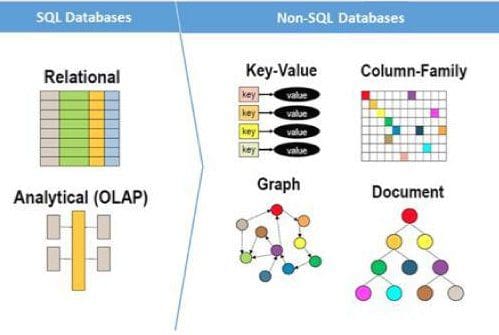
== Graph Data Models == | == Graph Data Models == | ||
| − | * [ | + | * [https://medium.com/terminusdb/graph-fundamentals-part-2-labelled-property-graphs-ba9a8edb5dfe Graph Fundamentals | Kevin Feeney TerminusDB - Medium] |
| − | * [ | + | * [https://neo4j.com/blog/rdf-triple-store-vs-labeled-property-graph-difference/ RDF Triple Stores vs. Labeled Property Graphs: What’s the Difference? | Jesús Barrasa - Neo4j] |
** <i>Labeled</i> Property Graph (LPG) | ** <i>Labeled</i> Property Graph (LPG) | ||
| − | ** [ | + | ** [https://en.wikipedia.org/wiki/Resource_Description_Framework Resource Description Framework (RDF)] Graph |
** Others | ** Others | ||
| − | + | https://www.kdnuggets.com/wp-content/uploads/sql-nosql-dbs.jpg | |
| − | <img src=" | + | <img src="https://miro.medium.com/max/1920/1*FAK8MU1sYf6yrVpVmNQDzA.png" width="700" height="400"> |
== Graph Use Cases == | == Graph Use Cases == | ||
| − | * [ | + | * [https://medium.com/@dmccreary/a-taxonomy-of-graph-use-cases-2ba34618cf78 A Taxonomy of Graph Use Cases | Dan McCreary - Medium] |
| − | * [ | + | * [https://www.slideshare.net/maxdemarzi/graph-database-use-cases Graph database Use Cases | Max De Marzi - Slideshare] |
| − | + | https://miro.medium.com/max/759/1*6k0TELu2ewH7KIFERhj-DA.png | |
* Machine Learning | * Machine Learning | ||
| Line 183: | Line 184: | ||
=== <span id="GraphQL"></span>GraphQL === | === <span id="GraphQL"></span>GraphQL === | ||
| − | [ | + | [https://www.youtube.com/results?search_query=GraphQL+Graph+Query+Language Youtube search...] |
| − | [ | + | [https://www.google.com/search?q=GraphQL+Graph+Query+Language ...Google search] |
| − | * [ | + | * [https://graphql.org/ GraphQL] |
* [https://github.com/graphql/graphiql GraphiQL] is the reference implementation of GraphQL IDE, an official project under the GraphQL Foundation | * [https://github.com/graphql/graphiql GraphiQL] is the reference implementation of GraphQL IDE, an official project under the GraphQL Foundation | ||
* [[Git - GitHub and GitLab#GitHub GraphQL API| GitHub GraphQL API]] | * [[Git - GitHub and GitLab#GitHub GraphQL API| GitHub GraphQL API]] | ||
| Line 207: | Line 208: | ||
=== Cypher === | === Cypher === | ||
| − | [ | + | [https://www.youtube.com/results?search_query=Cypher+Neo4j+Graph+Query+Language Youtube search...] |
| − | [ | + | [https://www.google.com/search?q=Cypher+Neo4j+Graph+Query+Language ...Google search] |
| − | * [ | + | * [https://www.opencypher.org openCypher.org] - Originally contributed by Neo4j; transition planning from openCypher implementations to the developing graph query language standard, GQL |
<youtube>l76udM3wB4U</youtube> | <youtube>l76udM3wB4U</youtube> | ||
| Line 216: | Line 217: | ||
=== Graph Query Language (GQL) === | === Graph Query Language (GQL) === | ||
| − | [ | + | [https://www.youtube.com/results?search_query=GQL+Graph+Query+Language Youtube search...] |
| − | [ | + | [https://www.google.com/search?q=GQL+Graph+Query+Language ...Google search] |
| − | * [ | + | * [https://graphdatamodeling.com/Graph%20Data%20Modeling/GraphDataModeling/page/PropertyGraphs.html Property Graphs Explained | Thomas Frisendal] |
| − | Will enable SQL users to use property graph style queries on top of SQL tables. GQL draws heavily on existing languages. The main inspirations have been Cypher (now with over ten implementations, including six commercial products), Oracle's PGQL and SQL itself, as well as new extensions for read-only property graph querying to SQL. [ | + | Will enable SQL users to use property graph style queries on top of SQL tables. GQL draws heavily on existing languages. The main inspirations have been Cypher (now with over ten implementations, including six commercial products), Oracle's PGQL and SQL itself, as well as new extensions for read-only property graph querying to SQL. [https://www.linkedin.com/pulse/sql-now-gql-alastair-green/?trackingId=JHusYOenSoa23wu2xoAOvw%3D%3D SQL ... and now GQL | Alastair Green] |
<youtube>Iq518iZXxA4</youtube> | <youtube>Iq518iZXxA4</youtube> | ||
=== Gremlin === | === Gremlin === | ||
| − | [ | + | [https://www.youtube.com/results?search_query=Gremlin+Graph+TinkerPop Youtube search...] |
| − | [ | + | [https://www.google.com/search?q=Gremlin+Graph+TinkerPop ...Google search] |
| − | * [ | + | * [https://en.wikipedia.org/wiki/Gremlin_(programming_language) Wikipedia] |
| − | * [ | + | * [https://www.slideshare.net/calebwjones/intro-to-graph-databases-using-tinkerpops-titandb-and-gremlin Intro to Graph Databases Using Tinkerpop, TitanDB, and Gremlin | Caleb Jones] |
| − | * [ | + | * [https://tinkerpop.apache.org/gremlin.html Gremlin] Graph Traversal Machine and Language |
| − | * [ | + | * [https://tinkerpop.apache.org/ TinkerPop] |
is a graph traversal language and virtual machine developed by Apache TinkerPop of the Apache Software Foundation. Gremlin works for both OLTP-based graph databases as well as OLAP-based graph processors. As an explanatory analogy, Apache TinkerPop and Gremlin are to graph databases what the JDBC and SQL are to relational databases. Likewise, the Gremlin traversal machine is to graph computing as what the Java virtual machine is to general purpose computing. | is a graph traversal language and virtual machine developed by Apache TinkerPop of the Apache Software Foundation. Gremlin works for both OLTP-based graph databases as well as OLAP-based graph processors. As an explanatory analogy, Apache TinkerPop and Gremlin are to graph databases what the JDBC and SQL are to relational databases. Likewise, the Gremlin traversal machine is to graph computing as what the Java virtual machine is to general purpose computing. | ||
| Line 239: | Line 240: | ||
=== Oracle Property Graph (PGQL) === | === Oracle Property Graph (PGQL) === | ||
| − | [ | + | [https://www.youtube.com/results?search_query=Oracle+Property+Graph+PGQL Youtube search...] |
| − | [ | + | [https://www.google.com/search?q=Oracle+Property+Graph+PGQL ...Google search] |
| − | * [ | + | * [https://pgql-lang.org/ Property Graph Query Language] is a query language built on top of SQL, bringing graph pattern matching capabilities to existing SQL users as well as to new users who are interested in graph technology but who do not have an SQL background. |
<youtube>HDuLYiTimMo</youtube> | <youtube>HDuLYiTimMo</youtube> | ||
=== SPARQL === | === SPARQL === | ||
| − | [ | + | [https://www.youtube.com/results?search_query=SPARQL+Graph+RDF Youtube search...] |
| − | [ | + | [https://www.google.com/search?q=SPARQL+Graph+RDF ...Google search] |
| − | * [ | + | * [https://en.wikipedia.org/wiki/SPARQL SPARQL] a query language for [https://en.wikipedia.org/wiki/Resource_Description_Framework RDF] databases |
<youtube>RoogS47Fp8o</youtube> | <youtube>RoogS47Fp8o</youtube> | ||
<youtube>A2kkR1-qn5k</youtube> | <youtube>A2kkR1-qn5k</youtube> | ||
| − | == [ | + | == [https://en.wikipedia.org/wiki/Graph_database Graph Databases (GDB)] == |
...offer a more efficient way to model relationships and networks than relational (SQL) databases or other kinds of NoSQL databases (document, wide column, and so on). | ...offer a more efficient way to model relationships and networks than relational (SQL) databases or other kinds of NoSQL databases (document, wide column, and so on). | ||
| − | * [ | + | * [https://www.linkedin.com/pulse/sql-now-gql-alastair-green/?trackingId=JHusYOenSoa23wu2xoAOvw%3D%3D SQL ... and now GQL | Alastair Green] |
| − | * [ | + | * [https://aws.amazon.com/nosql/graph/ What Is a Graph Database? | Amazon AWS] |
| − | * [ | + | * [https://www.revolvy.com/folder/Graph-databases/197279 Graph databases] |
Offering: | Offering: | ||
| − | === [ | + | === [https://neo4j.com/ Neo4J] === |
<youtube>oRtVdXvtD3o</youtube> | <youtube>oRtVdXvtD3o</youtube> | ||
| − | === [ | + | === [https://aws.amazon.com/neptune/ Amazon Neptune] === |
| − | ...from [ | + | ...from [https://www.blazegraph.com/ Blazegraph] |
<youtube>f7FSpT7jrX4</youtube> | <youtube>f7FSpT7jrX4</youtube> | ||
| − | === [ | + | === [https://janusgraph.org/ JanusGraph] === |
<youtube>_3YP3QI_cYk</youtube> | <youtube>_3YP3QI_cYk</youtube> | ||
| − | === [ | + | === [https://titan.thinkaurelius.com/ TitanDB] === |
<youtube>CvO9i3D1di8</youtube> | <youtube>CvO9i3D1di8</youtube> | ||
| − | === [ | + | === [https://orientdb.com/ OrientDB] === |
<youtube>kpLqfFGubKM</youtube> | <youtube>kpLqfFGubKM</youtube> | ||
| − | === [ | + | === [https://giraph.apache.org/ Giraph] === |
<youtube>y5WxwVZXvs4</youtube> | <youtube>y5WxwVZXvs4</youtube> | ||
| − | === [ | + | === [https://www.tigergraph.com/ TigerGraph] === |
<youtube>ylqO-lOP9pE</youtube> | <youtube>ylqO-lOP9pE</youtube> | ||
| − | === [ | + | === [https://docs.cambridgesemantics.com/home.htm AnzoGraph] === |
<youtube>YDI-Xb0VDrE</youtube> | <youtube>YDI-Xb0VDrE</youtube> | ||
| − | === [ | + | === [https://dgraph.io/ Dgraph] === |
- written in Go | - written in Go | ||
<youtube>CjkKRbtwWXA</youtube> | <youtube>CjkKRbtwWXA</youtube> | ||
| − | === [ | + | === [https://www.analyticsvidhya.com/blog/2015/12/started-graphlab-python/ Dato GraphLab] === |
<youtube>oRIn2vOK3Tw</youtube> | <youtube>oRIn2vOK3Tw</youtube> | ||
| Line 320: | Line 321: | ||
== <span id="Semantic Knowledge Graph"></span>Semantic Knowledge Graph == | == <span id="Semantic Knowledge Graph"></span>Semantic Knowledge Graph == | ||
| − | * [ | + | * [https://www.manning.com/books/ai-powered-search AI Powered Search | Trey Grainger] |
| − | * [ | + | * [https://lucene.apache.org/solr/ Apache Solr] ...open source enterprise search platform built on [https://lucene.apache.org/[https://www.w3schools.com/js/js_json_http.asp Apache Lucene™]. Solr is highly scalable, providing fully fault tolerant distributed indexing, search and analytics. It exposes Lucene's features through easy to use [https://www.w3schools.com/js/js_json_http.asp JSON/HTTP] interfaces or native clients for [https://www.java.com/en/ Java] and other languages. The [https://lucene.apache.org/pylucene/ PyLucene] sub project provides [[Python]] bindings for Lucene. |
| − | * [ | + | * [https://www.manning.com/books/relevant-search Relevant Search: With applications for Solr and Elasticsearch | Doug Turnbull and John Berryman] |
| − | * [ | + | * [https://blog.mikemccandless.com/ Changing Bits] and [https://www.manning.com/books/lucene-in-action-second-edition Lucene in Action | Michael McCandless] |
* [[Wikis]] | * [[Wikis]] | ||
| Line 330: | Line 331: | ||
== <span id="Cybersecurity - Visualization"></span>Cybersecurity - Visualization == | == <span id="Cybersecurity - Visualization"></span>Cybersecurity - Visualization == | ||
| − | [ | + | [https://www.youtube.com/results?search_query=Cyber+Cybersecurity+Graph+Visualization+~tool+ai YouTube search...] |
| − | [ | + | [https://www.google.com/search?q=Cyber+Cybersecurity+Graph+Visualization+~tool+ai ...Google search] |
* [[Cybersecurity]] | * [[Cybersecurity]] | ||
| − | * [ | + | * [https://www.graphistry.com/use-cases/threat-hunting Threat Hunting | Graphistry] |
{|<!-- T --> | {|<!-- T --> | ||
Revision as of 18:58, 4 February 2023
Youtube search... ...Google search
- Framing Context
- Enterprise Architecture (EA)
- Explainable / Interpretable AI
- Computer Networks
- Network Pattern
- Graph Convolutional Network (GCN), Graph Neural Networks (Graph Nets), Geometric Deep Learning
- Connected Papers using Semantic Scholar to explore connected papers in a visual graph
- A Beginner's Guide to Graph Analytics and Deep Learning | Chris Nicholson - A.I. Wiki pathmind
- 7 Ways Your Data Is Telling You It’s a Graph | Karen Lopez - InfoAdvisors - Neo4j
- Linked Data Patterns book | leigh Dodds and Ian Davis
- A Guide To Knowledge Graphs | Mohit Mayank - TOPBOTS
Adding Context Will Take AI to the Next Level | Neo4j
|
|
|
|
|
|
|
|
|
|
|
|
|
Contents
- 1 Graph Data Models
- 2 Graph Use Cases
- 3 Graph query-programming languages
- 4 Graph Databases (GDB)
- 5 Graph Algorithms
- 5.1 Breadth First Search (BFS)
- 5.2 Depth-First Search Algorithm (DFS)
- 5.3 Dijkstras Algorithm for Single-Source Shortest Path
- 5.4 Prims Algorithm for Minimum Spanning Trees
- 5.5 Kruskals Algorithm for Minimum Spanning Trees
- 5.6 Bellman-Ford Single-Source Shortest-Path Algorithm
- 5.7 Floyd Warshall Algorithm
- 6 Semantic Knowledge Graph
- 7 Cybersecurity - Visualization
Graph Data Models
- Graph Fundamentals | Kevin Feeney TerminusDB - Medium
- RDF Triple Stores vs. Labeled Property Graphs: What’s the Difference? | Jesús Barrasa - Neo4j
- Labeled Property Graph (LPG)
- Resource Description Framework (RDF) Graph
- Others

Graph Use Cases
- A Taxonomy of Graph Use Cases | Dan McCreary - Medium
- Graph database Use Cases | Max De Marzi - Slideshare

- Machine Learning
- Portfolio Analytics (Asset Management)
- Master Data Management
- Data Integration
- Social Networks
- Genomics (Gene Sequencing) BioInformatics
- Epidemiology
- Web Browsing
- Semantic Web
- Communication Networks (Network Cell Analysis)
- Internet of Things (Sensor Networks)
- Recommendations
- Fraud Detection (Money Laundering)
- Geo Routing (Public Transport)
- Customer 360
- Insurance Risk Analysis
- Content Management & Access Control
- Privacy, Risk and Compliance
Graph query-programming languages
GraphQL
Youtube search... ...Google search
- GraphQL
- GraphiQL is the reference implementation of GraphQL IDE, an official project under the GraphQL Foundation
- GitHub GraphQL API
- Graph Convolutional Network (GCN), Graph Neural Networks (Graph Nets), Geometric Deep Learning
GraphQL is a query language for APIs and a runtime for fulfilling those queries with your existing data. GraphQL provides a complete and understandable description of the data in your API, gives clients the power to ask for exactly what they need and nothing more, makes it easier to evolve APIs over time, and enables powerful developer tools. GraphQL queries access not just the properties of one resource but also smoothly follow references between them. While typical REST APIs require loading from multiple URLs, GraphQL APIs get all the data your app needs in a single request. Apps using GraphQL can be quick even on slow mobile network connections.
With Python
Cypher
Youtube search... ...Google search
- openCypher.org - Originally contributed by Neo4j; transition planning from openCypher implementations to the developing graph query language standard, GQL
Graph Query Language (GQL)
Youtube search... ...Google search
Will enable SQL users to use property graph style queries on top of SQL tables. GQL draws heavily on existing languages. The main inspirations have been Cypher (now with over ten implementations, including six commercial products), Oracle's PGQL and SQL itself, as well as new extensions for read-only property graph querying to SQL. SQL ... and now GQL | Alastair Green
Gremlin
Youtube search... ...Google search
- Wikipedia
- Intro to Graph Databases Using Tinkerpop, TitanDB, and Gremlin | Caleb Jones
- Gremlin Graph Traversal Machine and Language
- TinkerPop
is a graph traversal language and virtual machine developed by Apache TinkerPop of the Apache Software Foundation. Gremlin works for both OLTP-based graph databases as well as OLAP-based graph processors. As an explanatory analogy, Apache TinkerPop and Gremlin are to graph databases what the JDBC and SQL are to relational databases. Likewise, the Gremlin traversal machine is to graph computing as what the Java virtual machine is to general purpose computing.
Oracle Property Graph (PGQL)
Youtube search... ...Google search
- Property Graph Query Language is a query language built on top of SQL, bringing graph pattern matching capabilities to existing SQL users as well as to new users who are interested in graph technology but who do not have an SQL background.
SPARQL
Youtube search... ...Google search
Graph Databases (GDB)
...offer a more efficient way to model relationships and networks than relational (SQL) databases or other kinds of NoSQL databases (document, wide column, and so on).
Offering:
Neo4J
Amazon Neptune
...from Blazegraph
JanusGraph
TitanDB
OrientDB
Giraph
TigerGraph
AnzoGraph
Dgraph
- written in Go
Dato GraphLab
Graph Algorithms
Breadth First Search (BFS)
Depth-First Search Algorithm (DFS)
Dijkstras Algorithm for Single-Source Shortest Path
Prims Algorithm for Minimum Spanning Trees
Kruskals Algorithm for Minimum Spanning Trees
Bellman-Ford Single-Source Shortest-Path Algorithm
Floyd Warshall Algorithm
Semantic Knowledge Graph
- AI Powered Search | Trey Grainger
- Apache Solr ...open source enterprise search platform built on [https://www.w3schools.com/js/js_json_http.asp Apache Lucene™. Solr is highly scalable, providing fully fault tolerant distributed indexing, search and analytics. It exposes Lucene's features through easy to use JSON/HTTP interfaces or native clients for Java and other languages. The PyLucene sub project provides Python bindings for Lucene.
- Relevant Search: With applications for Solr and Elasticsearch | Doug Turnbull and John Berryman
- Changing Bits and Lucene in Action | Michael McCandless
- Wikis
Cybersecurity - Visualization
YouTube search... ...Google search
|
|
|
|
