Difference between revisions of "Loop"
m (→Feedback Loop - The AI Economist) |
m |
||
| Line 5: | Line 5: | ||
|description=Helpful resources for your journey with artificial intelligence; videos, articles, techniques, courses, profiles, and tools | |description=Helpful resources for your journey with artificial intelligence; videos, articles, techniques, courses, profiles, and tools | ||
}} | }} | ||
| − | [ | + | [https://www.youtube.com/results?search_query=loop+machine+learning+reinforcement YouTube search...] |
| − | [ | + | [https://www.google.com/search?q=loop+machine+learning+reinforcement ...Google search] |
* [[Human-in-the-Loop (HITL) Learning]] | * [[Human-in-the-Loop (HITL) Learning]] | ||
| Line 16: | Line 16: | ||
= Observe–Orient–Decide–Act (OODA) Loop = | = Observe–Orient–Decide–Act (OODA) Loop = | ||
| − | [ | + | [https://www.youtube.com/results?search_query=OODA+loop YouTube search...] |
| − | [ | + | [https://www.google.com/search?q=OODA+loop ...Google search] |
| − | The <b>OODA loop</b> is the cycle: <b>O</b>bserve–<b>O</b>rient–<b>D</b>ecide–<b>A</b>ct ...emphasized that "the loop" is actually a set of interacting loops that are to be kept in continuous operation... developed by military strategist and United States Air Force Colonel [[Creatives#John Richard Boyd|John Boyd]]. [[Creatives#John Richard Boyd|Boyd]] applied the concept to the combat operations process, often at the operational level during military campaigns. It is now also often applied to understand commercial operations and learning processes. The approach explains how agility can overcome raw power in dealing with human opponents. It is especially applicable to cyber security and cyberwarfare. [ | + | The <b>OODA loop</b> is the cycle: <b>O</b>bserve–<b>O</b>rient–<b>D</b>ecide–<b>A</b>ct ...emphasized that "the loop" is actually a set of interacting loops that are to be kept in continuous operation... developed by military strategist and United States Air Force Colonel [[Creatives#John Richard Boyd|John Boyd]]. [[Creatives#John Richard Boyd|Boyd]] applied the concept to the combat operations process, often at the operational level during military campaigns. It is now also often applied to understand commercial operations and learning processes. The approach explains how agility can overcome raw power in dealing with human opponents. It is especially applicable to cyber security and cyberwarfare. [https://en.wikipedia.org/wiki/OODA_loop Wikipedia] ... [https://www.airuniversity.af.edu/Portals/10/AUPress/Books/B_0151_Boyd_Discourse_Winning_Losing.pdf A Discourse On Winning and Losing | John R. Boyd - Air University Press] |
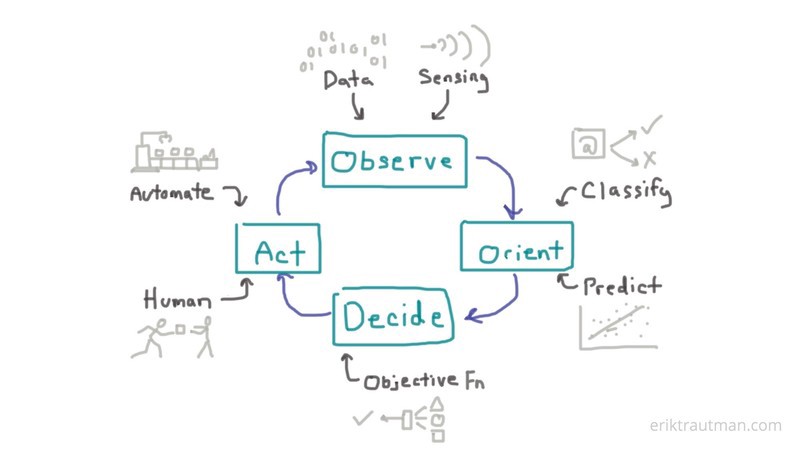
We’ve historically focused automation efforts on the <b>“Act”</b> portion but the real potential for new technologies is to address the prior 3 steps: <b>Improving Observation:</b> Improve the data itself with better sensing accuracy, timeliness, relevance, etc or improve our ability to use the data with higher throughput learning processes <b>Improving Orientation:</b> Improve the classification of the current state and the prediction of future states | We’ve historically focused automation efforts on the <b>“Act”</b> portion but the real potential for new technologies is to address the prior 3 steps: <b>Improving Observation:</b> Improve the data itself with better sensing accuracy, timeliness, relevance, etc or improve our ability to use the data with higher throughput learning processes <b>Improving Orientation:</b> Improve the classification of the current state and the prediction of future states | ||
| − | <b>Improving Decision:</b> Improve the ability to choose between paths via better objective functions. [ | + | <b>Improving Decision:</b> Improve the ability to choose between paths via better objective functions. [https://hackernoon.com/how-artificial-intelligence-is-closing-the-loop-with-better-predictions-1e8b50df3655 How Artificial Intelligence is Closing the Loop with Better Predictions | Erik Trautman - HackerNoon]] |
| − | + | https://hackernoon.com/hn-images/0*6dXaN5l0DCo8cOon.JPG | |
| Line 48: | Line 48: | ||
= Feedback Loop = | = Feedback Loop = | ||
| − | [ | + | [https://www.youtube.com/results?search_query=loop+feedback+machine+learning+reinforcement YouTube search...] |
| − | [ | + | [https://www.google.com/search?q=loop+feedback+machine+learning+reinforcement ...Google search] |
| − | * [ | + | * [https://en.wikipedia.org/wiki/Feedback Feedback | Wikipedia] |
| − | * [ | + | * [https://www.clarifai.com/blog/closing-the-loop-how-feedback-loops-help-to-maintain-quality-long-term-ai-results Closing the Loop: How Feedback Loops Help to Maintain Quality Long-Term AI Results | Natalie Fletcher - Clarifai] |
| − | * [ | + | * [https://www.ultimate.ai/blog/ultimate-knowledge/so-what-actually-is-a-feedback-loop So, What Actually Is a Feedback Loop? | Tina Nord - Ultimate Knowledge] ...With feedback loops, a system is constantly in dialogue with itself. |
| − | * [ | + | * [https://www.sciencedirect.com/science/article/pii/S1474667017437190 AI in the Feedback Loop: A Survey of Alternative Approaches | Karl-ErikÅrzén - ScienceDirect] ...paper gives special attention to fuzzy control and expert control. |
| − | * [ | + | * [https://www.impira.com/blog/feedback-loop Feedback Loops in Machine Learning | Ankur Goyal - Impair] ...in spite of the immense benefits that Machine Learning offers, this technology has been very slow to take off, particularly in the enterprise world. At Impira, we believe a key reason for this is the lack of well-designed feedback loops that serve to continuously improve machine learning models. |
| − | * [ | + | * [https://en.wikipedia.org/wiki/HP200A HP200A | Wikipedia] ...oscillator to use a simple light bulb as the temperature-dependent resistor in its feedback network. Walt Disney bought eight HP200A for use in the production of Fantasia |
| − | * [ | + | * [https://www.nextgov.com/analytics-data/2020/09/air-force-wants-novel-ideas-building-data-scientists-ecosystems-operations-centers/168859/ The Air Force Research Lab wants tools, techniques and innovative ideas for shortening the OODA Loop. | Aaron Boyd - Nextgov] |
| − | any process where the outputs of a system are plugged back in and used as iterative inputs. Feedback loops exist just about everywhere. In nature, the evolutionary "arms race" between predators and prey is a classic example. In business, the practice of taking customer feedback (the output of a product or service) and using it to improve future processes is another commonly used feedback loop. Today, rapid advances in artificial intelligence (AI) and machine learning are helping businesses do more with data. These systems — and their ability to analyze an inhuman amount of data — allow businesses to adjust algorithms, workflows and processes on the fly. [ | + | any process where the outputs of a system are plugged back in and used as iterative inputs. Feedback loops exist just about everywhere. In nature, the evolutionary "arms race" between predators and prey is a classic example. In business, the practice of taking customer feedback (the output of a product or service) and using it to improve future processes is another commonly used feedback loop. Today, rapid advances in artificial intelligence (AI) and machine learning are helping businesses do more with data. These systems — and their ability to analyze an inhuman amount of data — allow businesses to adjust algorithms, workflows and processes on the fly. [https://www.forbes.com/sites/forbestechcouncil/2019/07/18/get-more-out-of-feedback-loops-with-ai/#24f968834f7d Get More Out Of Feedback Loops With AI | Arka Dhar - Forbes] |
| Line 81: | Line 81: | ||
= Multi-Loop Learning = | = Multi-Loop Learning = | ||
| − | [ | + | [https://www.youtube.com/results?search_query=double+loop+learning+feedback+ai YouTube search...] |
| − | [ | + | [https://www.google.com/search?q=double+loop+learning+feedback+ai ...Google search] |
| − | * [ | + | * [https://hbr.org/2016/11/how-artificial-intelligence-will-redefine-management How Artificial Intelligence Will Redefine Management | V. Kolbjørnsrud, R. Amico and R.J. Thomas] |
| − | * [ | + | * [https://infed.org/mobi/chris-argyris-theories-of-action-double-loop-learning-and-organizational-learning/ Chris Argyris: theories of action, double-loop learning and organizational learning | Infed.org] |
| − | * [ | + | * [https://infed.org/donald-schon-learning-reflection-change/ Donald Schon (Schön): learning, reflection and change | Infed.org] |
| − | * [ | + | * [https://www.emerald.com/insight/content/doi/10.1108/09696470310457469/full/html Organisational learning: a critical review | Catherine L. Wang, Pervaiz K. Ahmed] |
| − | * [ | + | * [https://organizationallearning9.wordpress.com/single-and-double-loop-learning/ Single and double loop learning | Organizational Learning] |
| − | * [ | + | * [https://en.wikipedia.org/wiki/Double-loop_learning Double-loop learning | Wikipedia] |
| − | * [ | + | * [https://emergentchange.net/2017/07/20/focus-perspective/ Re-Framing Perspectives | Patrick A. Trottier - The Institute Of Emergent Organizational Development and Emergent Change®] |
| − | * [ | + | * [https://medium.com/@kimsvandenberg/working-visually-record-reflect-reframe-38b58df08622 Working visually: Record, Reflect, Reframe, Part 1] [https://medium.com/@kimsvandenberg/record-reflect-and-reframe-part-2-baba506c9ce1 Part 2 | Kim S van den Berg] |
| − | * [ | + | * [https://managementhelp.org/misc/learning-types-loops.pdf Different Kinds of Learning (Loops of Learning) ] Adapted from [https://www.authenticityconsulting.com “Field Guide to Consulting and Organizational Development”] |
| − | <img src=" | + | <img src="https://organizationallearning9.files.wordpress.com/2014/09/taulukko2.jpg" width="800"> |
| Line 129: | Line 129: | ||
<youtube>hhzysrZG8cU</youtube> | <youtube>hhzysrZG8cU</youtube> | ||
<b>Understanding Triple Loop Learning and it's impact on the Coaching Process | <b>Understanding Triple Loop Learning and it's impact on the Coaching Process | ||
| − | </b><br>The results that people achieve in life come from the actions that they take both at conscious and unconscious levels. Often a client will express a desire for change, and seek actionable steps from his coach to create that change. Taking positive actions can lead to positive changes and results, but may still fall short of being transformational. Coaches can help clients achieve real breakthrough when they understand how <b>Triple Loop Learning</b> occurs. For more, please visit us at | + | </b><br>The results that people achieve in life come from the actions that they take both at conscious and unconscious levels. Often a client will express a desire for change, and seek actionable steps from his coach to create that change. Taking positive actions can lead to positive changes and results, but may still fall short of being transformational. Coaches can help clients achieve real breakthrough when they understand how <b>Triple Loop Learning</b> occurs. For more, please visit us at https://www.coachmastersacademy.com/ |
|} | |} | ||
|}<!-- B --> | |}<!-- B --> | ||
| Line 146: | Line 146: | ||
<youtube>JN6elXXSrRM</youtube> | <youtube>JN6elXXSrRM</youtube> | ||
<b>Double-loop learning: a case study from the front-line | Roderic Yapp | TEDxWandsworth | <b>Double-loop learning: a case study from the front-line | Roderic Yapp | TEDxWandsworth | ||
| − | </b><br>Roderic Yapp is a former Royal Marines Officer, he led marines on operations around the world including the front-line in Afghanistan in 2007, and evacuated civilians from Libya during the Arab Spring. Roderic delves into his experience as a Royal Marine explaining why we must challenge our own behaviour. He uses examples of changes made by UK Military and the Taliban to explain why we must challenge how we think if we are to solve tomorrow's problems effectively. This talk was given at a TEDx event using the TED conference format but independently organized by a local community. Learn more at | + | </b><br>Roderic Yapp is a former Royal Marines Officer, he led marines on operations around the world including the front-line in Afghanistan in 2007, and evacuated civilians from Libya during the Arab Spring. Roderic delves into his experience as a Royal Marine explaining why we must challenge our own behaviour. He uses examples of changes made by UK Military and the Taliban to explain why we must challenge how we think if we are to solve tomorrow's problems effectively. This talk was given at a TEDx event using the TED conference format but independently organized by a local community. Learn more at https://ted.com/tedx |
|} | |} | ||
|}<!-- B --> | |}<!-- B --> | ||
= <span id="Triple Golden OODA"></span>Triple Golden OODA = | = <span id="Triple Golden OODA"></span>Triple Golden OODA = | ||
| − | [ | + | [https://www.youtube.com/results?search_query=Golden+Circle+Triple+Loop+OODA+feedback+Why+What+How+Decide+Act+Observe+Orient+ai YouTube search...] |
| − | [ | + | [https://www.google.com/search?q=Golden+Circle+Triple+Loop+OODA+feedback+Why+What+How+Decide+Act+Observe+Orient+ai ...Google search] |
* [[Framing Context]] | * [[Framing Context]] | ||
* [[Loop#Multi-Loop Learning|Multi-Loop Learning]] | * [[Loop#Multi-Loop Learning|Multi-Loop Learning]] | ||
| − | * [ | + | * [https://simonsinek.com/product/start-with-why/ Start With Why | ][[Creatives#Simon Sinek|Simon Sinek]] ...[https://en.wikipedia.org/wiki/Start_with_Why Wikipedia] |
| − | * [[Loop#Observe–Orient–Decide–Act (OODA) Loop|Observe–Orient–Decide–Act (OODA) Loop]] ...[ | + | * [[Loop#Observe–Orient–Decide–Act (OODA) Loop|Observe–Orient–Decide–Act (OODA) Loop]] ...[https://en.wikipedia.org/wiki/OODA_loop Wikipedia] |
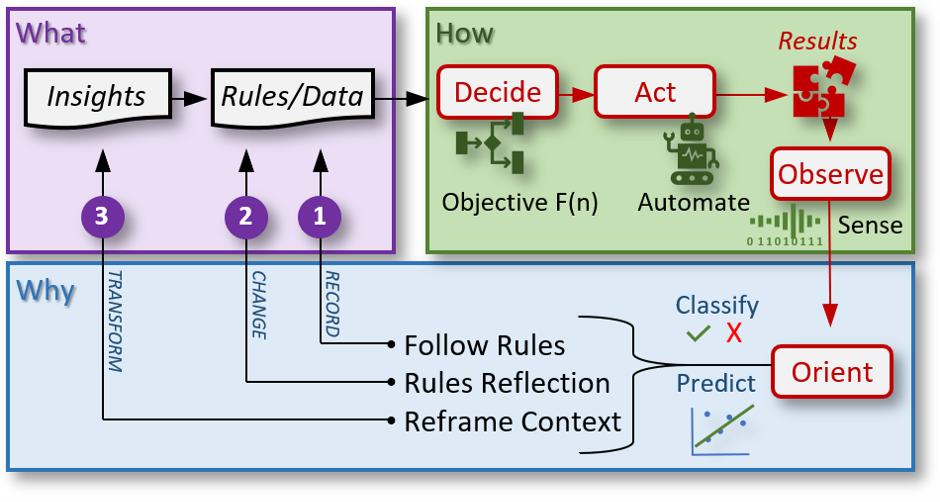
The Triple Golden OODA loop diagram depicts a hybrid of concepts from the Triple Loop concept inspired by Chris Argyris & Donald Schön's work on the Double Loop, [[Creatives#Simon Sinek|Simon Sinek]]'s Golden Circle in 'Start with Why', and [[Creatives#John Richard Boyd|Colonel John Boyd]]'s Observe, Orient, Decide and Act (OODA) Loop from his ‘A Discourse On Winning and Losing'. | The Triple Golden OODA loop diagram depicts a hybrid of concepts from the Triple Loop concept inspired by Chris Argyris & Donald Schön's work on the Double Loop, [[Creatives#Simon Sinek|Simon Sinek]]'s Golden Circle in 'Start with Why', and [[Creatives#John Richard Boyd|Colonel John Boyd]]'s Observe, Orient, Decide and Act (OODA) Loop from his ‘A Discourse On Winning and Losing'. | ||
| − | + | https://PRIMO.AI/images/TripleGoldenOODA.png | |
{|<!-- T --> | {|<!-- T --> | ||
| Line 188: | Line 188: | ||
= <span id="Feedback Loop - Peer Learning"></span>Feedback Loop - Peer Learning = | = <span id="Feedback Loop - Peer Learning"></span>Feedback Loop - Peer Learning = | ||
| − | [ | + | [https://www.youtube.com/results?search_query=~Automated+~peer+feedback+loop+ai+FeedbackFruits+machine+learning YouTube search...] |
| − | [ | + | [https://www.google.com/search?q=~Automated+~peer+feedback+loop+ai+FeedbackFruits+machine+learning ...Google search] |
* [[Education]] | * [[Education]] | ||
* [[Decentralized: Federated & Distributed]] Learning | * [[Decentralized: Federated & Distributed]] Learning | ||
| − | * [ | + | * [https://feedbackfruits.com/ FeedbackFruits] |
| − | * [ | + | * [https://blog.mrtz.org/2014/12/15/the-nips-experiment.html The NIPS experiment | Eric Price - A blog on machine learning very broadly construed by Moritz Hardt] |
| − | + | https://assets.website-files.com/5e318ddf83dd66053d55c38a/5f5a0d4872a99ec9cde81526_engagement.gif | |
{|<!-- T --> | {|<!-- T --> | ||
| Line 212: | Line 212: | ||
<youtube>XUYxXlysmtI</youtube> | <youtube>XUYxXlysmtI</youtube> | ||
<b>FeedbackFruits Official Video: The Reason Behind Our Journey | <b>FeedbackFruits Official Video: The Reason Behind Our Journey | ||
| − | </b><br>FeedbackFruits mission: Improve Learning. Find out more about our initiative to nurture innovation in higher education on a global scale on | + | </b><br>FeedbackFruits mission: Improve Learning. Find out more about our initiative to nurture innovation in higher education on a global scale on https://edtech-consortium.com or check out our official homepage at https://feedbackfruits.com ! |
|} | |} | ||
|}<!-- B --> | |}<!-- B --> | ||
| Line 221: | Line 221: | ||
<youtube>pv8Sl2rWyCQ</youtube> | <youtube>pv8Sl2rWyCQ</youtube> | ||
<b>Google AI's Take on How To Fix Peer Review | <b>Google AI's Take on How To Fix Peer Review | ||
| − | </b><br>The paper "Avoiding a Tragedy of the Commons in the Peer Review Process" is available here: | + | </b><br>The paper "Avoiding a Tragedy of the Commons in the Peer Review Process" is available here: https://arxiv.org/abs/1901.06246 |
|} | |} | ||
|<!-- M --> | |<!-- M --> | ||
| Line 234: | Line 234: | ||
= <span id="Feedback Loop - Creating Consciousness"></span>Feedback Loop - Creating Consciousness = | = <span id="Feedback Loop - Creating Consciousness"></span>Feedback Loop - Creating Consciousness = | ||
| − | [ | + | [https://www.youtube.com/results?search_query=~Consciousness+feedback+Strange+loop+ai+machine+learning YouTube search...] |
| − | [ | + | [https://www.google.com/search?q=~Consciousness+feedback+Strange+loop+ai+machine+learning ...Google search] |
| − | * [ | + | * [https://www.popularmechanics.com/science/health/a10320/michio-kaku-and-the-mysteries-of-the-mind-16582552/ Michio Kaku and the Mysteries of the Mind | Alyson Sheppard - Popular Mechanics] ...The Future of the Mind: The Scientific Quest to Understand, Enhance, and Empower the Mind |
| − | * [ | + | * [https://medium.com/@tylerneylon/a-theory-of-consciousness-d5866b2f8fce A Theory of Consciousness | Tyler Neylon - Medium] |
| − | * [ | + | * [https://www.ams.org/notices/200707/tx070700852p.pdf Do Loops Explain Consciousness? | Martin Gardner - AMS.org] ...Review of I Am a Strange Loop |
| − | ** [ | + | ** [https://en.wikipedia.org/wiki/Strange_loop#In_cognitive_science Strange Loop | Wikipedia] ...The "strangeness" of a strange loop comes from our way of perception |
| − | * [ | + | * [https://www.pulitzer.org/winners/douglas-r-hofstadter Godel, Escher, Bach: an Eternal Golden Braid | Douglas R. Hofstadter] |
| − | ** [ | + | ** [https://en.wikipedia.org/wiki/G%C3%B6del,_Escher,_Bach Gödel, Escher, Bach | Wikipedia] |
* [[Generative]] ...[[Simulated Environment Learning]] | * [[Generative]] ...[[Simulated Environment Learning]] | ||
| Line 283: | Line 283: | ||
= Feedback Loop - Scientific Discovery = | = Feedback Loop - Scientific Discovery = | ||
| − | [ | + | [https://www.youtube.com/results?search_query=~Scientific+Discovery+loop+ai+machine+learning YouTube search...] |
| − | [ | + | [https://www.google.com/search?q=~Scientific+Discovery+loop+ai+machine+learning ...Google search] |
| − | * [ | + | * [https://www.weforum.org/agenda/2020/11/scientific-discovery-must-be-redefined-quantum-and-ai-can-help/ Scientific discovery must be redefined. [[Quantum]] and AI can help | Dario Gil - World Economic Forum] |
| − | * [ | + | * [https://www.the-scientist.com/reading-frames/can-artificial-intelligence-make-scientific-discoveries--65790 Can Artificial Intelligence Make Scientific Discoveries? | Kartik Hosanagar - The Scientist] |
| − | * [ | + | * [https://www.eurekalert.org/pub_releases/2020-06/uok-cai061720.php Can artificial intelligence lead scientific discoveries? | University of Konstanz - EurekAlert!] |
| Line 294: | Line 294: | ||
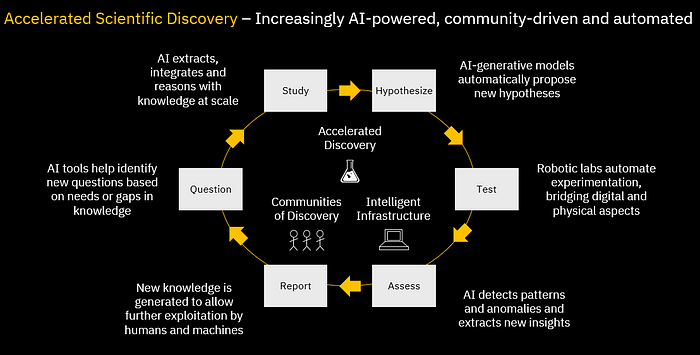
The paradigm shift will be from AI used for analysing the data which has already been obtained, to AI deciding what to measure next. | The paradigm shift will be from AI used for analysing the data which has already been obtained, to AI deciding what to measure next. | ||
| − | [ | + | [https://www.graphcore.ai/posts/why-artificial-intelligence-will-allow-us-to-make-new-scientific-discoveries Why Artificial Intelligence Will Enable New Scientific Discoveries - Andrew Briggs - Graphcore] |
<hr> | <hr> | ||
| − | [ | + | [https://ibm-research.medium.com/quantum-computing-and-ai-to-enable-our-sustainable-future-58aa494cd4bc [[Quantum]] Computing and AI to Enable Our Sustainable Future | Katia Moskvitch - ][[IBM]] |
| − | <img src=" | + | <img src="https://miro.medium.com/max/700/1*KHspoRWJhAFeTqOJk_s5Pg.png" width="1000"> |
| − | [ | + | [https://www.researchgate.net/publication/40867995_Toward_Robot_Scientists_for_autonomous_scientific_discovery Toward Robot Scientist for autonomous scientific discovery | A. Sparkes, W. Aubrey, E. Byrne, and A. Clare - ResearchGate] |
| − | <img src=" | + | <img src="https://www.researchgate.net/profile/Maria_Liakata/publication/40867995/figure/fig1/AS:202527296495616@1425297678351/Hypothesis-driven-closed-loop-learning-Diagram-showing-how-iterative-cycles-of.png" width="1000"> |
{|<!-- T --> | {|<!-- T --> | ||
| Line 322: | Line 322: | ||
<youtube>Q2po1QZONIg</youtube> | <youtube>Q2po1QZONIg</youtube> | ||
<b>Hypothesis Generation with AGATHA : Accelerate Scientific Discovery with Deep Learning | AISC | <b>Hypothesis Generation with AGATHA : Accelerate Scientific Discovery with Deep Learning | AISC | ||
| − | </b><br>ML Explained - Aggregate Intellect - AISC For slides and more information on the paper, visit | + | </b><br>ML Explained - Aggregate Intellect - AISC For slides and more information on the paper, visit https://ai.science/e/hypothesis-generation-with-agatha-accelerate-scientific-discovery-with-deep-learning--2020-04-01 |
Discussion lead: Justin Sybrandt Discussion facilitator(s): Rouzbeh Afrasiabi Medical research is risky and expensive. Drug discovery, as an example, requires that researchers efficiently winnow thousands of potential targets to a small candidate set for more thorough evaluation. However, research groups spend significant time and money to perform the experiments necessary to determine this candidate set long before seeing intermediate results. Hypothesis generation systems address this challenge by mining the wealth of publicly available scientific information to predict plausible research directions. We present AGATHA, a deep-learning hypothesis generation system that can introduce data-driven insights earlier in the discovery process. Through a learned ranking criteria, this system quickly prioritizes plausible term-pairs among entity sets, allowing us to recommend new research directions. We massively validate our system with a temporal holdout wherein we predict connections first introduced after 2015 using data published beforehand. We additionally explore biomedical sub-domains, and demonstrate AGATHA's predictive capacity across the twenty most popular relationship types. This system achieves best-in-class performance on an established benchmark, and demonstrates high recommendation scores across subdomains. Reproducibility: All code, experimental data, and pre-trained models are available online: | Discussion lead: Justin Sybrandt Discussion facilitator(s): Rouzbeh Afrasiabi Medical research is risky and expensive. Drug discovery, as an example, requires that researchers efficiently winnow thousands of potential targets to a small candidate set for more thorough evaluation. However, research groups spend significant time and money to perform the experiments necessary to determine this candidate set long before seeing intermediate results. Hypothesis generation systems address this challenge by mining the wealth of publicly available scientific information to predict plausible research directions. We present AGATHA, a deep-learning hypothesis generation system that can introduce data-driven insights earlier in the discovery process. Through a learned ranking criteria, this system quickly prioritizes plausible term-pairs among entity sets, allowing us to recommend new research directions. We massively validate our system with a temporal holdout wherein we predict connections first introduced after 2015 using data published beforehand. We additionally explore biomedical sub-domains, and demonstrate AGATHA's predictive capacity across the twenty most popular relationship types. This system achieves best-in-class performance on an established benchmark, and demonstrates high recommendation scores across subdomains. Reproducibility: All code, experimental data, and pre-trained models are available online: | ||
|} | |} | ||
| Line 328: | Line 328: | ||
= <span id="Feedback Loop - Stock Market Predictions"></span>Feedback Loop - Stock Market Predictions = | = <span id="Feedback Loop - Stock Market Predictions"></span>Feedback Loop - Stock Market Predictions = | ||
| − | [ | + | [https://www.youtube.com/results?search_query=Stock+Market+Predictions+feedback+loop+ai+machine+learning YouTube search...] |
| − | [ | + | [https://www.google.com/search?q=Stock+Market+Predictions+feedback+loop+ai ...Google search] |
* [[Case Studies]] | * [[Case Studies]] | ||
| Line 335: | Line 335: | ||
Why you can beat the market, even when it does not seem so. The importance of loops, patterns, and predictable events. Random events are don’t measure risks, and should not affect your decision making. | Why you can beat the market, even when it does not seem so. The importance of loops, patterns, and predictable events. Random events are don’t measure risks, and should not affect your decision making. | ||
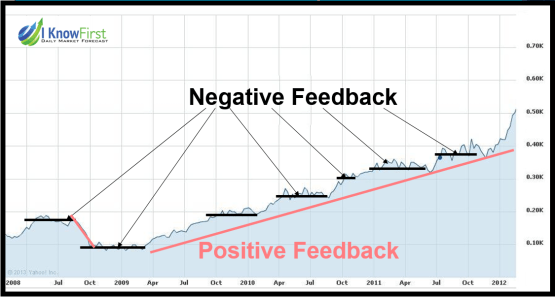
| − | Some traders follow the trend, and some go against it. At I Know First we work on algorithmic strategies which are neither, we simply try an assess where the next opportunity is and provide stock market predictions. If this means to do what everyone else does, than why not. If it means going against when everyone else does, this is also fine. The tricky part is determining where this opportunities are, this article will discuss how to find opportunities in what can seem as total randomness. Markets are Complex, but not Unpredictable! There are two major misconceptions about the stock market. The first one is connected to the classical economic theory which claims markets to be efficient, and as such unpredictable. In this case trying to select one stock over another becomes useless, as no opportunity is ever better than the other. Both stocks are perfectly priced according to their opportunity and risk, with everyone having all information. However, the truth of the matter is that some people profit trading stocks while others lose – this by itself proves the market to be inefficient, and thus exploitable. While US markets are very efficient, and most information is available, not everyone interprets this information the same. [ | + | Some traders follow the trend, and some go against it. At I Know First we work on algorithmic strategies which are neither, we simply try an assess where the next opportunity is and provide stock market predictions. If this means to do what everyone else does, than why not. If it means going against when everyone else does, this is also fine. The tricky part is determining where this opportunities are, this article will discuss how to find opportunities in what can seem as total randomness. Markets are Complex, but not Unpredictable! There are two major misconceptions about the stock market. The first one is connected to the classical economic theory which claims markets to be efficient, and as such unpredictable. In this case trying to select one stock over another becomes useless, as no opportunity is ever better than the other. Both stocks are perfectly priced according to their opportunity and risk, with everyone having all information. However, the truth of the matter is that some people profit trading stocks while others lose – this by itself proves the market to be inefficient, and thus exploitable. While US markets are very efficient, and most information is available, not everyone interprets this information the same. [https://iknowfirst.com/stock-market-predictions-where-in-the-feedback-loop-is-your-portfolio Stock Market Predictions: Where In The Feedback Loop Is Your Portfolio? | I Know First] |
| − | + | https://iknowfirst.com/wp-content/uploads/2015/06/07.png | |
{|<!-- T --> | {|<!-- T --> | ||
| Line 351: | Line 351: | ||
= <span id="Feedback Loop - The AI Economist"></span>Feedback Loop - The AI Economist = | = <span id="Feedback Loop - The AI Economist"></span>Feedback Loop - The AI Economist = | ||
| − | [ | + | [https://www.youtube.com/results?search_query=Economist+Predictions+feedback+loop+ai+reinforcement+machine+learning YouTube search...] |
| − | [ | + | [https://www.google.com/search?q=Economist+Predictions+feedback+loop+ai+reinforcement+machine+learning ...Google search] |
* [[Case Studies]] | * [[Case Studies]] | ||
| Line 359: | Line 359: | ||
* [[Reinforcement Learning (RL)]] | * [[Reinforcement Learning (RL)]] | ||
| − | Optimal Tax Design as Learned Reward Design Using Reinforcement Learning. Reinforcement learning is a powerful framework in which agents learn from experience collected through trial-and-error. We use model-free RL, in which agents do not use any prior world knowledge or modeling assumptions. Another benefit of RL is that agents can optimize for any objective. In our setting, this means that a tax policy can be learned that optimizes any social objective, and without knowledge of workers’ utility functions or skills. [ | + | Optimal Tax Design as Learned Reward Design Using Reinforcement Learning. Reinforcement learning is a powerful framework in which agents learn from experience collected through trial-and-error. We use model-free RL, in which agents do not use any prior world knowledge or modeling assumptions. Another benefit of RL is that agents can optimize for any objective. In our setting, this means that a tax policy can be learned that optimizes any social objective, and without knowledge of workers’ utility functions or skills. [https://blog.einstein.ai/the-ai-economist/ The AI Economist: Improving Equality and Productivity with AI-Driven Tax Policies | S. Zheng, A. Trott, S. Srinivasa, N. Naik, M. Gruesbeck, D. Parkes, and R. Socher - Einstein.ai]] |
| − | <img src=" | + | <img src="https://blog.einstein.ai/content/images/2020/03/1a-2.png" width="1000"> |
{|<!-- T --> | {|<!-- T --> | ||
| Line 391: | Line 391: | ||
= Feedback Loop - Synthetic = | = Feedback Loop - Synthetic = | ||
| − | [ | + | [https://www.youtube.com/results?search_query=~Synthetic+feedback+loop+ai+machine+learning YouTube search...] |
| − | [ | + | [https://www.google.com/search?q=~Synthetic+feedback+loop+ai+machine+learning ...Google search] |
{|<!-- T --> | {|<!-- T --> | ||
| Line 400: | Line 400: | ||
<youtube>5Zus6ZOG-lw</youtube> | <youtube>5Zus6ZOG-lw</youtube> | ||
<b>The Wandering Dreamer: An Synthetic Feedback Loop | <b>The Wandering Dreamer: An Synthetic Feedback Loop | ||
| − | </b><br>This experiment uses four machine learning models to create a feedback loop between synthesized images and text. All of the images you see here are fabricated, as is the text that describes each image. Made by Brannon Dorsey using Runway. [ | + | </b><br>This experiment uses four machine learning models to create a feedback loop between synthesized images and text. All of the images you see here are fabricated, as is the text that describes each image. Made by Brannon Dorsey using Runway. [https://github.com/brannondorsey/the-wandering-dreamer Source code] |
1. The first row of images are produced from a class label using BigGAN. | 1. The first row of images are produced from a class label using BigGAN. | ||
| Line 410: | Line 410: | ||
= Recursion = | = Recursion = | ||
| − | [ | + | [https://www.youtube.com/results?search_query=Programming+Recursion+loop+ai+machine+learning YouTube search...] |
| − | [ | + | [https://www.google.com/search?q=Programming+Recursion+loop+ai+machine+learning ...Google search] |
| − | + | https://upload.wikimedia.org/wikipedia/commons/6/60/Tower_of_Hanoi_4.gif | |
{|<!-- T --> | {|<!-- T --> | ||
| Line 446: | Line 446: | ||
|| | || | ||
<youtube>buWXDMbY3Ww</youtube> | <youtube>buWXDMbY3Ww</youtube> | ||
| − | <b>Can you solve the [ | + | <b>Can you solve the [https://en.wikipedia.org/wiki/Tower_of_Hanoi Towers of Hanoi] problem in [[Python]] using recursion? SOLUTION INCLUDED |
| − | </b><br>This is a complete explanation of recursion. Recursion is a very useful tool in computer science and data science. Here I show you what recursion is and how to use recursion to solve the [ | + | </b><br>This is a complete explanation of recursion. Recursion is a very useful tool in computer science and data science. Here I show you what recursion is and how to use recursion to solve the [https://en.wikipedia.org/wiki/Tower_of_Hanoi Towers of Hanoi] problem using [[Python]]. I also use recursion to calculate factorial. Want to learn [[Python]]? You can buy my course here: https://bit.ly/2OwUA09 Want to ace the Data Science Interview? Over 1000 Data Science Practice Questions with model solutions: https://bit.ly/30ul0nX |
|} | |} | ||
|<!-- M --> | |<!-- M --> | ||
| Line 455: | Line 455: | ||
<youtube>G_UYXzGuqvM</youtube> | <youtube>G_UYXzGuqvM</youtube> | ||
<b>[[Python]] Sudoku Solver - Computerphile | <b>[[Python]] Sudoku Solver - Computerphile | ||
| − | </b><br>Fun comes in many forms - playing puzzles, or writing programs that solve the puzzles for you. Professor Thorsten Altenkirch on a recursive Sudoku solver. | + | </b><br>Fun comes in many forms - playing puzzles, or writing programs that solve the puzzles for you. Professor Thorsten Altenkirch on a recursive Sudoku solver. https://www.facebook.com/computerphile https://twitter.com/computer_phile This video was filmed and edited by Sean Riley. Computer Science at the University of Nottingham: https://bit.ly/nottscomputer Computerphile is a sister project to Brady Haran's Numberphile. More at https://www.bradyharan.com |
|} | |} | ||
|}<!-- B --> | |}<!-- B --> | ||
= <span id="Unintended Feedback Loop"></span>Unintended Feedback Loop = | = <span id="Unintended Feedback Loop"></span>Unintended Feedback Loop = | ||
| − | [ | + | [https://www.youtube.com/results?search_query=~Unforeseen+~Unintended+Consequences+feedback+loop+artificial+intelligence YouTube search...] |
| − | [ | + | [https://www.google.com/search?q=~Unforeseen+~Unintended+Consequences+feedback+loop+artificial+intelligence ...Google search] |
* [[Bias and Variances]] | * [[Bias and Variances]] | ||
| − | * [ | + | * [https://en.wikipedia.org/wiki/AI_control_problem#Unintended_consequences_from_existing_AI Unintended consequences from existing AI | Wikipedia] |
| − | * [ | + | * [https://weaponsofmathdestructionbook.com/ Weapons of Math Destruction: How Big Data Increases Inequality and Threatens Democracy | Cathy O'Neil] |
| − | * [ | + | * [https://www.wired.com/story/the-toxic-potential-of-youtubes-feedback-loop/ The Toxic Potential of YouTube’s Feedback Loop | Guillaume Chaslot - Wired] |
| − | * [ | + | * [https://www.kdnuggets.com/2017/06/unintended-consequences-machine-learning.html The Unintended Consequences of Machine Learning | Frank Kane - Sundog Education - KDnuggets] |
| − | * [ | + | * [https://towardsdatascience.com/dangerous-feedback-loops-in-ml-e9394f2e8f43 Dangerous Feedback Loops in ML | David Blaszka - Towards Data Science] |
| − | * [ | + | * [https://youthedata.com/2018/05/23/the-negative-feedback-loop-technology-needs-to-know-when-it-gets-things-wrong/ The Negative Feedback Loop: Technology Needs To Know When It Gets Things Wrong | Fiona McEvoy - You The Data] ...This is not a secret problem. AI developers are painfully aware that there is currently no straightforward way to combat biased data or solicit full feedback. However, increasingly they are making efforts to harvest this critical information wherever and however they can. Not just in the name of [[ethics]], but also to ensure that their creations perform as accurately as possible. |
| − | + | https://miro.medium.com/max/400/1*2-mGCxjRYINaExTLwH-Bhw.gif | |
| − | Models that are an integrated part of a product experience, or what we referred to as data products, often involve feedback loops. When done right, feedback loops can help us to create better experiences. However, feedback loops can also create unintended negative consequences, such as bias or inaccurate model performance measurements... [ | + | Models that are an integrated part of a product experience, or what we referred to as data products, often involve feedback loops. When done right, feedback loops can help us to create better experiences. However, feedback loops can also create unintended negative consequences, such as bias or inaccurate model performance measurements... [https://medium.com/@rchang/getting-better-at-machine-learning-16b4dd913a1f Getting Better at Machine Learning | Robert Chang - Medium] |
| − | Leaders hoping to shift their posture from hindsight to foresight need to better understand the types of risks they are taking on, their interdependencies, and their underlying causes... [ | + | Leaders hoping to shift their posture from hindsight to foresight need to better understand the types of risks they are taking on, their interdependencies, and their underlying causes... [https://www.mckinsey.com/business-functions/mckinsey-analytics/our-insights/confronting-the-risks-of-artificial-intelligence Confronting the risks of artificial intelligence | B. Cheatham, K. Javanmardian, and H. Samandari - Mckinsey & Company] |
One of the key features of live ML systems is that they often end up influencing their own behavior if they update over time. This leads to a form of analysis debt, in which it is difficult to predict the behavior of a given model before it is released. These feedback loops can take different forms, but they are all more difficult to detect and address if they occur gradually over time, as may be the case when models are updated infrequently. | One of the key features of live ML systems is that they often end up influencing their own behavior if they update over time. This leads to a form of analysis debt, in which it is difficult to predict the behavior of a given model before it is released. These feedback loops can take different forms, but they are all more difficult to detect and address if they occur gradually over time, as may be the case when models are updated infrequently. | ||
| Line 482: | Line 482: | ||
one selecting products to show and another selecting related reviews. Improving one system may lead to changes in behavior in the other, as users begin clicking more or less on the other components | one selecting products to show and another selecting related reviews. Improving one system may lead to changes in behavior in the other, as users begin clicking more or less on the other components | ||
in reaction to the changes. Note that these hidden loops may exist between completely disjoint systems. Consider the case of two stock-market prediction models from two different investment | in reaction to the changes. Note that these hidden loops may exist between completely disjoint systems. Consider the case of two stock-market prediction models from two different investment | ||
| − | companies. Improvements (or, more scarily, bugs) in one may influence the bidding and buying behavior of the other. [ | + | companies. Improvements (or, more scarily, bugs) in one may influence the bidding and buying behavior of the other. [https://papers.nips.cc/paper/5656-hidden-technical-debt-in-machine-learning-systems.pdf Hidden Technical Debt in Machine Learning Systems | D. Sculley, G. Holt, D. Golovin, E. Davydov, T. Phillips, D. Ebner, V. Chaudhary, M. Young, J. Crespo, and D. Dennison - Google] |
| − | <img src=" | + | <img src="https://www.microsoft.com/en-us/research/uploads/prod/2020/01/MSResearch_20200108_PaperBlogPost_r1t1_1400x788-2.png" width="500"> |
| − | <img src=" | + | <img src="https://www.microsoft.com/en-us/research/uploads/prod/2020/01/Post.jpg" width="500"> |
| − | When the system is retrained on future data, it may become not less but more detrimental to historically disadvantaged groups. In order to build AI systems that are aligned with desirable long-term societal outcomes, we need to understand when and why such negative feedback loops occur, and we need to learn how to prevent them. [ | + | When the system is retrained on future data, it may become not less but more detrimental to historically disadvantaged groups. In order to build AI systems that are aligned with desirable long-term societal outcomes, we need to understand when and why such negative feedback loops occur, and we need to learn how to prevent them. [https://www.microsoft.com/en-us/research/blog/when-bias-begets-bias-a-source-of-negative-feedback-loops-in-ai-systems/ When bias begets bias: A source of negative feedback loops in AI systems | Lydia T. Liu - University of California, Berkeley -] [[Microsoft]] Research Blog |
{|<!-- T --> | {|<!-- T --> | ||
| Line 495: | Line 495: | ||
<youtube>TQHs8SA1qpk</youtube> | <youtube>TQHs8SA1qpk</youtube> | ||
<b>Weapons of Math Destruction | Cathy O'Neil | Talks at Google | <b>Weapons of Math Destruction | Cathy O'Neil | Talks at Google | ||
| − | </b><br>Cathy O'Neil is a data scientist and author of the blog mathbabe.org. She earned a Ph.D. in mathematics from Harvard and taught at Barnard College before moving to the private sector and working for the hedge fund D. E. Shaw. O'Neil started the Lede Program in Data Journalism at Columbia and is the author of "Doing Data Science." She appears weekly on the "Slate Money" podcast. In this talk, O'Neil sounds an alarm on the mathematical models that pervade modern life and threaten to rip apart our social fabric. [ | + | </b><br>Cathy O'Neil is a data scientist and author of the blog mathbabe.org. She earned a Ph.D. in mathematics from Harvard and taught at Barnard College before moving to the private sector and working for the hedge fund D. E. Shaw. O'Neil started the Lede Program in Data Journalism at Columbia and is the author of "Doing Data Science." She appears weekly on the "Slate Money" podcast. In this talk, O'Neil sounds an alarm on the mathematical models that pervade modern life and threaten to rip apart our social fabric. [https://goo.gl/1L61P5 Get the book] ... [https://mathbabe.org/ mathbabe] |
|} | |} | ||
|<!-- M --> | |<!-- M --> | ||
| Line 504: | Line 504: | ||
<b>Building Trust in Your AI | Veritone | <b>Building Trust in Your AI | Veritone | ||
</b><br>AI can deliver compelling business results, but do you know for a fact you are using the best available AI model for your data? Do you know what to expect after deploying? Is there risk of performance degradation or bias? Many AI projects fall short of expectations due to poor model performance or the unintended consequences of inaccurate AI decisions. What if there was a universal way for ML Ops / AI Ops to evaluate and monitor the performance and behavior of AI models, both pre-deployment and ongoing, no matter the vendor or features used? In this session we will review the pitfalls of opaque AI models, and discover how to evaluate, compare, and monitor performance and behavior across AI models, for better AI model trust and explainability. We will also demonstrate the Veritone Clarity product, showing how you can easily select the best AI model for the job, detect drift and correct it to achieve better business outcomes. For more details, visit us at | </b><br>AI can deliver compelling business results, but do you know for a fact you are using the best available AI model for your data? Do you know what to expect after deploying? Is there risk of performance degradation or bias? Many AI projects fall short of expectations due to poor model performance or the unintended consequences of inaccurate AI decisions. What if there was a universal way for ML Ops / AI Ops to evaluate and monitor the performance and behavior of AI models, both pre-deployment and ongoing, no matter the vendor or features used? In this session we will review the pitfalls of opaque AI models, and discover how to evaluate, compare, and monitor performance and behavior across AI models, for better AI model trust and explainability. We will also demonstrate the Veritone Clarity product, showing how you can easily select the best AI model for the job, detect drift and correct it to achieve better business outcomes. For more details, visit us at | ||
| − | + | https://Veritone.com | |
|} | |} | ||
|}<!-- B --> | |}<!-- B --> | ||
== Unintended Feedback Loop - Filter Bubbles == | == Unintended Feedback Loop - Filter Bubbles == | ||
| − | [ | + | [https://www.youtube.com/results?search_query=Filter+Bubbles+loop+feedback+machine+learning+reinforcement YouTube search...] |
| − | [ | + | [https://www.google.com/search?q=Filter+Bubbles+loop+feedback+machine+learning+reinforcement ...Google search] |
| − | * [ | + | * [https://edu.gcfglobal.org/en/digital-media-literacy/how-filter-bubbles-isolate-you/1/ How filter bubbles isolate you | GCF Global] |
| − | In December 2009, Google began customizing its search results for all users, and we entered a new era of personalization. With little notice or fanfare, our online experience is changing, as the websites we visit are increasingly tailoring themselves to us. In this engaging and visionary book, MoveOn.org board president Eli Pariser lays bare the personalization that is already taking place on every major website, from Facebook to AOL to ABC News. As Pariser reveals, this new trend is nothing short of an invisible revolution in how we consume information, one that will shape how we learn, what we know, and even how our democracy works. [ | + | In December 2009, Google began customizing its search results for all users, and we entered a new era of personalization. With little notice or fanfare, our online experience is changing, as the websites we visit are increasingly tailoring themselves to us. In this engaging and visionary book, MoveOn.org board president Eli Pariser lays bare the personalization that is already taking place on every major website, from Facebook to AOL to ABC News. As Pariser reveals, this new trend is nothing short of an invisible revolution in how we consume information, one that will shape how we learn, what we know, and even how our democracy works. [https://www.penguinrandomhouse.com/books/309214/the-filter-bubble-by-eli-pariser/ The Filter Bubble | Eli Pariser] |
<hr> | <hr> | ||
| − | In news media, echo chamber is a metaphorical description of a situation in which beliefs are amplified or reinforced by communication and repetition inside a closed system. [ | + | In news media, echo chamber is a metaphorical description of a situation in which beliefs are amplified or reinforced by communication and repetition inside a closed system. [https://en.wikipedia.org/wiki/Filter_bubble Filter Bubble | Wikipedia] |
<hr> | <hr> | ||
| Line 529: | Line 529: | ||
<youtube>pT-k1kDIRnw</youtube> | <youtube>pT-k1kDIRnw</youtube> | ||
<b>How Filter Bubbles Isolate You | <b>How Filter Bubbles Isolate You | ||
| − | </b><br>In this video, you’ll learn more about how filter bubbles work to automatically curate content for you when you're online. [ | + | </b><br>In this video, you’ll learn more about how filter bubbles work to automatically curate content for you when you're online. [https://edu.gcfglobal.org/en/digital-media-literacy/how-filter-bubbles-isolate-you/1/ Our text-based lesson] We hope you enjoy! |
|} | |} | ||
|<!-- M --> | |<!-- M --> | ||
| Line 546: | Line 546: | ||
<youtube>B8ofWFx525s</youtube> | <youtube>B8ofWFx525s</youtube> | ||
<b>Beware online "filter bubbles" | Eli Pariser | <b>Beware online "filter bubbles" | Eli Pariser | ||
| − | </b><br> | + | </b><br>https://www.ted.com As web companies strive to tailor their services (including news and search results) to our personal tastes, there's a dangerous unintended consequence: We get trapped in a "filter bubble" and don't get exposed to information that could challenge or broaden our worldview. Eli Pariser argues powerfully that this will ultimately prove to be bad for us and bad for democracy. Read our community Q&A with Eli (featuring 10 ways to turn off the filter bubble): https://on.ted.com/PariserQA |
|} | |} | ||
|<!-- M --> | |<!-- M --> | ||
| Line 554: | Line 554: | ||
<youtube>DSp8H6P1n1I</youtube> | <youtube>DSp8H6P1n1I</youtube> | ||
<b>Feedback loops in data systems - Matthieu Ranger | <b>Feedback loops in data systems - Matthieu Ranger | ||
| − | </b><br>When 'filter bubbles' came to public attention, it became pressing that systems that consume their own recommendations as data can be subject to noxious feedback loops. In this talk, we go over several examples of feedback loops, then discuss the technical and management issues related. Montréal-[[Python]] 74: Virtual Echo | + | </b><br>When 'filter bubbles' came to public attention, it became pressing that systems that consume their own recommendations as data can be subject to noxious feedback loops. In this talk, we go over several examples of feedback loops, then discuss the technical and management issues related. Montréal-[[Python]] 74: Virtual Echo https://montrealpython.org/2019/03/mp74/ |
|} | |} | ||
|}<!-- B --> | |}<!-- B --> | ||
= <span id="Using the OODA Loop - Purple Team with Cybersecurity"></span>Using the OODA Loop - Purple Team with Cybersecurity = | = <span id="Using the OODA Loop - Purple Team with Cybersecurity"></span>Using the OODA Loop - Purple Team with Cybersecurity = | ||
| − | [ | + | [https://www.youtube.com/results?search_query=Purple+Team+Blue+Red+attack+cyber+security YouTube search...] |
| − | [ | + | [https://www.google.com/search?q=Purple+Team+Blue+Red+attack+cyber+security ...Google search] |
* [[Cybersecurity#MITRE ATT&CK™|MITRE ATT&CK™]] | * [[Cybersecurity#MITRE ATT&CK™|MITRE ATT&CK™]] | ||
| − | * [ | + | * [https://csrc.nist.gov/CSRC/media/Presentations/The-Cyber-OODA-Loop-How-Your-Attacker-Should-Help/images-media/day3_security-automation_930-1020.pdf The Cyber OODA Loop, How Your Attacker Should Help You Design Your Defense | Tony Sager - The Center for Internet Security - NIST] |
| − | * [ | + | * [https://www.praetorian.com/blog/the-4-phases-of-effective-incident-response-decision-making The 4 Phases of Effective Incident Response Decision Making | Andrew Cook - Praetorian] |
* [https://resources.infosecinstitute.com/ooda-and-cybersecurity/ OODA and Cybersecurity | INFOSEC] | * [https://resources.infosecinstitute.com/ooda-and-cybersecurity/ OODA and Cybersecurity | INFOSEC] | ||
| − | * [ | + | * [https://purplesec.us/red-team-vs-blue-team-cyber-security/ Red Team VS Blue Team: What’s The Difference? | Jason Firch - PurpleSec] |
| − | * [ | + | * [https://www.packetlabs.net/purple-team/ Purple Team: When Red and Blue Teams Work Together | Packetlabs] |
| − | Modern security organizations create new capabilities within an overall cyber defense team by organizing themselves around a fundamental concept of an “OODA loop” — enabling teams to quickly make necessary decisions as they are responding to live or simulated incidents. ... Handling incidents effectively requires this sort of cyclical and quick decision making. In this quick-decision cycle, the IR team becomes the Blue Team, the “attackers” comprise the Red Team and run attack scenarios, and an even more novel third team called the Purple Team proactively hunts the attackers. This structure allows organizations to “train like they fight,” enabling them to prepare for increasingly more advanced adversarial techniques....Purple Teams help optimize security detection processes within an organization by reproducing attacks, determining if successful detection of these attacks occurred, and exposing existing deficiencies within the organization’s IR plan. [ | + | Modern security organizations create new capabilities within an overall cyber defense team by organizing themselves around a fundamental concept of an “OODA loop” — enabling teams to quickly make necessary decisions as they are responding to live or simulated incidents. ... Handling incidents effectively requires this sort of cyclical and quick decision making. In this quick-decision cycle, the IR team becomes the Blue Team, the “attackers” comprise the Red Team and run attack scenarios, and an even more novel third team called the Purple Team proactively hunts the attackers. This structure allows organizations to “train like they fight,” enabling them to prepare for increasingly more advanced adversarial techniques....Purple Teams help optimize security detection processes within an organization by reproducing attacks, determining if successful detection of these attacks occurred, and exposing existing deficiencies within the organization’s IR plan. [https://medium.com/@bogov/improving-cyber-defense-by-purple-team-using-ooda-loop-ae0459bbe734 Improving Cyber Defense by Purple Team using OODA loop | Ozren (Oz) Bogovac - Medium] |
<img src="https://cdn.packetlabs.net/wp-content/uploads/2019/09/10115222/purple-team-fig2.png" width="700"> | <img src="https://cdn.packetlabs.net/wp-content/uploads/2019/09/10115222/purple-team-fig2.png" width="700"> | ||
| Line 579: | Line 579: | ||
<youtube>jNY59pil8Tk</youtube> | <youtube>jNY59pil8Tk</youtube> | ||
<b>Red Team VS Blue Team: What’s The Difference? | PurpleSec | <b>Red Team VS Blue Team: What’s The Difference? | PurpleSec | ||
| − | </b><br>PurpleSec Cyber Security Red teams are offensive security professionals who are experts in attacking systems and breaking into defenses. Blue teams are defensive security professionals responsible for maintaining internal network defenses against all cyber attacks and threats. Red teams simulate attacks against blue teams to test the effectiveness of the network’s security. These red and blue team exercises provide a holistic security solution ensuring strong defenses while keeping in view evolving threats. Jason Firch, MBA What Is A Purple Team? A purple team isn’t necessarily a stand alone team, although it could be. The goal of a purple team is to bring both red and blue teams together while encouraging them to work as a team to share insights and create a strong feedback loop. Management should ensure that the red and blue teams work together and keep each other informed. Enhanced cooperation between both teams through proper resource sharing, reporting and knowledge share is essential for the continual improvement of the security program. If you need help securing your business from cyber attacks then feel free to check out: | + | </b><br>PurpleSec Cyber Security Red teams are offensive security professionals who are experts in attacking systems and breaking into defenses. Blue teams are defensive security professionals responsible for maintaining internal network defenses against all cyber attacks and threats. Red teams simulate attacks against blue teams to test the effectiveness of the network’s security. These red and blue team exercises provide a holistic security solution ensuring strong defenses while keeping in view evolving threats. Jason Firch, MBA What Is A Purple Team? A purple team isn’t necessarily a stand alone team, although it could be. The goal of a purple team is to bring both red and blue teams together while encouraging them to work as a team to share insights and create a strong feedback loop. Management should ensure that the red and blue teams work together and keep each other informed. Enhanced cooperation between both teams through proper resource sharing, reporting and knowledge share is essential for the continual improvement of the security program. If you need help securing your business from cyber attacks then feel free to check out: https://purplesec.us |
|} | |} | ||
|<!-- M --> | |<!-- M --> | ||
| Line 593: | Line 593: | ||
= OODA Loop - Security Approaches = | = OODA Loop - Security Approaches = | ||
| − | [ | + | [https://www.youtube.com/results?search_query=OODA+loop YouTube search...] |
| − | [ | + | [https://www.google.com/search?q=OODA+loop ...Google search] |
{|<!-- T --> | {|<!-- T --> | ||
Revision as of 14:31, 4 January 2023
YouTube search... ...Google search
- Human-in-the-Loop (HITL) Learning
- Recommendation
- Reinforcement Learning (RL)
- Causation vs. Correlation
- Algorithm Administration
- Network Pattern
Contents
- 1 Observe–Orient–Decide–Act (OODA) Loop
- 2 Feedback Loop
- 3 Multi-Loop Learning
- 4 Triple Golden OODA
- 5 Feedback Loop - Peer Learning
- 6 Feedback Loop - Creating Consciousness
- 7 Feedback Loop - Scientific Discovery
- 8 Feedback Loop - Stock Market Predictions
- 9 Feedback Loop - The AI Economist
- 10 Feedback Loop - Synthetic
- 11 Recursion
- 12 Unintended Feedback Loop
- 13 Using the OODA Loop - Purple Team with Cybersecurity
- 14 OODA Loop - Security Approaches
Observe–Orient–Decide–Act (OODA) Loop
YouTube search... ...Google search
The OODA loop is the cycle: Observe–Orient–Decide–Act ...emphasized that "the loop" is actually a set of interacting loops that are to be kept in continuous operation... developed by military strategist and United States Air Force Colonel John Boyd. Boyd applied the concept to the combat operations process, often at the operational level during military campaigns. It is now also often applied to understand commercial operations and learning processes. The approach explains how agility can overcome raw power in dealing with human opponents. It is especially applicable to cyber security and cyberwarfare. Wikipedia ... A Discourse On Winning and Losing | John R. Boyd - Air University Press
We’ve historically focused automation efforts on the “Act” portion but the real potential for new technologies is to address the prior 3 steps: Improving Observation: Improve the data itself with better sensing accuracy, timeliness, relevance, etc or improve our ability to use the data with higher throughput learning processes Improving Orientation: Improve the classification of the current state and the prediction of future states
Improving Decision: Improve the ability to choose between paths via better objective functions. How Artificial Intelligence is Closing the Loop with Better Predictions | Erik Trautman - HackerNoon]
|
|
Feedback Loop
YouTube search... ...Google search
- Feedback | Wikipedia
- Closing the Loop: How Feedback Loops Help to Maintain Quality Long-Term AI Results | Natalie Fletcher - Clarifai
- So, What Actually Is a Feedback Loop? | Tina Nord - Ultimate Knowledge ...With feedback loops, a system is constantly in dialogue with itself.
- AI in the Feedback Loop: A Survey of Alternative Approaches | Karl-ErikÅrzén - ScienceDirect ...paper gives special attention to fuzzy control and expert control.
- Feedback Loops in Machine Learning | Ankur Goyal - Impair ...in spite of the immense benefits that Machine Learning offers, this technology has been very slow to take off, particularly in the enterprise world. At Impira, we believe a key reason for this is the lack of well-designed feedback loops that serve to continuously improve machine learning models.
- HP200A | Wikipedia ...oscillator to use a simple light bulb as the temperature-dependent resistor in its feedback network. Walt Disney bought eight HP200A for use in the production of Fantasia
- The Air Force Research Lab wants tools, techniques and innovative ideas for shortening the OODA Loop. | Aaron Boyd - Nextgov
any process where the outputs of a system are plugged back in and used as iterative inputs. Feedback loops exist just about everywhere. In nature, the evolutionary "arms race" between predators and prey is a classic example. In business, the practice of taking customer feedback (the output of a product or service) and using it to improve future processes is another commonly used feedback loop. Today, rapid advances in artificial intelligence (AI) and machine learning are helping businesses do more with data. These systems — and their ability to analyze an inhuman amount of data — allow businesses to adjust algorithms, workflows and processes on the fly. Get More Out Of Feedback Loops With AI | Arka Dhar - Forbes
|
|
Multi-Loop Learning
YouTube search... ...Google search
- How Artificial Intelligence Will Redefine Management | V. Kolbjørnsrud, R. Amico and R.J. Thomas
- Chris Argyris: theories of action, double-loop learning and organizational learning | Infed.org
- Donald Schon (Schön): learning, reflection and change | Infed.org
- Organisational learning: a critical review | Catherine L. Wang, Pervaiz K. Ahmed
- Single and double loop learning | Organizational Learning
- Double-loop learning | Wikipedia
- Re-Framing Perspectives | Patrick A. Trottier - The Institute Of Emergent Organizational Development and Emergent Change®
- Working visually: Record, Reflect, Reframe, Part 1 Part 2 | Kim S van den Berg
- Different Kinds of Learning (Loops of Learning) Adapted from “Field Guide to Consulting and Organizational Development”

|
|
|
|
|
|
Triple Golden OODA
YouTube search... ...Google search
- Framing Context
- Multi-Loop Learning
- Start With Why | Simon Sinek ...Wikipedia
- Observe–Orient–Decide–Act (OODA) Loop ...Wikipedia
The Triple Golden OODA loop diagram depicts a hybrid of concepts from the Triple Loop concept inspired by Chris Argyris & Donald Schön's work on the Double Loop, Simon Sinek's Golden Circle in 'Start with Why', and Colonel John Boyd's Observe, Orient, Decide and Act (OODA) Loop from his ‘A Discourse On Winning and Losing'.
|
|
Feedback Loop - Peer Learning
YouTube search... ...Google search
- Education
- Decentralized: Federated & Distributed Learning
- FeedbackFruits
- The NIPS experiment | Eric Price - A blog on machine learning very broadly construed by Moritz Hardt
|
|
|
|
Feedback Loop - Creating Consciousness
YouTube search... ...Google search
- Michio Kaku and the Mysteries of the Mind | Alyson Sheppard - Popular Mechanics ...The Future of the Mind: The Scientific Quest to Understand, Enhance, and Empower the Mind
- A Theory of Consciousness | Tyler Neylon - Medium
- Do Loops Explain Consciousness? | Martin Gardner - AMS.org ...Review of I Am a Strange Loop
- Strange Loop | Wikipedia ...The "strangeness" of a strange loop comes from our way of perception
- Godel, Escher, Bach: an Eternal Golden Braid | Douglas R. Hofstadter
- Generative ...Simulated Environment Learning
|
|
|
|
Feedback Loop - Scientific Discovery
YouTube search... ...Google search
- Scientific discovery must be redefined. Quantum and AI can help | Dario Gil - World Economic Forum
- Can Artificial Intelligence Make Scientific Discoveries? | Kartik Hosanagar - The Scientist
- Can artificial intelligence lead scientific discoveries? | University of Konstanz - EurekAlert!
The paradigm shift will be from AI used for analysing the data which has already been obtained, to AI deciding what to measure next. Why Artificial Intelligence Will Enable New Scientific Discoveries - Andrew Briggs - Graphcore
Quantum Computing and AI to Enable Our Sustainable Future | Katia Moskvitch - IBM

|
|
Feedback Loop - Stock Market Predictions
YouTube search... ...Google search
Why you can beat the market, even when it does not seem so. The importance of loops, patterns, and predictable events. Random events are don’t measure risks, and should not affect your decision making. Some traders follow the trend, and some go against it. At I Know First we work on algorithmic strategies which are neither, we simply try an assess where the next opportunity is and provide stock market predictions. If this means to do what everyone else does, than why not. If it means going against when everyone else does, this is also fine. The tricky part is determining where this opportunities are, this article will discuss how to find opportunities in what can seem as total randomness. Markets are Complex, but not Unpredictable! There are two major misconceptions about the stock market. The first one is connected to the classical economic theory which claims markets to be efficient, and as such unpredictable. In this case trying to select one stock over another becomes useless, as no opportunity is ever better than the other. Both stocks are perfectly priced according to their opportunity and risk, with everyone having all information. However, the truth of the matter is that some people profit trading stocks while others lose – this by itself proves the market to be inefficient, and thus exploitable. While US markets are very efficient, and most information is available, not everyone interprets this information the same. Stock Market Predictions: Where In The Feedback Loop Is Your Portfolio? | I Know First
|
Feedback Loop - The AI Economist
YouTube search... ...Google search
Optimal Tax Design as Learned Reward Design Using Reinforcement Learning. Reinforcement learning is a powerful framework in which agents learn from experience collected through trial-and-error. We use model-free RL, in which agents do not use any prior world knowledge or modeling assumptions. Another benefit of RL is that agents can optimize for any objective. In our setting, this means that a tax policy can be learned that optimizes any social objective, and without knowledge of workers’ utility functions or skills. The AI Economist: Improving Equality and Productivity with AI-Driven Tax Policies | S. Zheng, A. Trott, S. Srinivasa, N. Naik, M. Gruesbeck, D. Parkes, and R. Socher - Einstein.ai]

|
Feedback Loop - Synthetic
YouTube search... ...Google search
|
Recursion
YouTube search... ...Google search

|
|
|
|
Unintended Feedback Loop
YouTube search... ...Google search
- Bias and Variances
- Unintended consequences from existing AI | Wikipedia
- Weapons of Math Destruction: How Big Data Increases Inequality and Threatens Democracy | Cathy O'Neil
- The Toxic Potential of YouTube’s Feedback Loop | Guillaume Chaslot - Wired
- The Unintended Consequences of Machine Learning | Frank Kane - Sundog Education - KDnuggets
- Dangerous Feedback Loops in ML | David Blaszka - Towards Data Science
- The Negative Feedback Loop: Technology Needs To Know When It Gets Things Wrong | Fiona McEvoy - You The Data ...This is not a secret problem. AI developers are painfully aware that there is currently no straightforward way to combat biased data or solicit full feedback. However, increasingly they are making efforts to harvest this critical information wherever and however they can. Not just in the name of ethics, but also to ensure that their creations perform as accurately as possible.

Models that are an integrated part of a product experience, or what we referred to as data products, often involve feedback loops. When done right, feedback loops can help us to create better experiences. However, feedback loops can also create unintended negative consequences, such as bias or inaccurate model performance measurements... Getting Better at Machine Learning | Robert Chang - Medium
Leaders hoping to shift their posture from hindsight to foresight need to better understand the types of risks they are taking on, their interdependencies, and their underlying causes... Confronting the risks of artificial intelligence | B. Cheatham, K. Javanmardian, and H. Samandari - Mckinsey & Company
One of the key features of live ML systems is that they often end up influencing their own behavior if they update over time. This leads to a form of analysis debt, in which it is difficult to predict the behavior of a given model before it is released. These feedback loops can take different forms, but they are all more difficult to detect and address if they occur gradually over time, as may be the case when models are updated infrequently.
- Direct Feedback Loops. A model may directly influence the selection of its own future training data. It is common practice to use standard supervised algorithms, although the theoretically correct solution would be to use bandit algorithms. The problem here is that bandit algorithms (such as contextual bandits) do not necessarily scale well to the size of action spaces typically required for real-world problems. It is possible to mitigate these effects by using some amount of randomization, or by isolating certain parts of data from being influenced by a given model.
- Hidden Feedback Loops. Direct feedback loops are costly to analyze, but at least they pose a statistical challenge that ML researchers may find natural to investigate. A more difficult case is hidden feedback loops, in which two systems influence each other indirectly through the world. One example of this may be if two systems independently determine facets of a web page, such as
one selecting products to show and another selecting related reviews. Improving one system may lead to changes in behavior in the other, as users begin clicking more or less on the other components in reaction to the changes. Note that these hidden loops may exist between completely disjoint systems. Consider the case of two stock-market prediction models from two different investment companies. Improvements (or, more scarily, bugs) in one may influence the bidding and buying behavior of the other. Hidden Technical Debt in Machine Learning Systems | D. Sculley, G. Holt, D. Golovin, E. Davydov, T. Phillips, D. Ebner, V. Chaudhary, M. Young, J. Crespo, and D. Dennison - Google
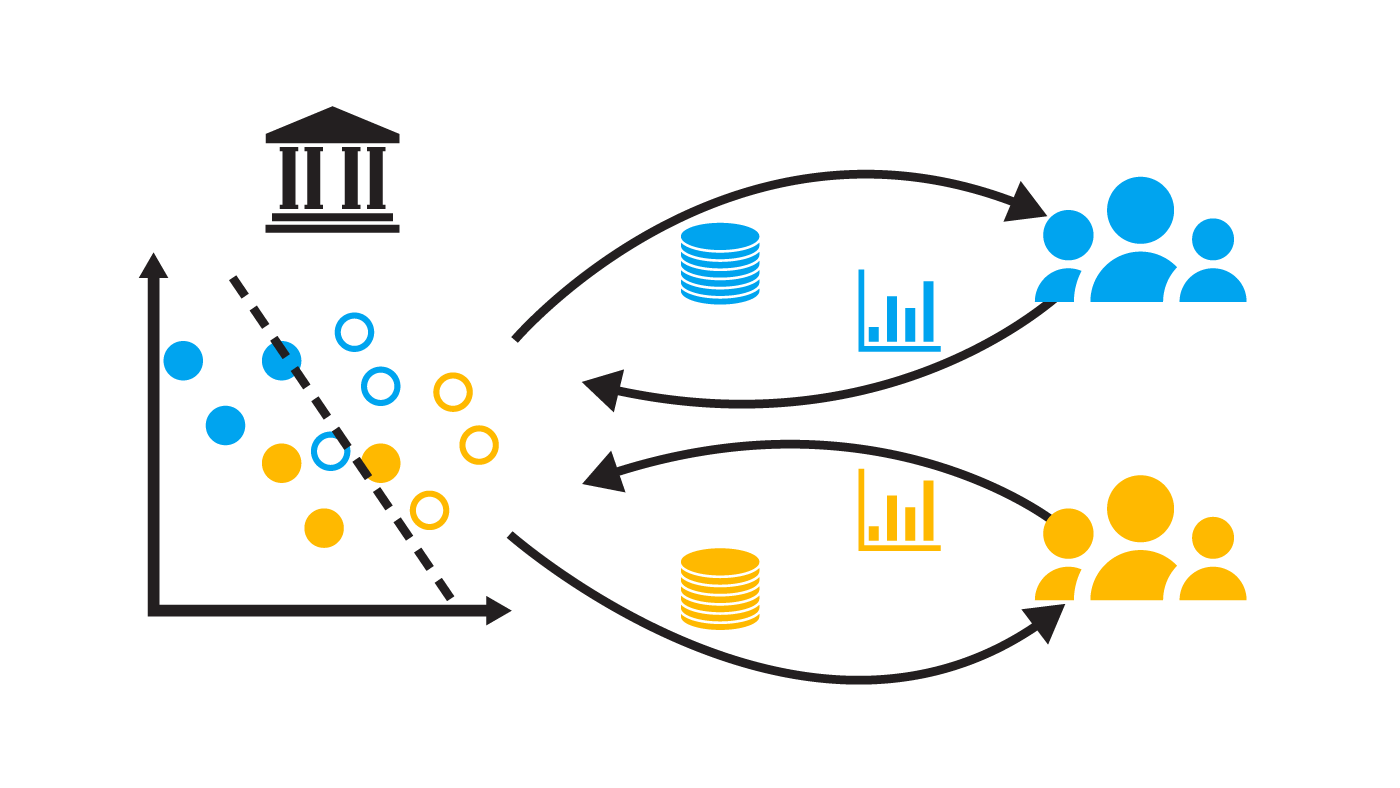
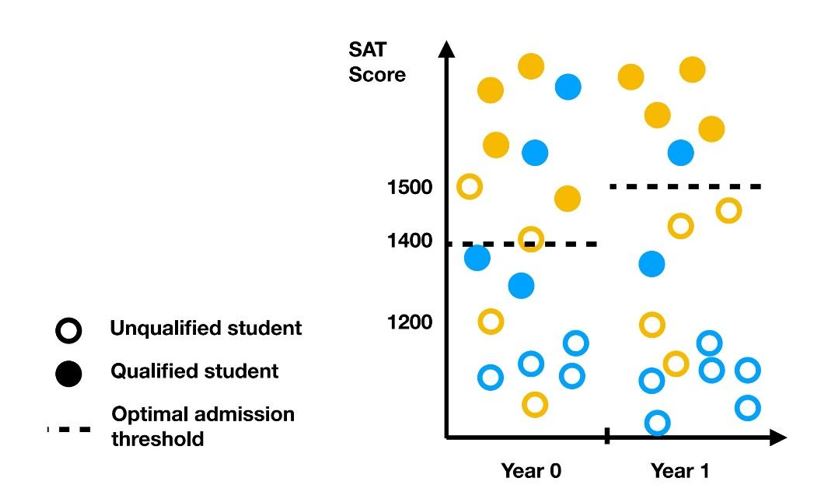
When the system is retrained on future data, it may become not less but more detrimental to historically disadvantaged groups. In order to build AI systems that are aligned with desirable long-term societal outcomes, we need to understand when and why such negative feedback loops occur, and we need to learn how to prevent them. When bias begets bias: A source of negative feedback loops in AI systems | Lydia T. Liu - University of California, Berkeley - Microsoft Research Blog
|
|
Unintended Feedback Loop - Filter Bubbles
YouTube search... ...Google search
In December 2009, Google began customizing its search results for all users, and we entered a new era of personalization. With little notice or fanfare, our online experience is changing, as the websites we visit are increasingly tailoring themselves to us. In this engaging and visionary book, MoveOn.org board president Eli Pariser lays bare the personalization that is already taking place on every major website, from Facebook to AOL to ABC News. As Pariser reveals, this new trend is nothing short of an invisible revolution in how we consume information, one that will shape how we learn, what we know, and even how our democracy works. The Filter Bubble | Eli Pariser
In news media, echo chamber is a metaphorical description of a situation in which beliefs are amplified or reinforced by communication and repetition inside a closed system. Filter Bubble | Wikipedia
|
|
|
|
Using the OODA Loop - Purple Team with Cybersecurity
YouTube search... ...Google search
- MITRE ATT&CK™
- The Cyber OODA Loop, How Your Attacker Should Help You Design Your Defense | Tony Sager - The Center for Internet Security - NIST
- The 4 Phases of Effective Incident Response Decision Making | Andrew Cook - Praetorian
- OODA and Cybersecurity | INFOSEC
- Red Team VS Blue Team: What’s The Difference? | Jason Firch - PurpleSec
- Purple Team: When Red and Blue Teams Work Together | Packetlabs
Modern security organizations create new capabilities within an overall cyber defense team by organizing themselves around a fundamental concept of an “OODA loop” — enabling teams to quickly make necessary decisions as they are responding to live or simulated incidents. ... Handling incidents effectively requires this sort of cyclical and quick decision making. In this quick-decision cycle, the IR team becomes the Blue Team, the “attackers” comprise the Red Team and run attack scenarios, and an even more novel third team called the Purple Team proactively hunts the attackers. This structure allows organizations to “train like they fight,” enabling them to prepare for increasingly more advanced adversarial techniques....Purple Teams help optimize security detection processes within an organization by reproducing attacks, determining if successful detection of these attacks occurred, and exposing existing deficiencies within the organization’s IR plan. Improving Cyber Defense by Purple Team using OODA loop | Ozren (Oz) Bogovac - Medium

|
|
OODA Loop - Security Approaches
YouTube search... ...Google search
|
|
