Difference between revisions of "Sequence to Sequence (Seq2Seq)"
| Line 16: | Line 16: | ||
* [[Attention]] Mechanism/[[Transformer]] Model | * [[Attention]] Mechanism/[[Transformer]] Model | ||
* [[NLP Keras model in browser with TensorFlow.js]] | * [[NLP Keras model in browser with TensorFlow.js]] | ||
| − | |||
* [http://towardsdatascience.com/nlp-sequence-to-sequence-networks-part-1-processing-text-data-d141a5643b72 NLP - Sequence to Sequence Networks - Part 1 - Processing text data | Mohammed Ma'amari - Towards Data Science] | * [http://towardsdatascience.com/nlp-sequence-to-sequence-networks-part-1-processing-text-data-d141a5643b72 NLP - Sequence to Sequence Networks - Part 1 - Processing text data | Mohammed Ma'amari - Towards Data Science] | ||
* [http://towardsdatascience.com/understanding-encoder-decoder-sequence-to-sequence-model-679e04af4346 Understanding Encoder-Decoder Sequence to Sequence Model | Simeon Kostadinov - Towards Data Science] | * [http://towardsdatascience.com/understanding-encoder-decoder-sequence-to-sequence-model-679e04af4346 Understanding Encoder-Decoder Sequence to Sequence Model | Simeon Kostadinov - Towards Data Science] | ||
| − | |||
* [[End-to-End Speech]] | * [[End-to-End Speech]] | ||
* [[Generative]] Modeling | * [[Generative]] Modeling | ||
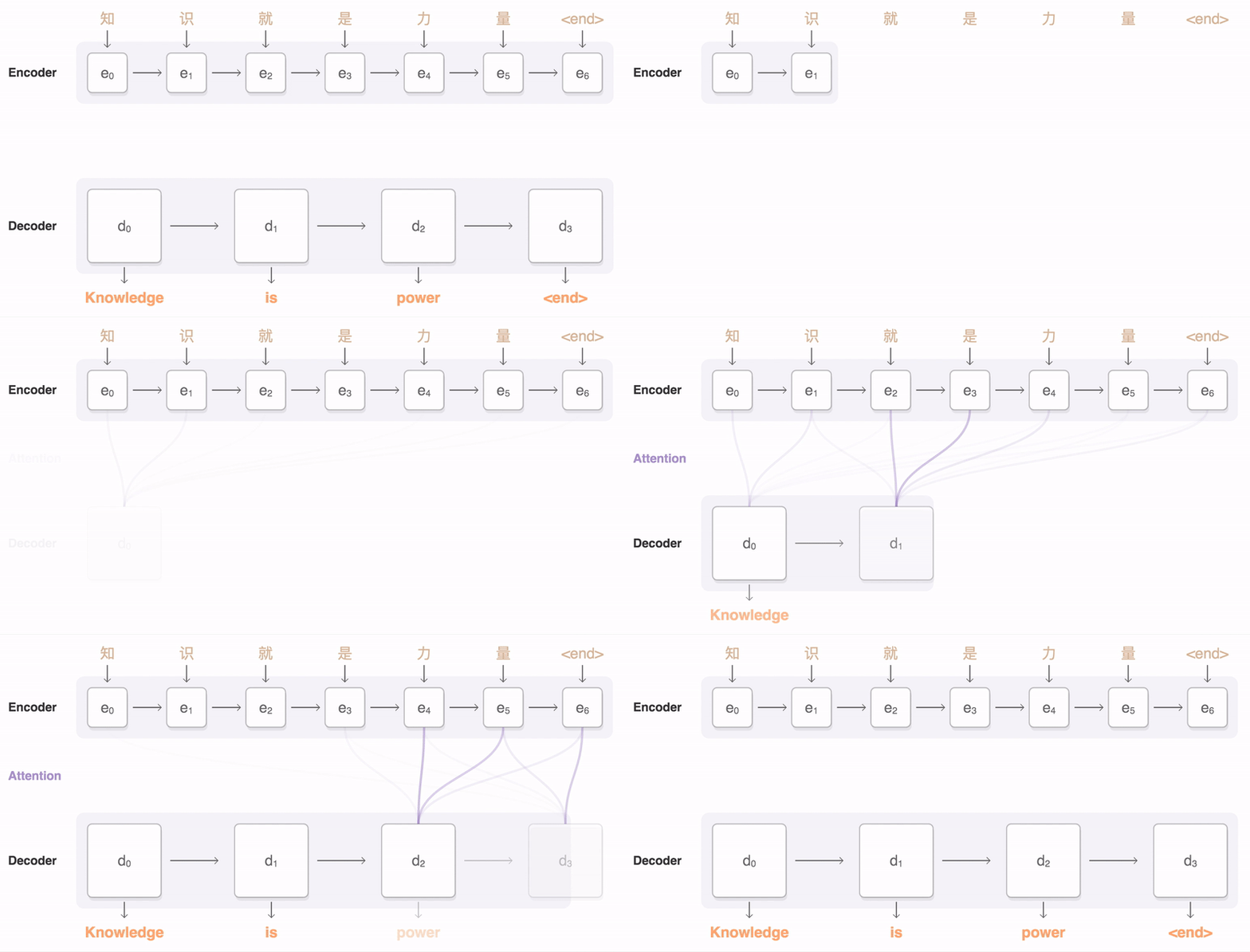
| − | a general-purpose encoder-decoder that can be used for machine translation, text summarization, conversational modeling, image captioning, interpreting dialects of software code, and more. | + | a general-purpose encoder-decoder that can be used for machine translation, text summarization, conversational modeling, image captioning, interpreting dialects of software code, and more. The encoder processes each item in the input sequence, it compiles the information it captures into a vector (called the context). After processing the entire input sequence, the encoder sends the context over to the decoder, which begins producing the output sequence item by item. The context is a vector (an array of numbers, basically) in the case of machine translation. The encoder and decoder tend to both be [[Recurrent Neural Network (RNN)]]. [http://jalammar.github.io/visualizing-neural-machine-translation-mechanics-of-seq2seq-models-with-attention/ Visualizing A Neural Machine Translation Model (Mechanics of Seq2seq Models With Attention) | Jay Alammar] |
http://3.bp.blogspot.com/-3Pbj_dvt0Vo/V-qe-Nl6P5I/AAAAAAAABQc/z0_6WtVWtvARtMk0i9_AtLeyyGyV6AI4wCLcB/s1600/nmt-model-fast.gif | http://3.bp.blogspot.com/-3Pbj_dvt0Vo/V-qe-Nl6P5I/AAAAAAAABQc/z0_6WtVWtvARtMk0i9_AtLeyyGyV6AI4wCLcB/s1600/nmt-model-fast.gif | ||
Revision as of 08:37, 11 June 2020
YouTube search... ...Google search
- Natural Language Processing (NLP)
- Open Seq2Seq | NVIDIA
- Recurrent Neural Network (RNN)
- Autoencoder (AE) / Encoder-Decoder
- Attention Models
- Assistants
- Attention Mechanism/Transformer Model
- NLP Keras model in browser with TensorFlow.js
- NLP - Sequence to Sequence Networks - Part 1 - Processing text data | Mohammed Ma'amari - Towards Data Science
- Understanding Encoder-Decoder Sequence to Sequence Model | Simeon Kostadinov - Towards Data Science
- End-to-End Speech
- Generative Modeling
a general-purpose encoder-decoder that can be used for machine translation, text summarization, conversational modeling, image captioning, interpreting dialects of software code, and more. The encoder processes each item in the input sequence, it compiles the information it captures into a vector (called the context). After processing the entire input sequence, the encoder sends the context over to the decoder, which begins producing the output sequence item by item. The context is a vector (an array of numbers, basically) in the case of machine translation. The encoder and decoder tend to both be Recurrent Neural Network (RNN). Visualizing A Neural Machine Translation Model (Mechanics of Seq2seq Models With Attention) | Jay Alammar
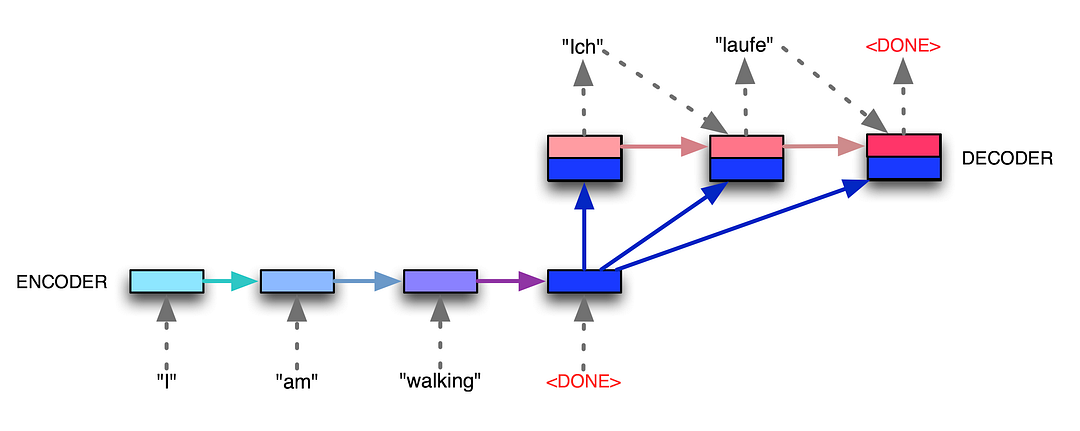
We essentially have two different recurrent neural networks tied together here — the encoder RNN (bottom left boxes) listens to the input tokens until it gets a special <DONE> token, and then the decoder RNN (top right boxes) takes over and starts generating tokens, also finishing with its own <DONE> token. The encoder RNN evolves its internal state (depicted by light blue changing to dark blue while the English sentence tokens come in), and then once the <DONE> token arrives, we take the final encoder state (the dark blue box) and pass it, unchanged and repeatedly, into the decoder RNN along with every single generated German token. The decoder RNN also has its own dynamic internal state, going from light red to dark red. Voila! Variable-length input, variable-length output, from a fixed-size architecture. seq2seq: the clown car of deep learning | Dev Nag - Medium