Decision Forest Regression
Decision trees are non-parametric models that perform a sequence of simple tests for each instance, traversing a binary tree data structure until a leaf node (decision) is reached. Decision trees have these advantages:
- They are efficient in both computation and memory usage during training and prediction.
- They can represent non-linear decision boundaries.
- They perform integrated feature selection and classification and are resilient in the presence of noisy features.
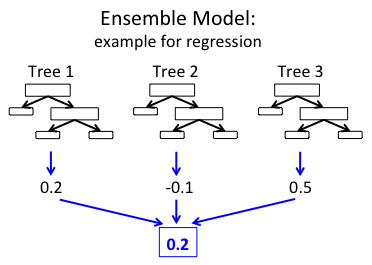
This regression model consists of an ensemble of decision trees. Each tree in a regression decision forest outputs a Gaussian distribution as a prediction. An aggregation is performed over the ensemble of trees to find a Gaussian distribution closest to the combined distribution for all trees in the model.