YouTube search...
...Google search
Brain Machine Interface (BMI) / Brain Computer Interface (BCI)
YouTube search...
...Google search
- Kernel ...Neuroscience as a Service (NaaS)
Researchers say they’ve built a system that can translate brain signals directly into text — a promising step toward a “speech prosthesis” that could effectively allow you to think text directly into a computer. Machine translation of cortical activity to text with an encoder–decoder framework | J. Makin, D. Moses, and E. Chang - Nature Neuroscience ...Scientists Debut System To Translate Thoughts Directly Into Text | Victor Tangermann - The Byte
Neuralink
YouTube search...
...Google search
Neuralink Corporation is an American neurotechnology company founded by Elon Musk and others, developing implantable brain–machine interfaces.

Brain to Brain Interface (BBI)
YouTube search...
...Google search
|
Mind Melds and Brain Beams: The Dawn of Brain-to-Brain Communication
Music students download the technique of their favorite pianist or singer directly into their brains. Medical students download the skills of a seasoned surgeon or diagnostician. And each one of us routinely uploads our thoughts and memories to the digital cloud. While these scenarios still lie in the future, rudimentary versions of the necessary brain-to-brain technology exist today. But the ability to directly influence another person’s brain raises serious questions about human rights and individual freedoms. This program will present the latest technology and explore how the ethical implications of enhanced thinking go to the heart of consciousness itself.
|
|
|
|
Human brain to brain communication has arrived | Giulio Ruffini | TEDxBarcelona
For the first time, information has been sent from one brain to another without the need to use invasive technology, i.e. without any cirurgical inventions. In the experiment, one person thought of a word ("Hola") and the second person could receive and decipher the signals to understand the word. Both persons were thousands of miles apart. This technology can already now help people with brain pathologies and - who knows - might become in some far future our preferred way of communication. Dr. Giulio Ruffini obtained his BA in mathematics and physics at the UC of Berkeley, and his PhD in Theoretic Physics at UC David/LANL. In 2000, he co-founded Starlab with the dream of transforming theoric science in technology with a real impact. Ten years later, he founded Neuroelectrics, marketing innovative products of brain stimulation that today could change the world of interpersonal communication as we know it. The 7.700 km which separates Strasburg and Thiruvananthapuram (India) didn’t prevent Ruffini and his team from achieving a transmition of a counscious message, from one brain to another in each city for the first time.
|
|
|
Miguel Nicolelis: Brain-to-brain communication has arrived. How we did it
<You may remember neuroscientist Miguel Nicolelis — he built the brain-controlled exoskeleton that allowed a paralyzed man to kick the first ball of the 2014 World Cup. What’s he working on now? Building ways for two minds (rats and monkeys, for now) to send messages brain to brain. Watch to the end for an experiment that, as he says, will go to "the limit of your imagination."
|
|
|
|
Dr. Miguel Nicolelis Explains Brain to Brain Interface Study Published in Scientific Reports
February 28, 2013
|
|
|
Brain-to-Brain Communication is Coming!
The paper "BrainNet: A Multi-Person Brain-to-Brain Interface for Direct Collaboration Between Brains" is available here:
https://arxiv.org/abs/1809.08632
|
|
|
|
Reporter Explains Brain-to-Brain Gaming in 3 Steps | Reporter's Notebook | WIRED
WIRED writer Louise Matsakis explains how she goes about covering a research paper on multi-person brain-to-brain interfaces. A brain interface is a way for people to communicate with each other only using their minds. Louise goes through all the steps she takes when prepping an article for WIRED.com, which includes: reading the research paper, checking the landscape, and contacting the researchers.
|
|
PEDOT
- PEDOT:PSS Interfaces Support the Development of Neuronal Synaptic Networks with Reduced Neuroglia Response In vitro | G. Cellot, P. Lagonegro, G. Tarabella, D. Scaini, F. Fabbri, S. Iannotta, M. Prato, G. Salviati, and L. Ballerini
- Chronic Intracortical Neural Recordings Using Microelectrode Arrays Coated With PEDOT-TFB | NeuroNexus
- Improving the performance of poly(3,4-ethylenedioxythiophene) for brain–machine interface applications | H.Mandala, G. Knaack, H. Charkhkar, D. McHail, J. Kastee, Theodore Dumas, N. Peixoto, J. Rubinson, and J. Pancrazio - ScienceDirect
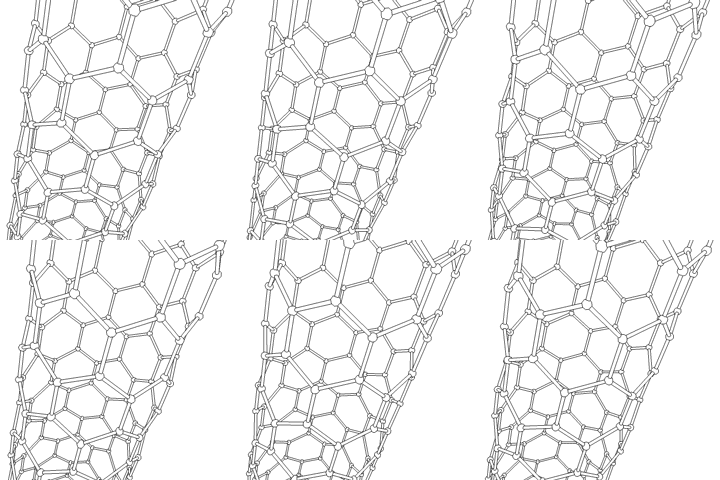
- Carbon Nanotube (CNT) | Wikipedia ...a molecular-scale structure consisting of carbon atoms arranged in one or more cylindrical layers, joined by covalent bonds in a hexagonal tiling pattern within each layer, so as to form a hollow tube
Connecting electronics to human tissue has been a major challenge due to traditional materials like gold, silicon and steel causing scarring when implanted....The polymer, known as a Pedot, has exactly the properties needed to interface electronic hardware with human tissue without causing scarring while also dramatically improving the performance of medical implants. ...The latest research used a Pedot film with an antibody that stimulates blood vessel growth after injury and could be used to detect early stages of tumour growth in the body. Pedot polymers could also be used to help sense or treat brain or nervous system disorders, while versions could theoretically attach peptides, antibodies and DNA. "Name your favorite biomolecule, and you can in principle make a Pedot film that has whatever biofunctional group you might be interested in," Dr. David Martin said. The researchers made a polymer with dopamine, which plays a role in addictive behaviors. Several companies and research institutions are already working on technology to connect brains to computers, with Elon Musk's Neuralink perhaps the closest to achieving a commercial product. The startup plans to reveal more details about its brain chips later this month, which could one day provide "full-bandwidth data streaming" to the brain through a USB-C cable.Groundbreaking New Material 'Could Allow Artificial Intelligence To Merge With The Human Brain' | Anthony Cuthbertson - Independent ...Technology could enable new health diagnostics and achieve Elon Musk's goal of integrating with artificial intelligence
poly(3,4-ethylenedioxythiophene) polystyrene sulfonate (PEDOT:PSS) is a polymer mixture of two ionomers. One component in this mixture is made up of sodium polystyrene sulfonate which is a sulfonated polystyrene. Part of the sulfonyl groups are deprotonated and carry a negative charge. The other component poly(3,4-ethylenedioxythiophene) (PEDOT) is a conjugated polymer and carries positive charges and is based on polythiophene. Together the charged macromolecules form a macromolecular salt. Wikipedia

Movies
|
A.I.187
Synopsis | The A.I. 187 chip which can revolutionize the inner workings of the human brain has been developed for the greater good, but falling in the wrong hands can be a weapon of mass destruction. Cast | Lance Henriksen, Paul Johansson, Thomas Dekker, Lindsey McKeon, Brad Rowe, David Andrews, Amber Wallace
|
|
