Difference between revisions of "Fuzzy C-Means (FCM)"
| Line 21: | Line 21: | ||
# Assign coefficients randomly to each data point for being in the clusters. | # Assign coefficients randomly to each data point for being in the clusters. | ||
# Repeat until the algorithm has converged (that is, the coefficients' change between two iterations is no more than E, the given sensitivity threshold) : | # Repeat until the algorithm has converged (that is, the coefficients' change between two iterations is no more than E, the given sensitivity threshold) : | ||
| − | + | ## Compute the centroid for each cluster. | |
| − | + | ## For each data point, compute its coefficients of being in the clusters. | |
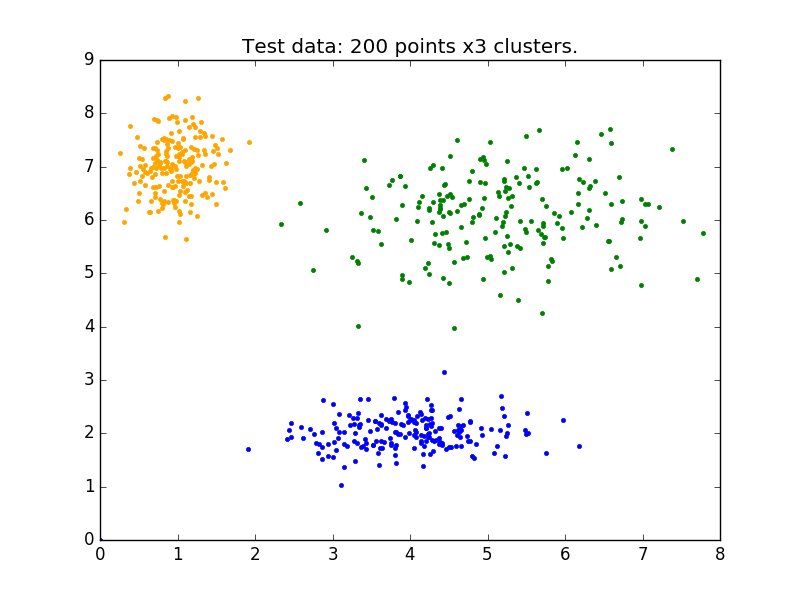
http://pythonhosted.org/scikit-fuzzy/_images/plot_cmeans_1.png | http://pythonhosted.org/scikit-fuzzy/_images/plot_cmeans_1.png | ||
Revision as of 20:04, 22 April 2019
YouTube search... ...Google search
- AI Solver
- Capabilities
- K-Means
- FCM: The fuzzy c-means clustering algorithm | J. Bezdek, R. Ehrlich, and W. Full - ScienceDirect
One of the most widely used fuzzy clustering algorithms is the Fuzzy C-means clustering (FCM) Algorithm. Fuzzy logic principles can be used to cluster multidimensional data, assigning each point a membership in each cluster center from 0 to 100 percent. This can be very powerful compared to traditional hard-thresholded clustering where every point is assigned a crisp, exact label.
The fuzzy c-means algorithm is very similar to the k-means algorithm:
- Choose a number of clusters.
- Assign coefficients randomly to each data point for being in the clusters.
- Repeat until the algorithm has converged (that is, the coefficients' change between two iterations is no more than E, the given sensitivity threshold) :
- Compute the centroid for each cluster.
- For each data point, compute its coefficients of being in the clusters.