Difference between revisions of "Topic Model/Mapping"
| Line 1: | Line 1: | ||
[http://www.youtube.com/results?search_query=topic+model+mapping+nlp+natural+language+semantics Youtube search...] | [http://www.youtube.com/results?search_query=topic+model+mapping+nlp+natural+language+semantics Youtube search...] | ||
| − | [http://www. | + | [http://www.youtube.com/results?search_query=%22topic+mapping%22+%22topic+model%22+machine+learning+nlp+natural+language+semantics+machine+learning+ML ...Google search] |
| + | |||
| + | * [[Latent Dirichlet Allocation (LDA)]] | ||
* [[Natural Language Processing (NLP)]] | * [[Natural Language Processing (NLP)]] | ||
* [http://www.crummy.com/software/BeautifulSoup/ Beautiful Soup] a Python library designed for quick turnaround projects like screen-scraping | * [http://www.crummy.com/software/BeautifulSoup/ Beautiful Soup] a Python library designed for quick turnaround projects like screen-scraping | ||
* [[Term Frequency–Inverse Document Frequency (TF-IDF)]] | * [[Term Frequency–Inverse Document Frequency (TF-IDF)]] | ||
* [[Probabilistic Latent Semantic Analysis (PLSA)]] | * [[Probabilistic Latent Semantic Analysis (PLSA)]] | ||
| − | * [[Latent | + | * [http://en.wikipedia.org/wiki/Topic_model Topic model | Wikipedia] |
| + | * [http://en.wikipedia.org/wiki/Hierarchical_Dirichlet_process Hierarchical Dirichlet Process | Wikipedia] | ||
| + | * [http://en.wikipedia.org/wiki/Latent_semantic_analysis Latent Semantic Analysis | Wikipedia] | ||
| + | * [http://en.wikipedia.org/wiki/Explicit_semantic_analysis Explicit semantic analysis | Wikipedia] | ||
| + | |||
| + | Topic modelling can be described as a method for finding a group of words (i.e topic) from a collection of documents that best represents the information in the collection. It can also be thought of as a form of text mining – a way to obtain recurring patterns of words in textual material. | ||
| − | In [[Natural Language Processing (NLP)]], | + | In machine learning and [[Natural Language Processing (NLP)]], a topic model is a type of statistical model for discovering the abstract "topics" that occur in a collection of documents. Topic modeling is a frequently used text-mining tool for discovery of hidden semantic structures in a text body. Intuitively, given that a document is about a particular topic, one would expect particular words to appear in the document more or less frequently: "dog" and "bone" will appear more often in documents about dogs, "cat" and "meow" will appear in documents about cats, and "the" and "is" will appear equally in both. |
| + | http://www.analyticsvidhya.com/wp-content/uploads/2016/08/Modeling1.png | ||
<youtube>BuMu-bdoVrU</youtube> | <youtube>BuMu-bdoVrU</youtube> | ||
| − | <youtube> | + | <youtube>fCmIceNqVog</youtube> |
| + | <youtube>1wcX4fEdNUo</youtube> | ||
| + | <youtube>DDq3OVp9dNA</youtube> | ||
| + | <youtube>UkmIljRIG_M</youtube> | ||
| + | <youtube>k-zkxdxyjTk</youtube> | ||
| + | |||
| + | == Topic Map == | ||
| + | * [http://en.wikipedia.org/wiki/Topic_map Topic Map | Wikipedia] | ||
| + | |||
| + | A topic map is a standard for the representation and interchange of knowledge, with an emphasis on the findability of information. Topic maps were originally developed in the late 1990s as a way to represent back-of-the-book index structures so that multiple indexes from different sources could be merged. However, the developers quickly realized that with a little additional generalization, they could create a meta-model with potentially far wider application. The ISO standard is formally known as ISO/IEC 13250:2003. | ||
| + | |||
| + | A topic map represents information using | ||
| + | |||
| + | * topics, representing any concept, from people, countries, and organizations to software modules, individual files, and events, | ||
| + | * associations, representing hypergraph relationships between topics, and | ||
| + | * occurrences, representing information resources relevant to a particular topic. | ||
| + | |||
| + | |||
| + | Topic maps are similar to concept maps and mind maps in many respects, though only topic maps are ISO standards. Topic maps are a form of semantic web technology similar to RDF. | ||
| + | |||
| + | http://upload.wikimedia.org/wikipedia/commons/f/f1/TopicMapKeyConcepts2.PNG | ||
Revision as of 23:44, 7 January 2019
Youtube search... ...Google search
- Latent Dirichlet Allocation (LDA)
- Natural Language Processing (NLP)
- Beautiful Soup a Python library designed for quick turnaround projects like screen-scraping
- Term Frequency–Inverse Document Frequency (TF-IDF)
- Probabilistic Latent Semantic Analysis (PLSA)
- Topic model | Wikipedia
- Hierarchical Dirichlet Process | Wikipedia
- Latent Semantic Analysis | Wikipedia
- Explicit semantic analysis | Wikipedia
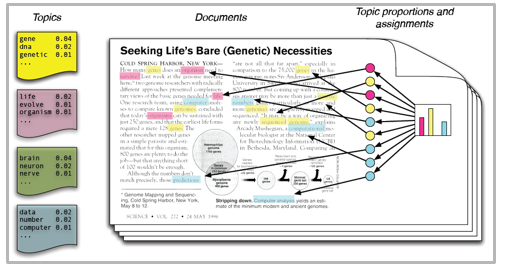
Topic modelling can be described as a method for finding a group of words (i.e topic) from a collection of documents that best represents the information in the collection. It can also be thought of as a form of text mining – a way to obtain recurring patterns of words in textual material.
In machine learning and Natural Language Processing (NLP), a topic model is a type of statistical model for discovering the abstract "topics" that occur in a collection of documents. Topic modeling is a frequently used text-mining tool for discovery of hidden semantic structures in a text body. Intuitively, given that a document is about a particular topic, one would expect particular words to appear in the document more or less frequently: "dog" and "bone" will appear more often in documents about dogs, "cat" and "meow" will appear in documents about cats, and "the" and "is" will appear equally in both.
Topic Map
A topic map is a standard for the representation and interchange of knowledge, with an emphasis on the findability of information. Topic maps were originally developed in the late 1990s as a way to represent back-of-the-book index structures so that multiple indexes from different sources could be merged. However, the developers quickly realized that with a little additional generalization, they could create a meta-model with potentially far wider application. The ISO standard is formally known as ISO/IEC 13250:2003.
A topic map represents information using
- topics, representing any concept, from people, countries, and organizations to software modules, individual files, and events,
- associations, representing hypergraph relationships between topics, and
- occurrences, representing information resources relevant to a particular topic.
Topic maps are similar to concept maps and mind maps in many respects, though only topic maps are ISO standards. Topic maps are a form of semantic web technology similar to RDF.

