Difference between revisions of "Fuzzy C-Means (FCM)"
m (Text replacement - "http:" to "https:") |
m |
||
| Line 2: | Line 2: | ||
|title=PRIMO.ai | |title=PRIMO.ai | ||
|titlemode=append | |titlemode=append | ||
| − | |keywords=artificial, intelligence, machine, learning, models | + | |keywords=ChatGPT, artificial, intelligence, machine, learning, GPT-4, GPT-5, NLP, NLG, NLC, NLU, models, data, singularity, moonshot, Sentience, AGI, Emergence, Moonshot, Explainable, TensorFlow, Google, Nvidia, Microsoft, Azure, Amazon, AWS, Hugging Face, OpenAI, Tensorflow, OpenAI, Google, Nvidia, Microsoft, Azure, Amazon, AWS, Meta, LLM, metaverse, assistants, agents, digital twin, IoT, Transhumanism, Immersive Reality, Generative AI, Conversational AI, Perplexity, Bing, You, Bard, Ernie, prompt Engineering LangChain, Video/Image, Vision, End-to-End Speech, Synthesize Speech, Speech Recognition, Stanford, MIT |description=Helpful resources for your journey with artificial intelligence; videos, articles, techniques, courses, profiles, and tools |
| − | |description=Helpful resources for your journey with artificial intelligence; videos, articles, techniques, courses, profiles, and tools | + | |
| + | <!-- Google tag (gtag.js) --> | ||
| + | <script async src="https://www.googletagmanager.com/gtag/js?id=G-4GCWLBVJ7T"></script> | ||
| + | <script> | ||
| + | window.dataLayer = window.dataLayer || []; | ||
| + | function gtag(){dataLayer.push(arguments);} | ||
| + | gtag('js', new Date()); | ||
| + | |||
| + | gtag('config', 'G-4GCWLBVJ7T'); | ||
| + | </script> | ||
}} | }} | ||
[https://www.youtube.com/results?search_query=Fuzzy+C+Means+clustering YouTube search...] | [https://www.youtube.com/results?search_query=Fuzzy+C+Means+clustering YouTube search...] | ||
| Line 10: | Line 19: | ||
* [[AI Solver]] | * [[AI Solver]] | ||
** [[...cluster]] | ** [[...cluster]] | ||
| − | |||
* [[K-Means]] | * [[K-Means]] | ||
| − | * [[Clustering]] | + | * [[Embedding]]: [[Agents#AI-Powered Search|Search]] ... [[Clustering]] ... [[Recommendation]] ... [[Anomaly Detection]] ... [[Classification]] ... [[Dimensional Reduction]] ... [[...find outliers]] |
* [https://www.sciencedirect.com/science/article/pii/0098300484900207 FCM: The fuzzy c-means clustering algorithm | J. Bezdek, R. Ehrlich, and W. Full - ScienceDirect] | * [https://www.sciencedirect.com/science/article/pii/0098300484900207 FCM: The fuzzy c-means clustering algorithm | J. Bezdek, R. Ehrlich, and W. Full - ScienceDirect] | ||
Revision as of 21:22, 7 July 2023
YouTube search... ...Google search
- AI Solver
- K-Means
- Embedding: Search ... Clustering ... Recommendation ... Anomaly Detection ... Classification ... Dimensional Reduction ... ...find outliers
- FCM: The fuzzy c-means clustering algorithm | J. Bezdek, R. Ehrlich, and W. Full - ScienceDirect
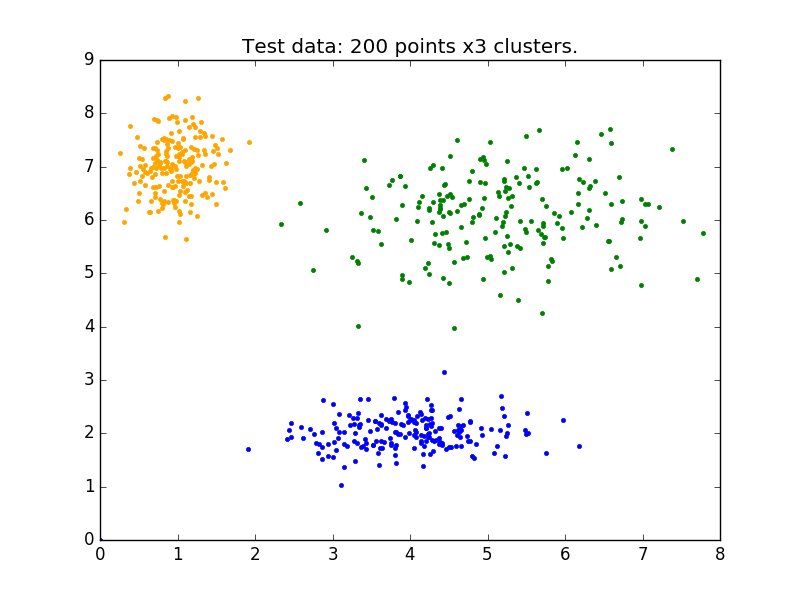
One of the most widely used fuzzy clustering algorithms is the Fuzzy C-means clustering (FCM) Algorithm. Fuzzy logic principles can be used to cluster multidimensional data, assigning each point a membership in each cluster center from 0 to 100 percent. This can be very powerful compared to traditional hard-thresholded clustering where every point is assigned a crisp, exact label.
The fuzzy c-means algorithm is very similar to the k-means algorithm:
- Choose a number of clusters.
- Assign coefficients randomly to each data point for being in the clusters.
- Repeat until the algorithm has converged (that is, the coefficients' change between two iterations is no more than E, the given sensitivity threshold) :
- Compute the centroid for each cluster.
- For each data point, compute its coefficients of being in the clusters.