Difference between revisions of "Radial Basis Function Network (RBFN)"
(→Adversarial Attack) |
|||
| Line 18: | Line 18: | ||
<youtube>Wzu2xwK-WnE</youtube> | <youtube>Wzu2xwK-WnE</youtube> | ||
| − | == Adversarial Attack == | + | == Adversarial Attack Resiliency == |
Watch 10:15 into the following video... | Watch 10:15 into the following video... | ||
| + | |||
<youtube>CIfsB_EYsVI</youtube> | <youtube>CIfsB_EYsVI</youtube> | ||
Revision as of 17:15, 28 June 2018
___________________________________________________
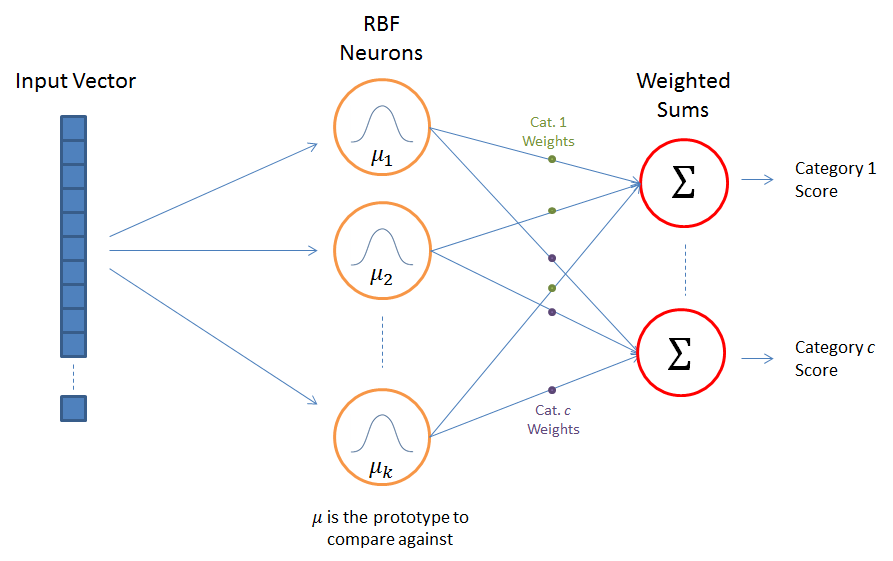
Performs classification by measuring the input’s similarity to examples from the training set. Each RBFN neuron stores a “prototype”, which is just one of the examples from the training set. When we want to classify a new input, each neuron computes the Euclidean distance between the input and its prototype. Roughly speaking, if the input more closely resembles the class A prototypes than the class B prototypes, it is classified as class A. Radial Basis Function Network (RBFN) Tutorial | Chris McCormick
Note: Support Vector Machine (SVM) represent a special case of RBFNs.
As a non-linear classifier...
Adversarial Attack Resiliency
Watch 10:15 into the following video...
