Difference between revisions of "Connecting Brains"
m (→Brain Machine Interface (BMI) / Brain Computer Interface (BCI)) |
m (→Brain Machine Interface (BMI) / Brain Computer Interface (BCI)) |
||
| Line 33: | Line 33: | ||
|| | || | ||
<youtube>CgFzmE2fGXA</youtube> | <youtube>CgFzmE2fGXA</youtube> | ||
| − | <b> | + | <b>New Brain Computer interface technology | Steve Hoffman | TEDxCEIBS |
| − | </b><br> | + | </b><br>Brain Computer interface technology opens up a world of possibilities. We are on the cusp of this technology that is so powerful and has the potential to so radically transform our lives and existence! After starting three venture-funded startups in Silicon Valley, Steven Hoffman, known as Captial Hoff, launched Founders Space with the mission to educate and accelerate entrepreneurs and intrapreneur. Founder Space has become one of the top startup accelerators in the world with over 50 partners in 22 countries. This talk was given at a TEDx event using the TED conference format but independently organized by a local community. |
|} | |} | ||
|<!-- M --> | |<!-- M --> | ||
| Line 41: | Line 41: | ||
|| | || | ||
<youtube>gM7YPFa34Po</youtube> | <youtube>gM7YPFa34Po</youtube> | ||
| − | <b> | + | <b>Thomas Oxley on the revolutionary stentrode device |
| − | </b><br> | + | </b><br>Dr Thomas Oxley is the brainchild behind the stentrode device. The stentrode can record brain signals from within a blood vessel. These thoughts are captured, decoded and passed wirelessly through the skin to enable control of an external device, such as a prosthetic limb. |
|} | |} | ||
|}<!-- B --> | |}<!-- B --> | ||
| Line 50: | Line 50: | ||
|| | || | ||
<youtube>nvUHDK59Igw</youtube> | <youtube>nvUHDK59Igw</youtube> | ||
| − | <b> | + | <b>Direct Neural Interface & DARPA - Dr Justin Sanchez |
| − | </b><br> | + | </b><br>The future of mind-controlled machines might not be as far away as we think. As director of DARPA’s Biological Technologies Office, Dr Justin Sanchez is part of a team that is looking at how to decode brain signals and use them to control robotic prosthetics. His research includes the [[Visualization]] and decoding of brain activity, the development of devices that could help patients with memory deficits, and advanced prosthetic arm systems that could restore feeling and movement after an injury. The former associate professor of Biomedical Engineering and Neuroscience at the University of Miami has also looked at the potential of neurotechnology for treating paralysis, Tourette’s Syndrome and Obsessive Compulsive Disorder. |
|} | |} | ||
|<!-- M --> | |<!-- M --> | ||
| Line 58: | Line 58: | ||
|| | || | ||
<youtube>PVuSHjeh1Os</youtube> | <youtube>PVuSHjeh1Os</youtube> | ||
| − | <b> | + | <b>The Direct Human/Machine Interface and Hints of a General Artificial Intelligence |
| − | </b><br> | + | </b><br>Dr. Phillip Alvelda, Wiseteachers.com, former DARPA PM Dr. Alvelda’s talk discusses the latest and future developments in Brain-Machine Interface technology, and how new discoveries and interdisciplinary work in neuroscience are driving new extensions to information theory and computing architectures. While most of the current work focuses on applications such as artificial limbs for the disabled, in the future this technology is likely to be much more widespread. |
|} | |} | ||
|}<!-- B --> | |}<!-- B --> | ||
| Line 67: | Line 67: | ||
|| | || | ||
<youtube>hIh2BR8viCY</youtube> | <youtube>hIh2BR8viCY</youtube> | ||
| − | <b> | + | <b>Brain-computer interfaces: two concurrent learning problems - Maureen Clerc |
| − | </b><br> | + | </b><br>Conférence de Maureen Clerc lors du colloquium Data Science Colloquium of the ENS ► http://savoirs.ens.fr/expose.php?id=3298 Brain-Computer Interfaces (BCI) are systems which provide real-time interaction through brain activity, bypassing traditional interfaces such as keyboard or mouse. A target application of BCI is to restore mobility or autonomy to severely disabled patients. In BCI, new modes of perception and interaction come into play, which users must learn, just as infants learn to explore their sensorimotor system. Feedback is central in this learning. From the point of view of the system, features must be extracted from the brain activity, and translated into commands. Feature extraction and classification issues, are important components of a BCI. Adaptive learning strategies, because of the high variability of the brain signals. Moreoever, additional markers may also be extracted to modulate the system's behavior. It is for instance possible to monitor the brain's reaction to the BCI outcome. In this talk I will present some of the current machine learning methods which are used in BCI, and the adaptation of BCI to users' needs. |
|} | |} | ||
|<!-- M --> | |<!-- M --> | ||
| Line 75: | Line 75: | ||
|| | || | ||
<youtube>6Qi5uoNYXqg</youtube> | <youtube>6Qi5uoNYXqg</youtube> | ||
| − | <b> | + | <b>Rethinking the Brain Machine Interface | Polina Anikeeva | TEDxCambridge |
| − | </b><br> | + | </b><br>The way humans interact with computers has evolved from punch cards, to the keyboard and mouse, to much more sophisticated user interfaces, but the kinds of connections imagined in movies like The Matrix, Avatar or Pacific Rim still seem like science fiction. Polina Anikeeva is working to turn fiction into fact, not to help with virtual reality technology, but to help amputees restore full functionality to prosthetic limbs - not just to control the muscles, but to be able to feel and touch again. To achieve this, you need the precision of a virtuoso pianist to connect neural tissue to the prosthetic limb. The key to this precision is finding the right materials. Dr. Polina Anikeeva is an assistant professor of Materials Science and Engineering at MIT and a principle investigator of the Bioelectronics group. Her research lies in the field of neuroprosthetics and brain-machine interfaces. |
|} | |} | ||
|}<!-- B --> | |}<!-- B --> | ||
| Line 84: | Line 84: | ||
|| | || | ||
<youtube>q7ZTb56dtv8</youtube> | <youtube>q7ZTb56dtv8</youtube> | ||
| − | <b> | + | <b>Brain-Computer Interfaces |
| − | </b><br> | + | </b><br>We could one day control our devices with our thoughts. |
|} | |} | ||
|<!-- M --> | |<!-- M --> | ||
| Line 92: | Line 92: | ||
|| | || | ||
<youtube>PVXQUItNEDQ</youtube> | <youtube>PVXQUItNEDQ</youtube> | ||
| − | <b> | + | <b>Ray Kurzweil: Get ready for hybrid thinking |
| − | </b><br> | + | </b><br>Two hundred million years ago, our mammal ancestors developed a new brain feature: the neocortex. This stamp-sized piece of tissue (wrapped around a brain the size of a walnut) is the key to what humanity has become. Now, futurist Ray Kurzweil suggests, we should get ready for the next big leap in brain power, as we tap into the computing power in the cloud. |
|} | |} | ||
|}<!-- B --> | |}<!-- B --> | ||
| Line 101: | Line 101: | ||
|| | || | ||
<youtube>C_jHS2cdibU</youtube> | <youtube>C_jHS2cdibU</youtube> | ||
| − | <b> | + | <b>fNIRS and Brain Computer Interfaces for Communication |
| − | </b><br> | + | </b><br>An essential webinar for all BCI researchers: fNIRS enables the read out of voluntarily controlled brain states in real time and opens a communication channel with completely locked-in patients, otherwise isolated from the external world. |
|} | |} | ||
|<!-- M --> | |<!-- M --> | ||
| Line 109: | Line 109: | ||
|| | || | ||
<youtube>YUVLgccVi54</youtube> | <youtube>YUVLgccVi54</youtube> | ||
| − | <b> | + | <b>eep Learning with Ensembles of Neocortical Microcircuits - Dr. Blake Richards |
| − | </b><br> | + | </b><br>Dr. Blake Richards is an Assistant Professor at the University of Toronto and Associate Fellow of the Canadian Institute for Advanced Research (CIFAR). Recorded May 2nd, 2018 at ICLR2018 |
|} | |} | ||
|}<!-- B --> | |}<!-- B --> | ||
| Line 118: | Line 118: | ||
|| | || | ||
<youtube>w7Wkerar00E</youtube> | <youtube>w7Wkerar00E</youtube> | ||
| − | <b> | + | <b>The Intelligence Revolution: Coupling AI and the Human Brain | Ed Boyden |
| − | </b><br> | + | </b><br>Edward Boyden is a Hertz Foundation Fellow and recipient of the prestigious Hertz Foundation Grant for graduate study in the applications of the physical, biological and engineering sciences. A professor of Biological Engineering and Brain and Cognitive Sciences at MIT, Edward Boyden explains how humanity is only at its infancy in merging with machines. His work is leading him towards the development of a "brain co-processor", a device that interacts intimately with the brain to upload and download information to and from it, augmenting human capabilities in memory storage, decision making, and cognition. The first step, however, is understanding the brain on a much deeper level. With the support of the Fannie and John Hertz Foundation, Ed Boyden pursued a PhD in neurosciences from Stanford University |
|} | |} | ||
|<!-- M --> | |<!-- M --> | ||
| Line 126: | Line 126: | ||
|| | || | ||
<youtube>7t84lGE5TXA</youtube> | <youtube>7t84lGE5TXA</youtube> | ||
| − | <b> | + | <b>Brain-Computer Interface - Mysteries of the Brain |
| − | </b><br> | + | </b><br>Neuroengineer Rajesh Rao of the University of Washington is developing brain-computer interfaces, devices that can monitor and extract brain activity to enable a machine or computer to accomplish tasks, from playing video games to controlling a prosthetic arm. "Mysteries of the Brain" is produced by NBC Learn in partnership with the NSF. |
|} | |} | ||
|}<!-- B --> | |}<!-- B --> | ||
| Line 135: | Line 135: | ||
|| | || | ||
<youtube>_6oNoLWcDqw</youtube> | <youtube>_6oNoLWcDqw</youtube> | ||
| − | <b> | + | <b>This Brain Implant Could Change Lives |
| − | </b><br> | + | </b><br>It sounds like science fiction: a device that can reconnect a paralyzed person’s brain to his or her body. But that’s exactly what the experimental NeuroLife system does. Developed by Battelle and Ohio State University, NeuroLife uses a brain implant, an algorithm and an electrode sleeve to give paralysis patients back control of their limbs. For Ian Burkhart, NeuroLife’s first test subject, the implications could be life-changing. |
|} | |} | ||
|<!-- M --> | |<!-- M --> | ||
| Line 143: | Line 143: | ||
|| | || | ||
<youtube>UiRH6V-NXuM</youtube> | <youtube>UiRH6V-NXuM</youtube> | ||
| − | <b> | + | <b>Consumer Brain-Computer Interfaces: From Science Fiction to Reality |
| − | </b><br> | + | </b><br>Current communication technologies often suffer from being impersonal and non-contextual. Using on-body sensors for implicit or explicit sensing to transfer information, sense context, cognitive states, attention or engagement, open the possibility to enhance technologies for improving mental well-being of a person, help a person with the tasks on-hand but also to connect people. In this talk we will explore the opportunities provided by the systems known as Brain-Computer Interfaces, which use physiological sensors to measure brain activity (like Electroencephalography - EEG), for building seamless, novel and embodied communication systems using several concrete examples among which: applications for direct control of robots, applications to derive users’ intents, applications for attention measurement and cognitive enhancement. |
|} | |} | ||
|}<!-- B --> | |}<!-- B --> | ||
| Line 152: | Line 152: | ||
|| | || | ||
<youtube>IKSVgja-AYU</youtube> | <youtube>IKSVgja-AYU</youtube> | ||
| − | <b> | + | <b>Brain Machine Interfaces: from basic science to neuroprostheses and neurological recovery |
| − | </b><br> | + | </b><br>Miguel Nicolelis, M.D., Ph.D., is the Duke School of Medicine Distinguished Professor of Neuroscience at Duke University, Professor of Neurobiology, Biomedical Engineering, Neurology, Neurosurgery and Psychology and Neuroscience, and founder of Duke's Center for Neuroengineering. He is Founder and Scientific Director of the Edmond and Lily Safra International Institute for Neuroscience of Natal. Dr. Nicolelis is also founder of the Walk Again Project, an international consortium of scientists and engineers, dedicated to the development of an exoskeleton device to assist severely paralyzed patients in regaining full body mobility. |
|} | |} | ||
|<!-- M --> | |<!-- M --> | ||
| Line 160: | Line 160: | ||
|| | || | ||
<youtube>IWAe_mdTslc</youtube> | <youtube>IWAe_mdTslc</youtube> | ||
| − | <b> | + | <b>Bryan Johnson & Neural Interfaces | Siraj Raval Podcast #1 |
| − | </b><br> | + | </b><br>On the first episode of my educational podcast, I have a very special guest for you! Bryan Johnson is an entrepreneur and venture capitalist that sold his payments company, Braintree, to Paypal for $800 million. What makes him someone I admire is how he decided to use that amount of wealth to improve human life through Science and technology. He invested $100 million into Kernel, a neuroscience startup that he leads and another $100 million into OS Fund, a venture fund that invests in scientist entrepreneurs. He's also an avid reader, which made for an amazing conversation. We touch on Artificial Intelligence, Science, mathematical mindsets, books, psychedelics, and so much more in this discussion. Enjoy! |
|} | |} | ||
|}<!-- B --> | |}<!-- B --> | ||
| Line 169: | Line 169: | ||
|| | || | ||
<youtube>5YxzWnbqaJI</youtube> | <youtube>5YxzWnbqaJI</youtube> | ||
| − | <b> | + | <b>Why is Elon Musk Connecting Brains to the Internet? |
| − | </b><br> | + | </b><br>Let's talk Brain Computer Interfaces. BCI's are the next step in human evolution, they are the inevitable upgrade we'll need after the age of smartphones. If done right, they can help us fulfill our wildest fantasies. We'll be able to learn anything, experience anything, and be anywhere in seconds. I'll discuss the philosophical, theoretical, and technical aspects behind the idea. |
|} | |} | ||
|<!-- M --> | |<!-- M --> | ||
| Line 177: | Line 177: | ||
|| | || | ||
<youtube>HhXg6568I3E</youtube> | <youtube>HhXg6568I3E</youtube> | ||
| − | <b> | + | <b>Brain Computer Interfaces |
| − | </b><br> | + | </b><br>I've laid out the blueprint for a brain computer interface called "The Link". This is a device that uses DNA for processing and storage, temporal interference to alter brain states, and infrared spectroscopy to read brain states. Its powered using your body heat, noninvasive, and waterproof. This device is just a thought experiment, but real companies are working on this technology today. What does this kind of technology entail for privacy? Will there be an intelligence disparity? What role does AI play in all of this? What does it even mean to be human? I tackle these hard questions and give a technical overview of this device in this video. Enjoy! |
|} | |} | ||
|}<!-- B --> | |}<!-- B --> | ||
Revision as of 22:06, 23 August 2020
YouTube search... ...Google search
- Case Studies
- Neuroscience
- Molecular Artificial Intelligence (AI)
- Bio-inspired Computing
- Metaverse
- Artificial intelligence turns brain activity into speech | Kelly Servick
- 29 Neurotech Companies Interfacing With Your Brain | Nanalyze
- CTRL-labs Uses AI for Brain-Computer Interface | Nanalyze
- Synchron – A Brain Computer Interface Using Stentrodes | Nanalyze
- Brain-Computer Interfaces (BCI) | Singularity Hub
Contents
Brain Machine Interface (BMI) / Brain Computer Interface (BCI)
YouTube search... ...Google search
- Kernel ...Neuroscience as a Service (NaaS)
Researchers say they’ve built a system that can translate brain signals directly into text — a promising step toward a “speech prosthesis” that could effectively allow you to think text directly into a computer. Machine translation of cortical activity to text with an encoder–decoder framework | J. Makin, D. Moses, and E. Chang - Nature Neuroscience ...Scientists Debut System To Translate Thoughts Directly Into Text | Victor Tangermann - The Byte
|
|
|
|
|
|
|
|
|
|
|
|
|
|
|
|
|
|
Neuralink
YouTube search... ...Google search
- Neuralink Homepage
- Neuralink | Wikipedia
- Neuralink Progress Update: What To Know About Elon Musk's Major Event | Inverse
Neuralink Corporation is an American neurotechnology company founded by Elon Musk and others, developing implantable brain–machine interfaces.

|
|
|
|
|
|
Brain to Brain Interface (BBI)
YouTube search... ...Google search
- Scientists Demonstrate Direct Brain-to-Brain Communication in Humans | Robert Martone - Scientific American ...Work on an “Internet of brains” takes another step
|
|
|
|
|
|
PEDOT
- PEDOT:PSS Interfaces Support the Development of Neuronal Synaptic Networks with Reduced Neuroglia Response In vitro | G. Cellot, P. Lagonegro, G. Tarabella, D. Scaini, F. Fabbri, S. Iannotta, M. Prato, G. Salviati, and L. Ballerini
- Chronic Intracortical Neural Recordings Using Microelectrode Arrays Coated With PEDOT-TFB | NeuroNexus
- Improving the performance of poly(3,4-ethylenedioxythiophene) for brain–machine interface applications | H.Mandala, G. Knaack, H. Charkhkar, D. McHail, J. Kastee, Theodore Dumas, N. Peixoto, J. Rubinson, and J. Pancrazio - ScienceDirect
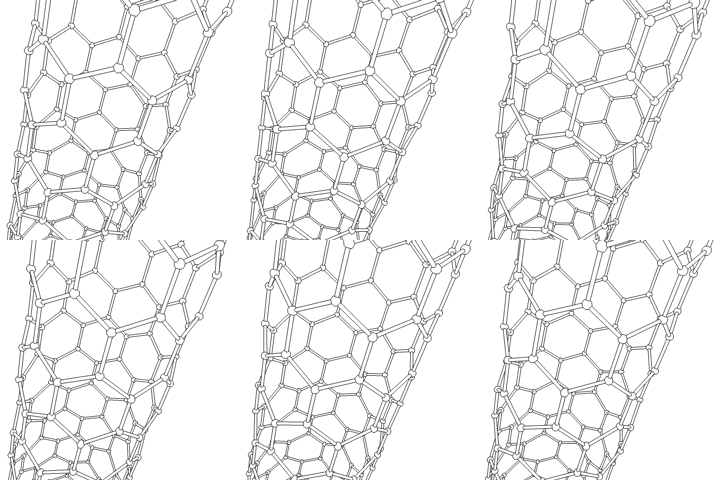
- Carbon Nanotube (CNT) | Wikipedia ...a molecular-scale structure consisting of carbon atoms arranged in one or more cylindrical layers, joined by covalent bonds in a hexagonal tiling pattern within each layer, so as to form a hollow tube
Connecting electronics to human tissue has been a major challenge due to traditional materials like gold, silicon and steel causing scarring when implanted....The polymer, known as a Pedot, has exactly the properties needed to interface electronic hardware with human tissue without causing scarring while also dramatically improving the performance of medical implants. ...The latest research used a Pedot film with an antibody that stimulates blood vessel growth after injury and could be used to detect early stages of tumour growth in the body. Pedot polymers could also be used to help sense or treat brain or nervous system disorders, while versions could theoretically attach peptides, antibodies and DNA. "Name your favorite biomolecule, and you can in principle make a Pedot film that has whatever biofunctional group you might be interested in," Dr. David Martin said. The researchers made a polymer with dopamine, which plays a role in addictive behaviors. Several companies and research institutions are already working on technology to connect brains to computers, with Elon Musk's Neuralink perhaps the closest to achieving a commercial product. The startup plans to reveal more details about its brain chips later this month, which could one day provide "full-bandwidth data streaming" to the brain through a USB-C cable.Groundbreaking New Material 'Could Allow Artificial Intelligence To Merge With The Human Brain' | Anthony Cuthbertson - Independent ...Technology could enable new health diagnostics and achieve Elon Musk's goal of integrating with artificial intelligence
poly(3,4-ethylenedioxythiophene) polystyrene sulfonate (PEDOT:PSS) is a polymer mixture of two ionomers. One component in this mixture is made up of sodium polystyrene sulfonate which is a sulfonated polystyrene. Part of the sulfonyl groups are deprotonated and carry a negative charge. The other component poly(3,4-ethylenedioxythiophene) (PEDOT) is a conjugated polymer and carries positive charges and is based on polythiophene. Together the charged macromolecules form a macromolecular salt. Wikipedia

Movies
|
