Difference between revisions of "Natural Language Generation (NLG)"
| Line 43: | Line 43: | ||
** [http://yseop.com/ yseop] | ** [http://yseop.com/ yseop] | ||
| + | [http://www.e-spirit.com/us/blog/natural_language_generation_the_future_of_content_management.html Benefits of Using Natural Language Generation (NGL):] | ||
| + | |||
| + | * Deliver Better Digital Experiences at Scale - benefits from high-quality, personalized copy that no human author would create ad hoc or cost efficiently. This helps get better search engine visibility leading to an increase in organic traffic, while also increasing engagement and dwell time. | ||
| + | * Reduce Spend while Driving Efficiency - content authors are relieved from repetitive, routine tasks and can focus on their other projects, with more time for creativity, strategy, and exploration. Meanwhile, the organization can increase content output without additional human resources. It can also minimize translation costs, as multiple output languages can be generated simultaneously. | ||
| + | * Increase Content Quality - ensures that spelling, grammar, and structure are correct without the need for review and approval. It also supports the use of the corporate verbal brand as it relates to specific words, voice, and tone. | ||
Natural-language generation (NLG) is the natural-language processing task of generating natural language from a machine-representation system such as a knowledge base or a logical form. Psycholinguists prefer the term language production when such formal representations are interpreted as models for mental representations. It could be said an NLG system is like a translator that converts data into a natural-language representation. However, the methods to produce the final language are different from those of a compiler due to the inherent expressivity of natural languages. ...NLG may be viewed as the opposite of natural-language understanding: whereas in natural-language understanding, the system needs to disambiguate the input sentence to produce the machine representation language, in NLG the system needs to make decisions about how to put a concept into words. [http://en.wikipedia.org/wiki/Natural-language_generation Wikipedia] | Natural-language generation (NLG) is the natural-language processing task of generating natural language from a machine-representation system such as a knowledge base or a logical form. Psycholinguists prefer the term language production when such formal representations are interpreted as models for mental representations. It could be said an NLG system is like a translator that converts data into a natural-language representation. However, the methods to produce the final language are different from those of a compiler due to the inherent expressivity of natural languages. ...NLG may be viewed as the opposite of natural-language understanding: whereas in natural-language understanding, the system needs to disambiguate the input sentence to produce the machine representation language, in NLG the system needs to make decisions about how to put a concept into words. [http://en.wikipedia.org/wiki/Natural-language_generation Wikipedia] | ||
Revision as of 11:57, 1 January 2020
Youtube search... ...Google search
- Natural Language Processing (NLP)
- The Future of Writing, With Robots | Garrett Grams
- Using Natural Language Processing for Smart Question Generation | Aditya S -Intel AI Academy
- Neural text generation: How to generate text using conditional language models | Neil Yager
- Narrative Science Systems: A Review | P. Sarao, P. Mittal, R. Kaur
- Generative Pre-trained Transformer-2 (GPT-2)
- Natural Language Generation: The Future of Content Management | Heidi Unruh - e-Sprint
- Companies:
- Abodit Natural Language Engine for .NET
- Arria
- Article Forge
- Automated Insights Wordsmith
- AX Semantics
- Digital Reasoning
- EY Ernst & Young Global Limited
- IBM Cognos Analytics
- Labsense
- Linguastat
- Marlabs mAdvisor
- Microsoft Semantic Machines
- Narrative Science Quill
- OnlyBoth
- Outlier
- PhraseTech
- Retresco
- Salesforce Einstein Analytics platform
- SAP Analytics Cloud
- Specifio
- Syllabs
- textengine.io
- Textio
- vPhrase Phrazor
- yseop
Benefits of Using Natural Language Generation (NGL):
- Deliver Better Digital Experiences at Scale - benefits from high-quality, personalized copy that no human author would create ad hoc or cost efficiently. This helps get better search engine visibility leading to an increase in organic traffic, while also increasing engagement and dwell time.
- Reduce Spend while Driving Efficiency - content authors are relieved from repetitive, routine tasks and can focus on their other projects, with more time for creativity, strategy, and exploration. Meanwhile, the organization can increase content output without additional human resources. It can also minimize translation costs, as multiple output languages can be generated simultaneously.
- Increase Content Quality - ensures that spelling, grammar, and structure are correct without the need for review and approval. It also supports the use of the corporate verbal brand as it relates to specific words, voice, and tone.
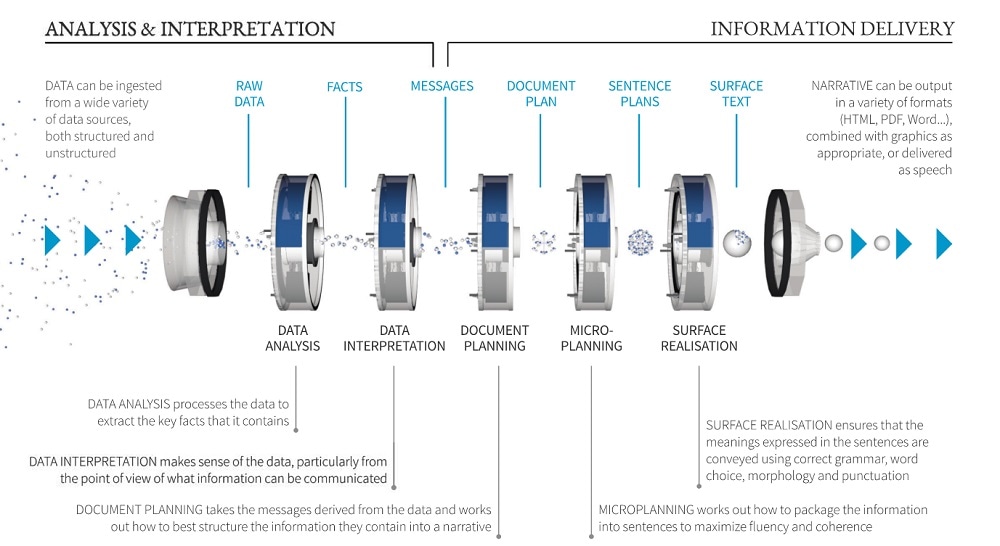
Natural-language generation (NLG) is the natural-language processing task of generating natural language from a machine-representation system such as a knowledge base or a logical form. Psycholinguists prefer the term language production when such formal representations are interpreted as models for mental representations. It could be said an NLG system is like a translator that converts data into a natural-language representation. However, the methods to produce the final language are different from those of a compiler due to the inherent expressivity of natural languages. ...NLG may be viewed as the opposite of natural-language understanding: whereas in natural-language understanding, the system needs to disambiguate the input sentence to produce the machine representation language, in NLG the system needs to make decisions about how to put a concept into words. Wikipedia

Mapping the Field of Algorithmic Journalism | Konstantin N. Dörr

- Artificial intelligence in healthcare: an interview with Dr Ehud Reiter | News Medical Life Sciences
- Arria NLG Engine
Augmented Analytics
Youtube search... ...Google search
- Gartner Identifies Top 10 Data and Analytics Technology Trends for 2019 | Susan Moore - Gartner
- NLP for Analytics: It's Not Just About Text | Lisa Morgan - InformationWeek
An augmented analytics engine can automatically go through a company’s data, clean it, analyze it, and convert these insights into action steps for the executives or marketers with little to no supervision from a technical person. Augmented analytics therefore can make analytics accessible to all SMB owners. Augmented Analytics Demystified | Bill Su - Medium
