Difference between revisions of "Fuzzy C-Means (FCM)"
m (Text replacement - "http:" to "https:") |
|||
| Line 5: | Line 5: | ||
|description=Helpful resources for your journey with artificial intelligence; videos, articles, techniques, courses, profiles, and tools | |description=Helpful resources for your journey with artificial intelligence; videos, articles, techniques, courses, profiles, and tools | ||
}} | }} | ||
| − | [ | + | [https://www.youtube.com/results?search_query=Fuzzy+C+Means+clustering YouTube search...] |
| − | [ | + | [https://www.google.com/search?q=Fuzzy+C+Means+clustering ...Google search] |
* [[AI Solver]] | * [[AI Solver]] | ||
| Line 13: | Line 13: | ||
* [[K-Means]] | * [[K-Means]] | ||
* [[Clustering]] | * [[Clustering]] | ||
| − | * [ | + | * [https://www.sciencedirect.com/science/article/pii/0098300484900207 FCM: The fuzzy c-means clustering algorithm | J. Bezdek, R. Ehrlich, and W. Full - ScienceDirect] |
One of the most widely used fuzzy clustering algorithms is the Fuzzy C-means clustering (FCM) Algorithm. Fuzzy logic principles can be used to cluster multidimensional data, assigning each point a membership in each cluster center from 0 to 100 percent. This can be very powerful compared to traditional hard-thresholded clustering where every point is assigned a crisp, exact label. | One of the most widely used fuzzy clustering algorithms is the Fuzzy C-means clustering (FCM) Algorithm. Fuzzy logic principles can be used to cluster multidimensional data, assigning each point a membership in each cluster center from 0 to 100 percent. This can be very powerful compared to traditional hard-thresholded clustering where every point is assigned a crisp, exact label. | ||
| Line 25: | Line 25: | ||
## For each data point, compute its coefficients of being in the clusters. | ## For each data point, compute its coefficients of being in the clusters. | ||
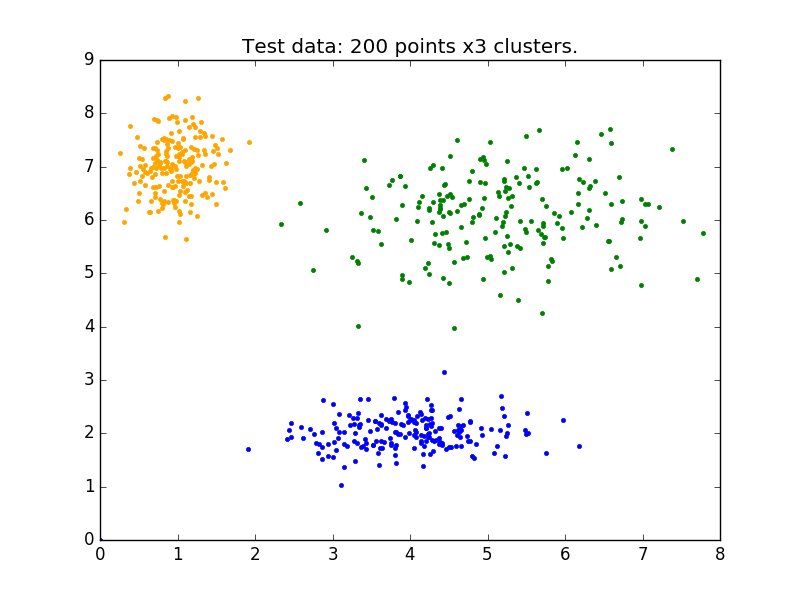
| − | + | https://pythonhosted.org/scikit-fuzzy/_images/plot_cmeans_1.png | |
| − | [ | + | [https://pythonhosted.org/scikit-fuzzy/auto_examples/plot_cmeans.html Fuzzy c-means clustering] |
<youtube>SdyukrDWTe0</youtube> | <youtube>SdyukrDWTe0</youtube> | ||
Revision as of 14:32, 28 March 2023
YouTube search... ...Google search
- AI Solver
- Capabilities
- K-Means
- Clustering
- FCM: The fuzzy c-means clustering algorithm | J. Bezdek, R. Ehrlich, and W. Full - ScienceDirect
One of the most widely used fuzzy clustering algorithms is the Fuzzy C-means clustering (FCM) Algorithm. Fuzzy logic principles can be used to cluster multidimensional data, assigning each point a membership in each cluster center from 0 to 100 percent. This can be very powerful compared to traditional hard-thresholded clustering where every point is assigned a crisp, exact label.
The fuzzy c-means algorithm is very similar to the k-means algorithm:
- Choose a number of clusters.
- Assign coefficients randomly to each data point for being in the clusters.
- Repeat until the algorithm has converged (that is, the coefficients' change between two iterations is no more than E, the given sensitivity threshold) :
- Compute the centroid for each cluster.
- For each data point, compute its coefficients of being in the clusters.