Difference between revisions of "Data Flow Graph (DFG)"
| Line 7: | Line 7: | ||
[http://www.youtube.com/results?search_query=Data+Flow+Graph+DFG+deep+machine+learning+ML YouTube search...] | [http://www.youtube.com/results?search_query=Data+Flow+Graph+DFG+deep+machine+learning+ML YouTube search...] | ||
[http://www.google.com/search?q=Data+Flow+Graph+DFG+deep+machine+learning+ML+artificial+intelligence ...Google search] | [http://www.google.com/search?q=Data+Flow+Graph+DFG+deep+machine+learning+ML+artificial+intelligence ...Google search] | ||
| + | |||
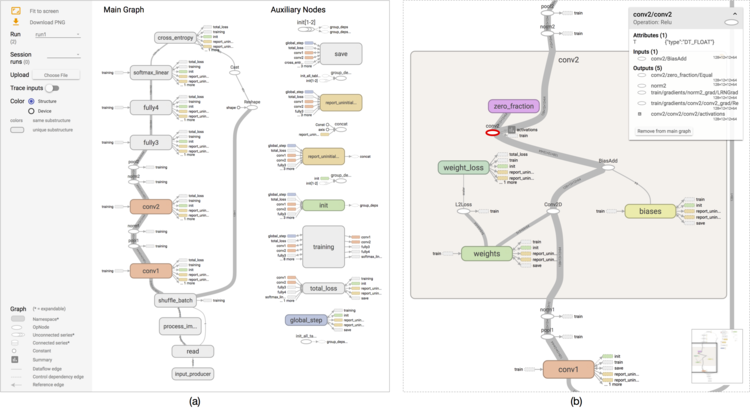
| + | * [http://idl.cs.washington.edu/papers/tfgraph/ Visualizing Dataflow Graphs of Deep Learning Models in TensorFlow | K. Wongsuphasawat, D. Smilkov, J. Wexler, J. Wilson, D. Mané, D. Fritz, D. Krishnan, F. B. Viégas, & M. Wattenberg - UW Interactive Data Lab] | ||
A data-flow graph (DFG) is a graph which represents a data dependencies between a number of operations. Any algorithm consists of a number of ordered operations. | A data-flow graph (DFG) is a graph which represents a data dependencies between a number of operations. Any algorithm consists of a number of ordered operations. | ||
| Line 17: | Line 19: | ||
** Special Edges: These edges are not data carriers between the output of a node (operator) and the input of another node. A special edge indicates a control dependency between two nodes. Let's suppose we have two nodes A and B and a special edges connecting A to B; it means that B will start its operation only when the operation in A ends. Special edges are used in Data Flow Graph to set the happens-before relationship between operations on the tensors. | ** Special Edges: These edges are not data carriers between the output of a node (operator) and the input of another node. A special edge indicates a control dependency between two nodes. Let's suppose we have two nodes A and B and a special edges connecting A to B; it means that B will start its operation only when the operation in A ends. Special edges are used in Data Flow Graph to set the happens-before relationship between operations on the tensors. | ||
| + | |||
| + | http://idl.cs.washington.edu/static/images/figures/tfgraph.png | ||
| + | |||
| + | * [http://vimeo.com/237663041 Visualizing Dataflow Graphs of Deep Learning Models in TensorFlow] | ||
<youtube>NTL12U1X2fc</youtube> | <youtube>NTL12U1X2fc</youtube> | ||
<youtube>QzF2Iii4s5c</youtube> | <youtube>QzF2Iii4s5c</youtube> | ||
Revision as of 22:43, 22 February 2019
YouTube search... ...Google search
A data-flow graph (DFG) is a graph which represents a data dependencies between a number of operations. Any algorithm consists of a number of ordered operations.
- Node: In TensorFlow, each node represents the instantion of an operation. Each operation has >= inputs and >= 0 outputs.
- Edges: In TensorFlow, there are two types of edge:
- Normal Edges: They are carriers of data structures (tensors), where an output of one operation (from one node) becomes the input for another operation.
- Special Edges: These edges are not data carriers between the output of a node (operator) and the input of another node. A special edge indicates a control dependency between two nodes. Let's suppose we have two nodes A and B and a special edges connecting A to B; it means that B will start its operation only when the operation in A ends. Special edges are used in Data Flow Graph to set the happens-before relationship between operations on the tensors.