Difference between revisions of "History of Artificial Intelligence (AI)"
m |
m |
||
| Line 5: | Line 5: | ||
|description=Helpful resources for your journey with artificial intelligence; videos, articles, techniques, courses, profiles, and tools | |description=Helpful resources for your journey with artificial intelligence; videos, articles, techniques, courses, profiles, and tools | ||
}} | }} | ||
| − | [ | + | [https://www.youtube.com/results?search_query=history+of+artificial+intelligence+ai Youtube search...] |
| − | [ | + | [https://www.google.com/search?q=history+of+artificial+intelligence+ai ...Google search] |
* [[Creatives]] | * [[Creatives]] | ||
* [[Gaming]] | * [[Gaming]] | ||
| − | * [ | + | * [https://en.wikipedia.org/wiki/History_of_artificial_intelligence History of Artificial Intelligence] ...[https://en.wikipedia.org/wiki/Timeline_of_artificial_intelligence Timeline] ...[https://en.wikipedia.org/wiki/Timeline_of_machine_learning Timeline of machine learning] | Wikipedia |
| − | * [ | + | * [https://www.aaai.org/ojs/index.php/aimagazine/article/view/1848/1746 A (Very) Brief History of Artificial Intelligence | Bruce G. Buchanan] |
| − | * [ | + | * [https://www.techrepublic.com/article/how-china-tried-and-failed-to-win-the-ai-race-the-inside-story/ How [[Government Services#China|China]] tried and failed to win the AI race: The inside story | Alison Rayome] |
* [[Bio-inspired Computing]] | * [[Bio-inspired Computing]] | ||
* [[Feature Exploration/Learning]] | * [[Feature Exploration/Learning]] | ||
| Line 21: | Line 21: | ||
# The second generation is shallow learning — you handcraft the features and learn a classifier. | # The second generation is shallow learning — you handcraft the features and learn a classifier. | ||
# The third generation, which a lot of people have enjoyed so far, is deep learning. Basically you handcraft the algorithm, but you learn the features and you learn the predictions, end to end. More learning than shallow learning, right? | # The third generation, which a lot of people have enjoyed so far, is deep learning. Basically you handcraft the algorithm, but you learn the features and you learn the predictions, end to end. More learning than shallow learning, right? | ||
| − | # And the fourth generation, this is something new, what I work on, I call it “learning-to-learn.” [ | + | # And the fourth generation, this is something new, what I work on, I call it “learning-to-learn.” [https://medium.com/syncedreview/google-brain-research-scientist-quoc-le-on-automl-and-more-a7f6d3f9392e Google Brain Research Scientist Quoc Le on] [[Algorithm Administration#AutoML|AutoML]] and More |
{|<!-- T --> | {|<!-- T --> | ||
| Line 37: | Line 37: | ||
<youtube>zYfzux7JKHE</youtube> | <youtube>zYfzux7JKHE</youtube> | ||
<b>You and AI – the history, capabilities and frontiers of AI | <b>You and AI – the history, capabilities and frontiers of AI | ||
| − | </b><br>[[Creatives#Demis Hassabis|Demis Hassabis]], world-renowned British neuroscientist, artificial intelligence (AI) researcher and the co-founder and CEO of DeepMind, explores the groundbreaking research driving the application of AI to scientific discovery. The talk launches the Royal Society’s 2018 series: You and AI, a collaborative effort to help people understand what machine learning and AI are, how these technologies work and the ways they may affect our lives. Supported by DeepMind. For more information on the event series: | + | </b><br>[[Creatives#Demis Hassabis|Demis Hassabis]], world-renowned British neuroscientist, artificial intelligence (AI) researcher and the co-founder and CEO of DeepMind, explores the groundbreaking research driving the application of AI to scientific discovery. The talk launches the Royal Society’s 2018 series: You and AI, a collaborative effort to help people understand what machine learning and AI are, how these technologies work and the ways they may affect our lives. Supported by DeepMind. For more information on the event series: https://ow.ly/PKug30jWEYV |
|} | |} | ||
|}<!-- B --> | |}<!-- B --> | ||
| Line 71: | Line 71: | ||
<youtube>NfQfJTIvTkE</youtube> | <youtube>NfQfJTIvTkE</youtube> | ||
<b>Short History Of Artificial Intelligence (AI) | <b>Short History Of Artificial Intelligence (AI) | ||
| − | </b><br>This is the audio version of Forbes which can be found here: | + | </b><br>This is the audio version of Forbes which can be found here: https://www.forbes.com/sites/gilpress/2016/12/30/a-very-short-history-of-artificial-intelligence-ai/#4219d7f26fba |
|} | |} | ||
|}<!-- B --> | |}<!-- B --> | ||
| Line 109: | Line 109: | ||
<youtube>Suevq-kZdIw</youtube> | <youtube>Suevq-kZdIw</youtube> | ||
<b>The Man who forever changed Artificial Intelligence | <b>The Man who forever changed Artificial Intelligence | ||
| − | </b><br>History of Artificial Intelligence: The success of Neural Networks has sparked the AI revolution in the last 10 years. From Atari Games to Go, to Dota and to Starcraft. What many people don't know - the basic idea of Neural Networks has been around since the late 1950s. My name is Sebastian Schuchmann and I hope you enjoy watching! Support me on Patreon: | + | </b><br>History of Artificial Intelligence: The success of Neural Networks has sparked the AI revolution in the last 10 years. From Atari Games to Go, to Dota and to Starcraft. What many people don't know - the basic idea of Neural Networks has been around since the late 1950s. My name is Sebastian Schuchmann and I hope you enjoy watching! Support me on Patreon: https://www.patreon.com/user?u=25285137 Keep in touch: https://twitter.com/SebastianSchuc7 |
|} | |} | ||
|<!-- M --> | |<!-- M --> | ||
| Line 117: | Line 117: | ||
<youtube>yRUUDJfDarU</youtube> | <youtube>yRUUDJfDarU</youtube> | ||
<b>The Year Artificial Intelligence changed forever | <b>The Year Artificial Intelligence changed forever | ||
| − | </b><br>Sebastian Schuchmann AI History: In 1986 the World of Neural Networks was about to change. After decades of silence, finally, a method to efficiently compute the weights in multi-layer Neural Networks was invented. The stage was set for a revolution. Learn more about A.I. History on my Medium: | + | </b><br>Sebastian Schuchmann AI History: In 1986 the World of Neural Networks was about to change. After decades of silence, finally, a method to efficiently compute the weights in multi-layer Neural Networks was invented. The stage was set for a revolution. Learn more about A.I. History on my Medium: https://medium.com/@schuchmannsebastian |
| − | Support me on Patreon: | + | Support me on Patreon: https://www.patreon.com/user?u=25285137 |
|} | |} | ||
|}<!-- B --> | |}<!-- B --> | ||
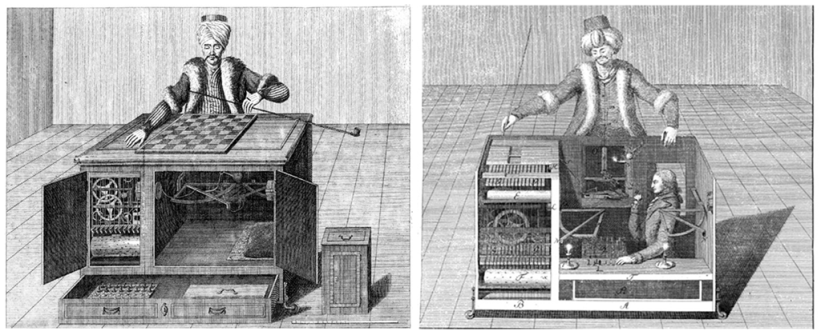
| − | == [ | + | == [https://en.wikipedia.org/wiki/The_Turk The Turk] == |
| − | + | https://rosfilmfestival.com/wp-content/uploads/2016/05/truco-Turco-ROS-821x335.png | |
{|<!-- T --> | {|<!-- T --> | ||
| valign="top" | | | valign="top" | | ||
Revision as of 18:31, 28 January 2023
Youtube search... ...Google search
- Creatives
- Gaming
- History of Artificial Intelligence ...Timeline ...Timeline of machine learning | Wikipedia
- A (Very) Brief History of Artificial Intelligence | Bruce G. Buchanan
- How China tried and failed to win the AI race: The inside story | Alison Rayome
- Bio-inspired Computing
- Feature Exploration/Learning
- Using AI to reveal historical mysteries
In AI, there are four generations.
- The first generation is the Good Old-fashioned AI, meaning that you handcraft everything and you learn nothing.
- The second generation is shallow learning — you handcraft the features and learn a classifier.
- The third generation, which a lot of people have enjoyed so far, is deep learning. Basically you handcraft the algorithm, but you learn the features and you learn the predictions, end to end. More learning than shallow learning, right?
- And the fourth generation, this is something new, what I work on, I call it “learning-to-learn.” Google Brain Research Scientist Quoc Le on AutoML and More
|
|
|
|
|
|
|
|
|
|
The Turk
|
