Difference between revisions of "Telecommunications"
m |
m |
||
| Line 2: | Line 2: | ||
|title=PRIMO.ai | |title=PRIMO.ai | ||
|titlemode=append | |titlemode=append | ||
| − | |keywords=artificial, intelligence, machine, learning, models, algorithms, data, singularity, moonshot, | + | |keywords=artificial, intelligence, machine, learning, models, algorithms, data, singularity, moonshot, TensorFlow, Google, Nvidia, Microsoft, Azure, Amazon, AWS |
|description=Helpful resources for your journey with artificial intelligence; videos, articles, techniques, courses, profiles, and tools | |description=Helpful resources for your journey with artificial intelligence; videos, articles, techniques, courses, profiles, and tools | ||
}} | }} | ||
| Line 79: | Line 79: | ||
<youtube>_uPtdGouCMc</youtube> | <youtube>_uPtdGouCMc</youtube> | ||
<b>Stanford Seminar - Promise of 5G Wireless – The Journey Begins | <b>Stanford Seminar - Promise of 5G Wireless – The Journey Begins | ||
| − | </b><br>Arogyaswami Paulraj Stanford University October 3, 2019 Professor Emeritus Arogyaswami Paulraj, Stanford University, is a pioneer of Multiple-Input Multiple-Output (MIMO) wireless communications, a technology break through that enables improved wireless performance. MIMO is now incorporated into all new wireless systems. Paulraj is the author of over 400 research papers, two text books and a co-inventor in 79 US patents. Paulraj has won over a dozen awards, notably the National Inventors Hall of Fame (USPTO), Marconi Prize and Fellowship, 2014 and the IEEE Alexander Graham Bell Medal, 2011. He is a fellow of eight scientific / engineering national academies including the US, China, India and Sweden. He is a fellow of IEEE and AAAS. In 1999, Paulraj founded Iospan Wireless Inc. – which developed and established MIMO-OFDMA wireless as the core 4G technology. Iospan was acquired in by Intel Corporation in 2003. In 2004, he co-founded Beceem Communications Inc. The company became the market leader in 4G-WiMAX semiconductor and was acquired by Broadcom Corp. in 2010. In 2014 he founded Rasa Networks to develop Machine Learning tools for WiFi Networks. The company was acquired HPE in 2016. During his 30 years in the Indian (Navy) (1961-1991), he founded three national level laboratories in India and headed one of India’s most successful military R&D projects – APSOH sonar. He received over a dozen awards (many at the national level) in India including the Padma Bhushan, Ati Vishist Seva Medal and the VASVIK Medal. | + | </b><br>Arogyaswami Paulraj Stanford University October 3, 2019 Professor Emeritus Arogyaswami Paulraj, Stanford University, is a pioneer of Multiple-Input Multiple-Output (MIMO) wireless communications, a technology break through that enables improved wireless performance. MIMO is now incorporated into all new wireless systems. Paulraj is the author of over 400 research papers, two text books and a co-inventor in 79 US patents. Paulraj has won over a dozen awards, notably the National Inventors Hall of Fame (USPTO), Marconi Prize and Fellowship, 2014 and the IEEE Alexander Graham Bell Medal, 2011. He is a fellow of eight scientific / engineering national academies including the US, [[Government Services#China|China]], India and Sweden. He is a fellow of IEEE and AAAS. In 1999, Paulraj founded Iospan Wireless Inc. – which developed and established MIMO-OFDMA wireless as the core 4G technology. Iospan was acquired in by Intel Corporation in 2003. In 2004, he co-founded Beceem Communications Inc. The company became the market leader in 4G-WiMAX semiconductor and was acquired by Broadcom Corp. in 2010. In 2014 he founded Rasa Networks to develop Machine Learning tools for WiFi Networks. The company was acquired HPE in 2016. During his 30 years in the Indian (Navy) (1961-1991), he founded three national level laboratories in India and headed one of India’s most successful military R&D projects – APSOH sonar. He received over a dozen awards (many at the national level) in India including the Padma Bhushan, Ati Vishist Seva Medal and the VASVIK Medal. |
|} | |} | ||
|<!-- M --> | |<!-- M --> | ||
| Line 103: | Line 103: | ||
|| | || | ||
<youtube>InPzlUE5Qck</youtube> | <youtube>InPzlUE5Qck</youtube> | ||
| − | <b>Why China can take a lead in 5G and AI technology application | + | <b>Why [[Government Services#China|China]] can take a lead in 5G and AI technology application |
| − | </b><br>China is among the world’s first countries to apply 5G to business services. | + | </b><br>[[Government Services#China|China]] is among the world’s first countries to apply 5G to business services. [[Government Services#China|China]]’s telecommunications guides the global 5G-technology trend. An open [[Government Services#China|China]] is becoming the “playground” for global AI businesses and a key landmark for a joint exploration of AI’s direction of end development. Check out this video and have a look at why [[Government Services#China|China]] can take a lead in 5G and AI technology application. Subscribe to us on YouTube: http://goo.gl/lP12gA |
|} | |} | ||
|}<!-- B --> | |}<!-- B --> | ||
Revision as of 11:43, 8 October 2020
Youtube search... ...Google search
- Case Studies
- Virtualization - Dynamic Spectrum Sharing (DSS)
- Ericsson launches unique AI functionality to boost radio access networks
- Deepsig pioneering the application of deep learning to wireless
- How Machine Learning Is Creating New Opportunities In The Telecommunications Industry | Julie Stoughton - Digitalist Magazine
- Top 10 Data Science Use cases in Telecom | Igor Bobriakov - Medium
Contents
Cognitive Radio (CR) / Software-defined radio (SDR)
Software-defined radio (SDR) is a radio communication system where components that have been traditionally implemented in hardware (e.g. mixers, filters, amplifiers, modulators/demodulators, detectors, etc.) are instead implemented by means of software on a personal computer or embedded system. Software radios have significant utility for the military and cell phone services, both of which must serve a wide variety of changing radio protocols in real time. In the long term, software-defined radios are to become the dominant technology in radio communications. SDRs, along with software defined antennas are the enablers of the cognitive radio.
GNU Radio
is a free & open-source software development toolkit that provides signal processing blocks to implement software radios. It can be used with readily-available low-cost external RF hardware to create software-defined radios, or without hardware in a simulation-like environment.
Deepwave Digital Systems
Enabling deep learning and AI at the edge of wireless systems. GPUs are extremely well suited for processes that are highly parallel. The Fast Fourier Transform (FFT) is one of the most common techniques in signal processing and happens to be a highly parallel algorithm. In this blog post the Deepwave team walks you though how to leverage the embedded GPU built into the AIR-T to perform high-speed FFTs without the computational bottleneck of a CPU and without having to experience the long development cycle associated with writing VHDL code for FPGAs. By leveraging the GPU on the AIR-T, you get the best of both worlds: fast development time and high speed processing. A familiar tool to anyone working in the wireless domain, GNU Radio allows signal processing experts to tie together blocks of functionality using an intuitive GUI. Many of the “in the weeds” details regarding the software implementation are well abstracted so the user can focus on the algorithm instead.Once an algorithm has been optimized (or a pre-trained algorithm has been downloaded by a 3rd party), the user will reference it in Deepwave’s GR-WAVELEARNER software that provides a TensorRT Inference block for GNU Radio Companion (GRC)
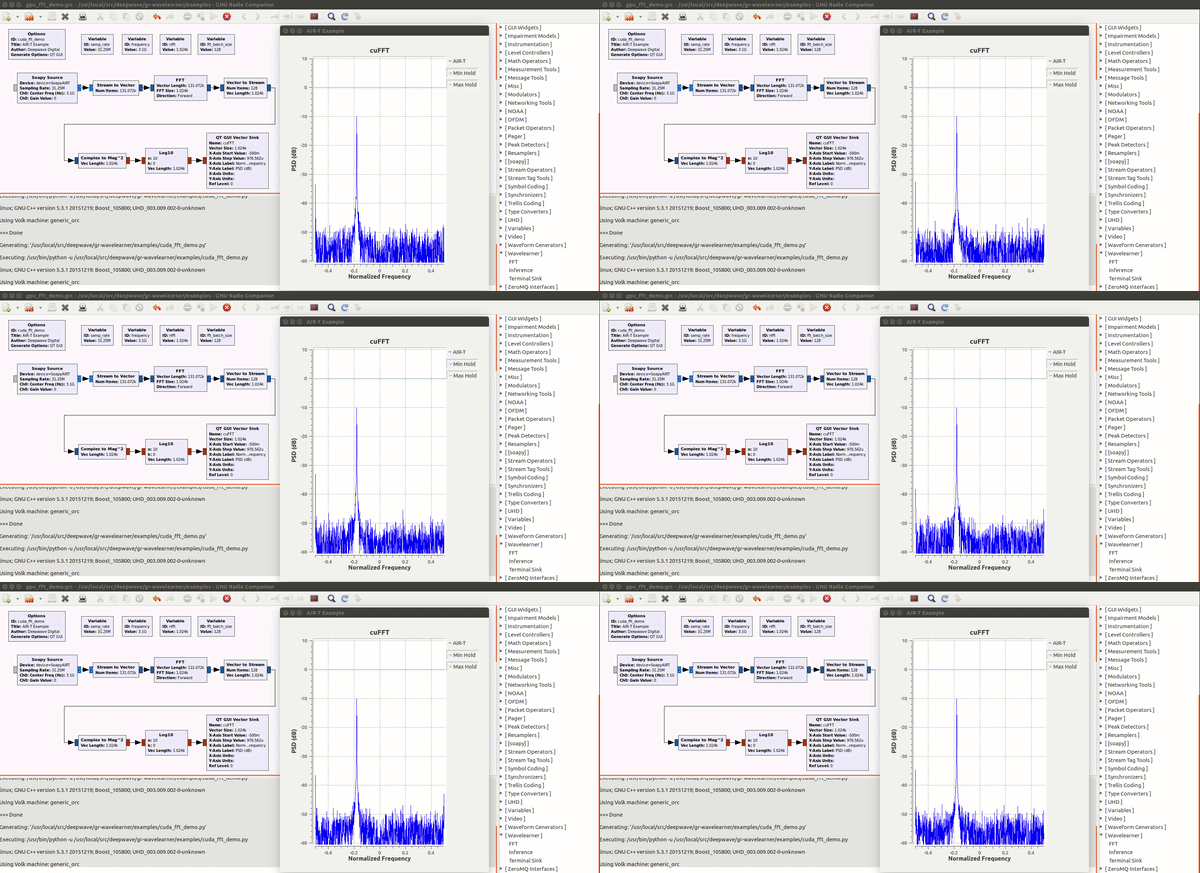
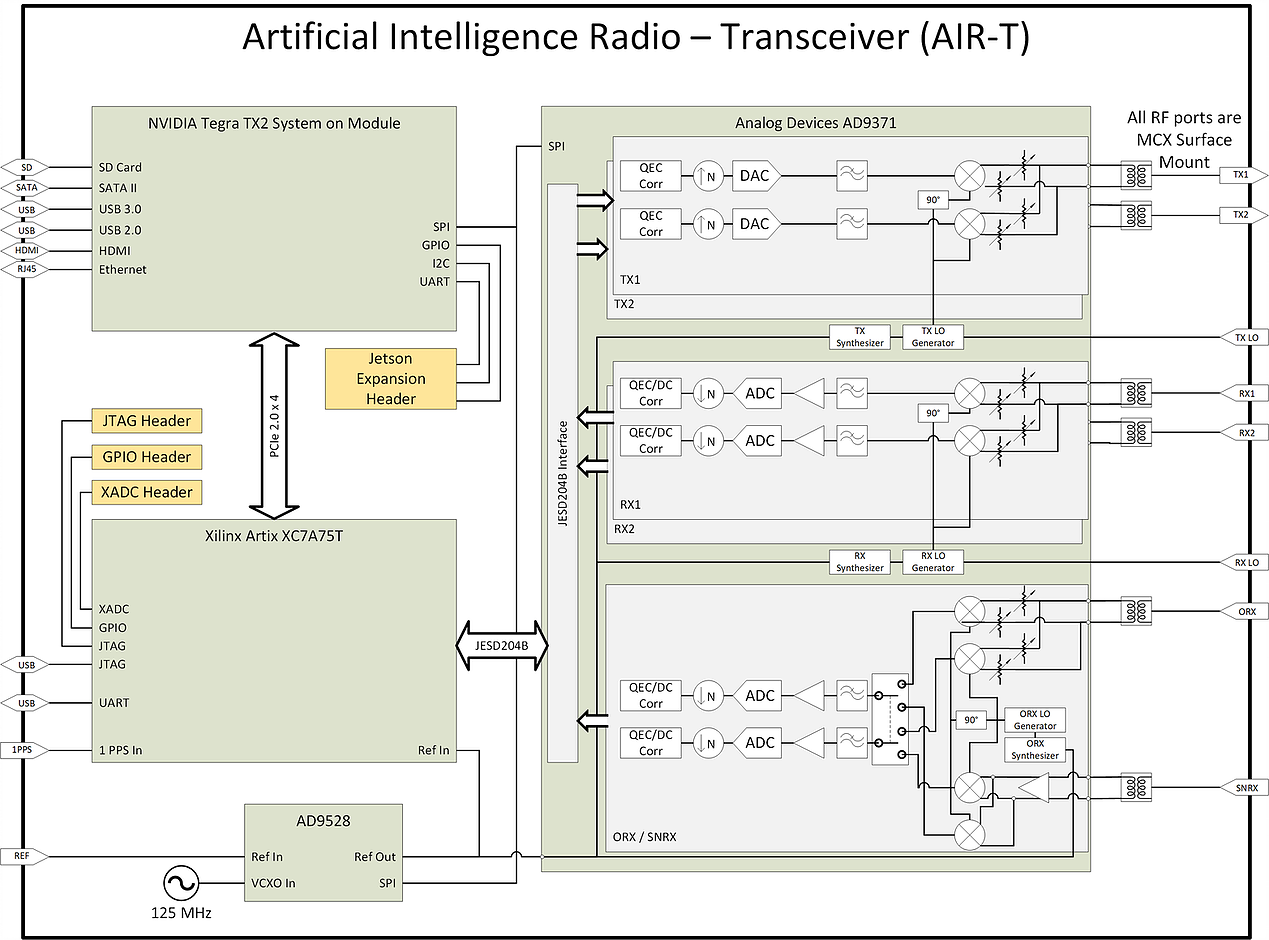
Machine learning solving practical problems in Communications
5G
YouTube search... ...Google search
- Internet of Things (IoT)
- 3rd Generation Partnership Project (3GPP) ...unites [Seven] telecommunications standard development organizations: ARIB, ATIS, CCSA, ETSI, TSDSI, TTA, TTC
- Internet Engineering Taskforce (IETF)
- What is 5G? | NIST
- European Telecommunications Standards Institute (ETSI) ISG Network Functions Virtualisation (NFV) - ETSI Industry Specification Group
- China Global Television Network (CGTN) | Wikipedia
- 5G + Cloud + AI: Huawei Works with Carriers to Power New ICT Infrastructure | Huawei - PR Newswire
- Armed Forces Communications and Electronics Association ...communications, information technology, intelligence and security
|
|
|
|
5G Security
YouTube search... ...Google search
Three-step approach to reach a high level of intelligent security management. How to master E2E network security when introducing 5G core | Kari-Pekka Perttula - Ericsson
- Dynamic: Introduce automated security policy configuration and compliance monitoring
- Cognitive: Automated threat and vulnerability detection assisted with ML /AI
- Intelligent: Repeatable, adaptive and holistic security management with threat intelligence. This provides end-to-end visibility for business-related security risks, and actions can be directed via automated workflows to mitigate risks faster.
Threat Model: STRIDE | Wikipedia The threats are:
- Spoofing
- Tampering
- Repudiation
- Information disclosure (breach or data leak)
- Denial of service
- Elevation of privilege]
|
|
|
|
|
|
5G Testing
YouTube search... ...Google search
- Model_Monitoring
- [1] DOD Announces New Locations for Additional 5G Testing, Experimentation | C. Todd Lopez - DOD News
|
|
