Difference between revisions of "Loop"
m (→Unintended Feedback Loop) |
m (→Synthetic Feedback Loop) |
||
| Line 89: | Line 89: | ||
<b>Michio Kaku: Feedback loops are creating consciousness | Big Think | <b>Michio Kaku: Feedback loops are creating consciousness | Big Think | ||
</b><br>One of the great questions in all of science is where consciousness comes from. When it comes to consciousness, Kaku believes different species have different levels of consciousness, based on their feedback loops needed to survive in space, society, and time. According to the theoretical physicist, human beings' ability to use past experiences, memories, to predict the future makes us distinct among animals — and even robots (they're currently unable to understand, or operate within, a social hierarchy). Dr. Michio Kaku is the co-founder of string field theory, and is one of the most widely recognized scientists in the world today. He has written 4 New York Times Best Sellers, is the science correspondent for CBS This Morning and has hosted numerous science specials for BBC-TV, the Discovery/Science Channel. His radio show broadcasts to 100 radio stations every week. Dr. Kaku holds the Henry Semat Chair and Professorship in theoretical physics at the City College of New York (CUNY), where he has taught for over 25 years. He has also been a visiting professor at the Institute for Advanced Study at Princeton, as well as New York University (NYU). | </b><br>One of the great questions in all of science is where consciousness comes from. When it comes to consciousness, Kaku believes different species have different levels of consciousness, based on their feedback loops needed to survive in space, society, and time. According to the theoretical physicist, human beings' ability to use past experiences, memories, to predict the future makes us distinct among animals — and even robots (they're currently unable to understand, or operate within, a social hierarchy). Dr. Michio Kaku is the co-founder of string field theory, and is one of the most widely recognized scientists in the world today. He has written 4 New York Times Best Sellers, is the science correspondent for CBS This Morning and has hosted numerous science specials for BBC-TV, the Discovery/Science Channel. His radio show broadcasts to 100 radio stations every week. Dr. Kaku holds the Henry Semat Chair and Professorship in theoretical physics at the City College of New York (CUNY), where he has taught for over 25 years. He has also been a visiting professor at the Institute for Advanced Study at Princeton, as well as New York University (NYU). | ||
| + | |} | ||
| + | |}<!-- B --> | ||
| + | |||
| + | = Stock Market Predictions - Feedback Loop = | ||
| + | [http://www.youtube.com/results?search_query=~Synthetic+feedback+loop+ai+machine+learning YouTube search...] | ||
| + | [http://www.google.com/search?q=~Synthetic+feedback+loop+ai+machine+learning ...Google search] | ||
| + | |||
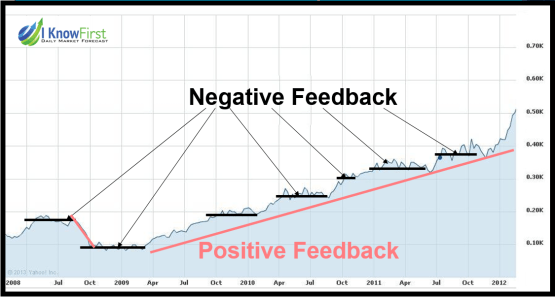
| + | Why you can beat the market, even when it does not seem so. The importance of loops, patterns, and predictable events. Random events are don’t measure risks, and should not affect your decision making. | ||
| + | Some traders follow the trend, and some go against it. At I Know First we work on algorithmic strategies which are neither, we simply try an assess where the next opportunity is and provide stock market predictions. If this means to do what everyone else does, than why not. If it means going against when everyone else does, this is also fine. The tricky part is determining where this opportunities are, this article will discuss how to find opportunities in what can seem as total randomness. Markets are Complex, but not Unpredictable! There are two major misconceptions about the stock market. The first one is connected to the classical economic theory which claims markets to be efficient, and as such unpredictable. In this case trying to select one stock over another becomes useless, as no opportunity is ever better than the other. Both stocks are perfectly priced according to their opportunity and risk, with everyone having all information. However, the truth of the matter is that some people profit trading stocks while others lose – this by itself proves the market to be inefficient, and thus exploitable. While US markets are very efficient, and most information is available, not everyone interprets this information the same. [http://iknowfirst.com/stock-market-predictions-where-in-the-feedback-loop-is-your-portfolio Stock Market Predictions: Where In The Feedback Loop Is Your Portfolio? | I Know First] | ||
| + | |||
| + | |||
| + | http://iknowfirst.com/wp-content/uploads/2015/06/07.png | ||
| + | |||
| + | {|<!-- T --> | ||
| + | | valign="top" | | ||
| + | {| class="wikitable" style="width: 550px;" | ||
| + | || | ||
| + | <youtube>5Zus6ZOG-lw</youtube> | ||
| + | <b>The Wandering Dreamer: An Synthetic Feedback Loop | ||
| + | </b><br>This experiment uses four machine learning models to create a feedback loop between synthesized images and text. All of the images you see here are fabricated, as is the text that describes each image. Made by Brannon Dorsey using Runway. [http://github.com/brannondorsey/the-wandering-dreamer Source code] | ||
| + | |||
| + | 1. The first row of images are produced from a class label using BigGAN. | ||
| + | 2. The text below is an auto-generated caption of the BigGAN image using Im2Text. | ||
| + | 3. The next set of images are synthesized by an Attentional GAN using the auto-generated captions. | ||
| + | 4. The text at the bottom classifies the image above it using MobileNet. This class label is then sent back to BigGAN as input to create an infinite loop. | ||
|} | |} | ||
|}<!-- B --> | |}<!-- B --> | ||
Revision as of 22:33, 25 September 2020
YouTube search... ...Google search
- Human-in-the-Loop (HITL) Learning
- Recommendation
- Reinforcement Learning (RL)
- Closing the Loop: How Feedback Loops Help to Maintain Quality Long-Term AI Results | Natalie Fletcher - Clarifai
Contents
Feedback Loop
YouTube search... ...Google search
any process where the outputs of a system are plugged back in and used as iterative inputs. Feedback loops exist just about everywhere. In nature, the evolutionary "arms race" between predators and prey is a classic example. In business, the practice of taking customer feedback (the output of a product or service) and using it to improve future processes is another commonly used feedback loop. Today, rapid advances in artificial intelligence (AI) and machine learning are helping businesses do more with data. These systems — and their ability to analyze an inhuman amount of data — allow businesses to adjust algorithms, workflows and processes on the fly. Get More Out Of Feedback Loops With AI | Arka Dhar - Forbes
|
|
|
|
Automated Feedback with AI
YouTube search... ...Google search
|
|
Feedback Loops are Creating Consciousness
YouTube search... ...Google search
|
Stock Market Predictions - Feedback Loop
YouTube search... ...Google search
Why you can beat the market, even when it does not seem so. The importance of loops, patterns, and predictable events. Random events are don’t measure risks, and should not affect your decision making. Some traders follow the trend, and some go against it. At I Know First we work on algorithmic strategies which are neither, we simply try an assess where the next opportunity is and provide stock market predictions. If this means to do what everyone else does, than why not. If it means going against when everyone else does, this is also fine. The tricky part is determining where this opportunities are, this article will discuss how to find opportunities in what can seem as total randomness. Markets are Complex, but not Unpredictable! There are two major misconceptions about the stock market. The first one is connected to the classical economic theory which claims markets to be efficient, and as such unpredictable. In this case trying to select one stock over another becomes useless, as no opportunity is ever better than the other. Both stocks are perfectly priced according to their opportunity and risk, with everyone having all information. However, the truth of the matter is that some people profit trading stocks while others lose – this by itself proves the market to be inefficient, and thus exploitable. While US markets are very efficient, and most information is available, not everyone interprets this information the same. Stock Market Predictions: Where In The Feedback Loop Is Your Portfolio? | I Know First
|
Synthetic Feedback Loop
YouTube search... ...Google search
|
Recursion
YouTube search... ...Google search

|
|
|
|
Unintended Feedback Loop
YouTube search... ...Google search
Models that are an integrated part of a product experience, or what we referred to as data products, often involve feedback loops. When done right, feedback loops can help us to create better experiences. However, feedback loops can also create unintended negative consequences, such as bias or inaccurate model performance measurements... Getting Better at Machine Learning | Robert Chang - Medium
|
|
Unintended Feedback Loop - Filter Bubbles
YouTube search... ...Google search
In December 2009, Google began customizing its search results for all users, and we entered a new era of personalization. With little notice or fanfare, our online experience is changing, as the websites we visit are increasingly tailoring themselves to us. In this engaging and visionary book, MoveOn.org board president Eli Pariser lays bare the personalization that is already taking place on every major website, from Facebook to AOL to ABC News. As Pariser reveals, this new trend is nothing short of an invisible revolution in how we consume information, one that will shape how we learn, what we know, and even how our democracy works. The Filter Bubble | Eli Pariser
In news media, echo chamber is a metaphorical description of a situation in which beliefs are amplified or reinforced by communication and repetition inside a closed system. Filter Bubble | Wikipedia
|
|
|
|
