Difference between revisions of "Connecting Brains"
m (→Neuralink) |
m (→Neuralink) |
||
| Line 64: | Line 64: | ||
|| | || | ||
<youtube>lA77zsJ31nA</youtube> | <youtube>lA77zsJ31nA</youtube> | ||
| − | <b> | + | <b>Watch Elon Musk’s Neuralink presentation |
| − | </b><br> | + | </b><br>Electric vehicles, rockets... and now brain-computer interfaces. Elon Musk's newest venture, Neuralink, aims to bridge the gap between humans and artificial intelligence by implanting tiny chips that can link up to the brain. At a press conference on July 16, Neuralink's ambitious plans were detailed for the first time, showcasing a future (a very distant future!) technology that could help people deal with brain or spinal cord injuries or controlling 3D digital avatars. |
|} | |} | ||
|<!-- M --> | |<!-- M --> | ||
| Line 72: | Line 72: | ||
|| | || | ||
<youtube>9uRK8Delzvk</youtube> | <youtube>9uRK8Delzvk</youtube> | ||
| − | <b> | + | <b>Neuralink - Merging Brain and Machine |
| − | </b><br> | + | </b><br>Elon Musk's Neuralink project brain machine interface (BMI) has been floating around as an idea for a while now, but recently we've been taken on a detailed inside glimpse of what the technology will entail. |
|} | |} | ||
|}<!-- B --> | |}<!-- B --> | ||
| Line 81: | Line 81: | ||
|| | || | ||
<youtube>mty_WVP8DvA</youtube> | <youtube>mty_WVP8DvA</youtube> | ||
| − | <b> | + | <b>Elon Musk's Neuralink: Everything We Know |
| − | </b><br> | + | </b><br>Elon Musk's company wants to install an implant in human brains by the year 2020. How does it work? What does it mean? Find out the basics here. |
|} | |} | ||
|<!-- M --> | |<!-- M --> | ||
| Line 98: | Line 98: | ||
|| | || | ||
<youtube>SBxtNGVjUX8</youtube> | <youtube>SBxtNGVjUX8</youtube> | ||
| − | <b> | + | <b>Neuralink: Upgrading The Human Brain and Neural Computation | What You Need To Know |
| − | </b><br> | + | </b><br>Elon Musk has been working on a brain-machine interface called Neuralink. Brain-machine interfaces could be the promising step forward that humans need to help correct neurological disorders and to ultimately – complete symbiosis with A.I. Implementation of Neuralink would essentially be both a hardware and software update of our ‘biological’ computers. The hardware update comes in the form of a neural processor (Neuralink ASIC) and extremely thin polymer threads to collect data about neural activity. The software update will give us powerful machine learning algorithms and a much better information system. |
|} | |} | ||
|<!-- M --> | |<!-- M --> | ||
| Line 106: | Line 106: | ||
|| | || | ||
<youtube>wxBk4WXMaiI</youtube> | <youtube>wxBk4WXMaiI</youtube> | ||
| − | <b> | + | <b>Our Neuralink Future |
| − | </b><br> | + | </b><br>Elon Musk's newer company "Neuralink" just demoed the brain device they've been working on the past 2 years during a live stream event. I've been waiting a long time to get a glimpse of the hardware, software, and intentions they have as they build this technology and the event was satisfying, thought provoking, and humbling. I'm going to review my impressions of the event, explain how the device works in technical detail, then make a few predictions of what it's going to be used for in the future. It's an exciting time to be alive, and although there are dangers involved, I have faith that we can learn from our mistakes and avoid having this tool be used for exploitation like social networks have been used for. |
|} | |} | ||
|}<!-- B --> | |}<!-- B --> | ||
Revision as of 21:26, 23 August 2020
YouTube search... ...Google search
- Case Studies
- Neuroscience
- Molecular Artificial Intelligence (AI)
- Bio-inspired Computing
- Metaverse
- Artificial intelligence turns brain activity into speech | Kelly Servick
- 29 Neurotech Companies Interfacing With Your Brain | Nanalyze
- CTRL-labs Uses AI for Brain-Computer Interface | Nanalyze
- Synchron – A Brain Computer Interface Using Stentrodes | Nanalyze
- Brain-Computer Interfaces (BCI) | Singularity Hub
Contents
Brain Machine Interface (BMI) / Brain Computer Interface (BCI)
YouTube search... ...Google search
- Kernel ...Neuroscience as a Service (NaaS)
Researchers say they’ve built a system that can translate brain signals directly into text — a promising step toward a “speech prosthesis” that could effectively allow you to think text directly into a computer. Machine translation of cortical activity to text with an encoder–decoder framework | J. Makin, D. Moses, and E. Chang - Nature Neuroscience ...Scientists Debut System To Translate Thoughts Directly Into Text | Victor Tangermann - The Byte
Neuralink
YouTube search... ...Google search
- Neuralink Homepage
- Neuralink | Wikipedia
- Neuralink Progress Update: What To Know About Elon Musk's Major Event | Inverse
Neuralink Corporation is an American neurotechnology company founded by Elon Musk and others, developing implantable brain–machine interfaces.

|
|
|
|
|
|
Brain to Brain Interface (BBI)
YouTube search... ...Google search
- Scientists Demonstrate Direct Brain-to-Brain Communication in Humans | Robert Martone - Scientific American ...Work on an “Internet of brains” takes another step
|
|
|
|
|
|
PEDOT
- PEDOT:PSS Interfaces Support the Development of Neuronal Synaptic Networks with Reduced Neuroglia Response In vitro | G. Cellot, P. Lagonegro, G. Tarabella, D. Scaini, F. Fabbri, S. Iannotta, M. Prato, G. Salviati, and L. Ballerini
- Chronic Intracortical Neural Recordings Using Microelectrode Arrays Coated With PEDOT-TFB | NeuroNexus
- Improving the performance of poly(3,4-ethylenedioxythiophene) for brain–machine interface applications | H.Mandala, G. Knaack, H. Charkhkar, D. McHail, J. Kastee, Theodore Dumas, N. Peixoto, J. Rubinson, and J. Pancrazio - ScienceDirect
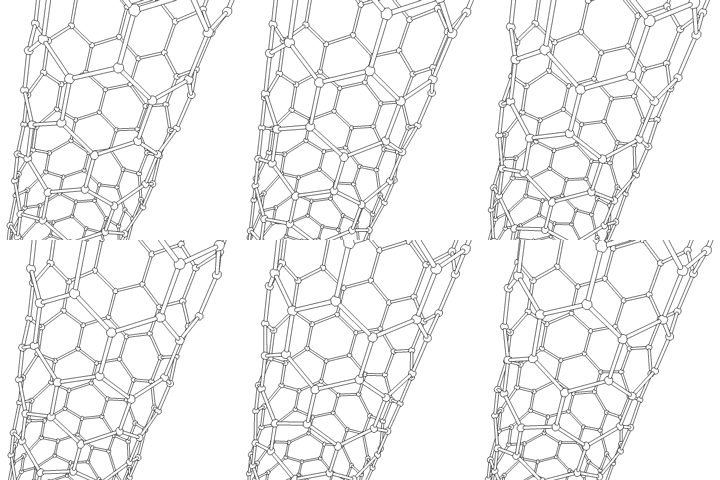
- Carbon Nanotube (CNT) | Wikipedia ...a molecular-scale structure consisting of carbon atoms arranged in one or more cylindrical layers, joined by covalent bonds in a hexagonal tiling pattern within each layer, so as to form a hollow tube
Connecting electronics to human tissue has been a major challenge due to traditional materials like gold, silicon and steel causing scarring when implanted....The polymer, known as a Pedot, has exactly the properties needed to interface electronic hardware with human tissue without causing scarring while also dramatically improving the performance of medical implants. ...The latest research used a Pedot film with an antibody that stimulates blood vessel growth after injury and could be used to detect early stages of tumour growth in the body. Pedot polymers could also be used to help sense or treat brain or nervous system disorders, while versions could theoretically attach peptides, antibodies and DNA. "Name your favorite biomolecule, and you can in principle make a Pedot film that has whatever biofunctional group you might be interested in," Dr. David Martin said. The researchers made a polymer with dopamine, which plays a role in addictive behaviors. Several companies and research institutions are already working on technology to connect brains to computers, with Elon Musk's Neuralink perhaps the closest to achieving a commercial product. The startup plans to reveal more details about its brain chips later this month, which could one day provide "full-bandwidth data streaming" to the brain through a USB-C cable.Groundbreaking New Material 'Could Allow Artificial Intelligence To Merge With The Human Brain' | Anthony Cuthbertson - Independent ...Technology could enable new health diagnostics and achieve Elon Musk's goal of integrating with artificial intelligence
poly(3,4-ethylenedioxythiophene) polystyrene sulfonate (PEDOT:PSS) is a polymer mixture of two ionomers. One component in this mixture is made up of sodium polystyrene sulfonate which is a sulfonated polystyrene. Part of the sulfonyl groups are deprotonated and carry a negative charge. The other component poly(3,4-ethylenedioxythiophene) (PEDOT) is a conjugated polymer and carries positive charges and is based on polythiophene. Together the charged macromolecules form a macromolecular salt. Wikipedia

Movies
|
