Difference between revisions of "Image-to-Image Translation"
| Line 7: | Line 7: | ||
[http://www.youtube.com/results?search_query=CycleGAN YouTube search...] | [http://www.youtube.com/results?search_query=CycleGAN YouTube search...] | ||
[http://www.google.com/search?q=CycleGAN ...Google search] | [http://www.google.com/search?q=CycleGAN ...Google search] | ||
| − | |||
* [[Generated Image]] | * [[Generated Image]] | ||
| Line 29: | Line 28: | ||
<youtube>8XfcDkkFbMs</youtube> | <youtube>8XfcDkkFbMs</youtube> | ||
| − | <youtube> | + | <youtube>u8qPvzk0AfY</youtube> |
| + | |||
= CycleGAN = | = CycleGAN = | ||
Revision as of 09:12, 19 July 2020
YouTube search... ...Google search
Approaches:
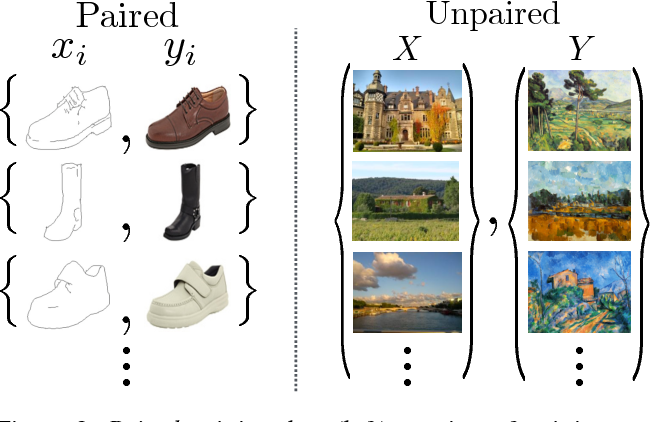
- Paired
- Unparied
Contents
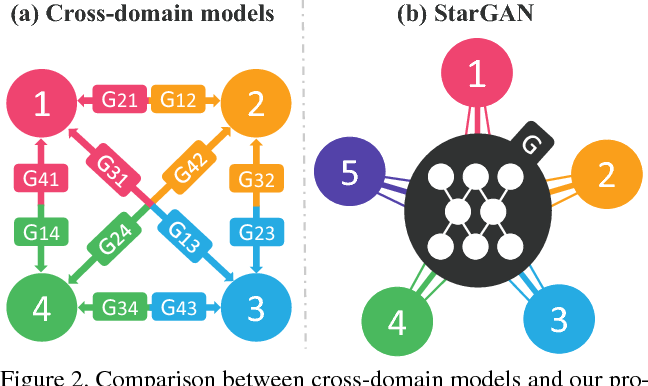
StarGAN
Existing image to image translation approaches have limited scalability and robustness in handling more than two domains, since different models should be built independently for every pair of image domains. StarGAN is a novel and scalable approach that can perform image-to-image translations for multiple domains using only a single model. Image-to-Image Translation | Yongfu Hao
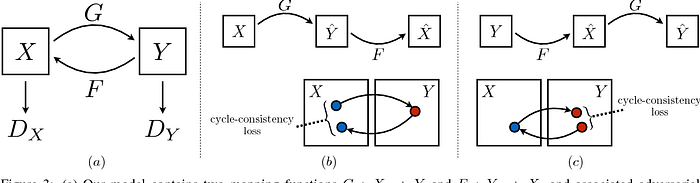
CycleGAN
An approach for learning to translate an image from a source domain X to a target domain Y in the absence of paired examples Image-to-Image Translation | Yongfu Hao
pix2pix
UNIT
