Difference between revisions of "Association Rule Learning"
(Created page with "[http://www.youtube.com/results?search_query=Ridge+Regression+artificial+intelligence YouTube search...] [http://www.google.com/search?q=Ridge+Regression+machine+learning+ML ....") |
|||
| Line 1: | Line 1: | ||
| − | [http://www.youtube.com/results?search_query= | + | [http://www.youtube.com/results?search_query=Association+Rule+Learning YouTube search...] |
| − | [http://www.google.com/search?q= | + | [http://www.google.com/search?q=Association+Rule+Learning+machine+learning+ML ...Google search] |
* [[AI Solver]] | * [[AI Solver]] | ||
| − | ** [[...predict | + | ** [[...predict categories]] |
* [[Capabilities]] | * [[Capabilities]] | ||
| − | * [ | + | * [http://en.wikipedia.org/wiki/Association_rule_learning Association Rule Learning | Wikipedia] |
| − | |||
| − | |||
| − | + | a rule-based machine learning method for discovering interesting relations between variables in large databases. It is intended to identify strong rules discovered in databases using some measures of interestingness. This rule-based approach also generates new rules as it analyzes more data. The ultimate goal, assuming a large enough dataset, is to help a machine mimic the human brain’s feature extraction and abstract association capabilities from new uncategorized data. | |
| − | http:// | + | http://annalyzin.files.wordpress.com/2016/04/association-rules-network-graph2.png |
| − | <youtube> | + | <youtube>WGlMlS_Yydk</youtube> |
| + | <youtube>a7pYbjCYGuI</youtube> | ||
| + | <youtube>tY1JE6XFjCY</youtube> | ||
| + | <youtube>YgnpqrgKTbE</youtube> | ||
| + | |||
| + | == Market Basket Analysis == | ||
| + | <youtube>b5hgDPa7a2k</youtube> | ||
Revision as of 09:36, 8 January 2019
YouTube search... ...Google search
a rule-based machine learning method for discovering interesting relations between variables in large databases. It is intended to identify strong rules discovered in databases using some measures of interestingness. This rule-based approach also generates new rules as it analyzes more data. The ultimate goal, assuming a large enough dataset, is to help a machine mimic the human brain’s feature extraction and abstract association capabilities from new uncategorized data.
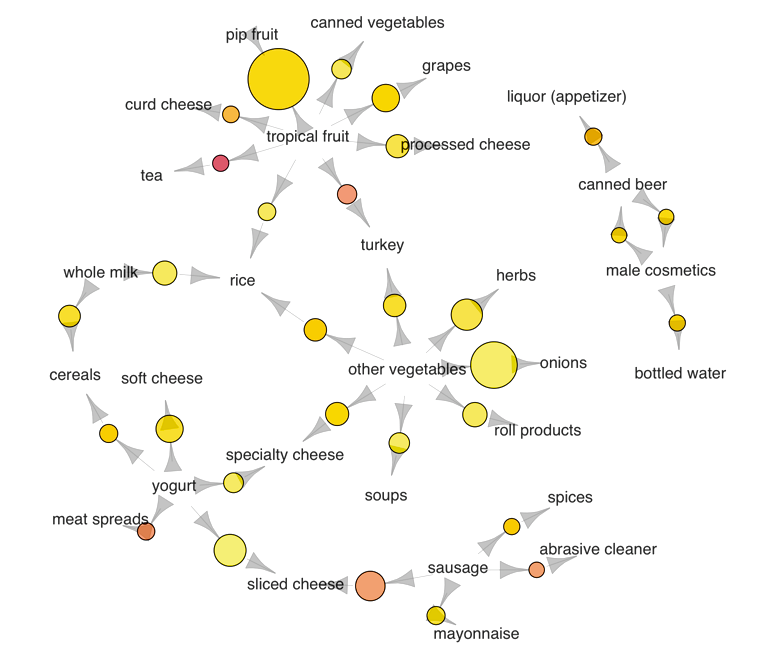
Market Basket Analysis
