Difference between revisions of "Monte Carlo"
m |
|||
| Line 11: | Line 11: | ||
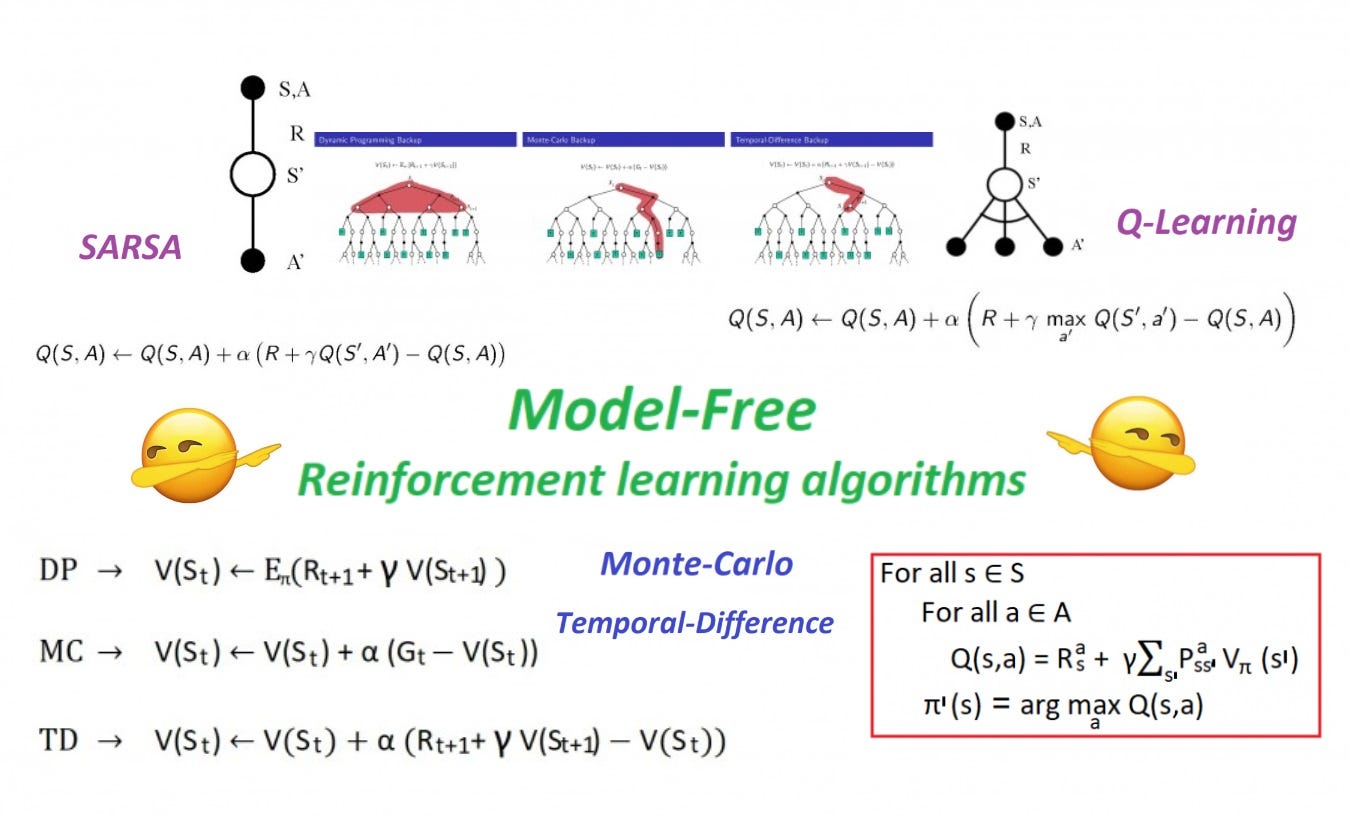
http://cdn-images-1.medium.com/max/1349/1*ioDQJWtRffT7LlIiwwOHXw.jpeg | http://cdn-images-1.medium.com/max/1349/1*ioDQJWtRffT7LlIiwwOHXw.jpeg | ||
| + | <youtube>-YpalutQCKw</youtube> | ||
| + | <youtube>kYWw6GBRjVk</youtube> | ||
<youtube>3gcLRU24-w0</youtube> | <youtube>3gcLRU24-w0</youtube> | ||
| − | <youtube> | + | <youtube>lhFXKNyA0QA</youtube> |
| + | <youtube>1HV6uENCs9o</youtube> | ||
| + | <youtube>ZIEMlD94JP8</youtube> | ||
Revision as of 12:19, 24 September 2018
- Model Free Reinforcement learning algorithms (Monte Carlo, SARSA, Q-learning) | Madhu Sanjeevi (Mady) - Medium
- Google DeepMind AlphaGo Zero
- An Introduction to Monte Carlo Techniques in Artificial Intelligence | Todd W. Neller
- Reinforcement Learning (RL)
- Monte Carlo Tree Search (MCTS)
A broad class of computational algorithms that rely on repeated random sampling to obtain numerical results. Their essential idea is using randomness to solve problems that might be deterministic in principle. They are often used in physical and mathematical problems and are most useful when it is difficult or impossible to use other approaches. Monte Carlo methods are mainly used in three problem classes:[1] optimization, numerical integration, and generating draws from a probability distribution.