Difference between revisions of "T-Distributed Stochastic Neighbor Embedding (t-SNE)"
m |
m |
||
| Line 9: | Line 9: | ||
* [[Principal Component Analysis (PCA)]] | * [[Principal Component Analysis (PCA)]] | ||
| − | * [[Embedding]] | + | * [[Embedding]] ... [[Fine-tuning]] ... [[Retrieval-Augmented Generation (RAG)|RAG]] ... [[Agents#AI-Powered Search|Search]] ... [[Clustering]] ... [[Recommendation]] ... [[Anomaly Detection]] ... [[Classification]] ... [[Dimensional Reduction]]. [[...find outliers]] |
** [[Local Linear Embedding (LLE)]] | ** [[Local Linear Embedding (LLE)]] | ||
* [[Dimensional Reduction]] Algorithms | * [[Dimensional Reduction]] Algorithms | ||
Latest revision as of 09:48, 13 September 2023
Youtube search... ...Google search
- Principal Component Analysis (PCA)
- Embedding ... Fine-tuning ... RAG ... Search ... Clustering ... Recommendation ... Anomaly Detection ... Classification ... Dimensional Reduction. ...find outliers
- Dimensional Reduction Algorithms
- Softmax
- Pooling / Sub-sampling: Max, Mean
- (Deep) Convolutional Neural Network (DCNN/CNN)
- Seven Techniques for Dimensionality Reduction | KNIME
- Principal Component Analysis (PCA) ...linear
- TensorFlow
- Visualization
- How to Use t-SNE Effectively | Martin Wattenberg - Distill
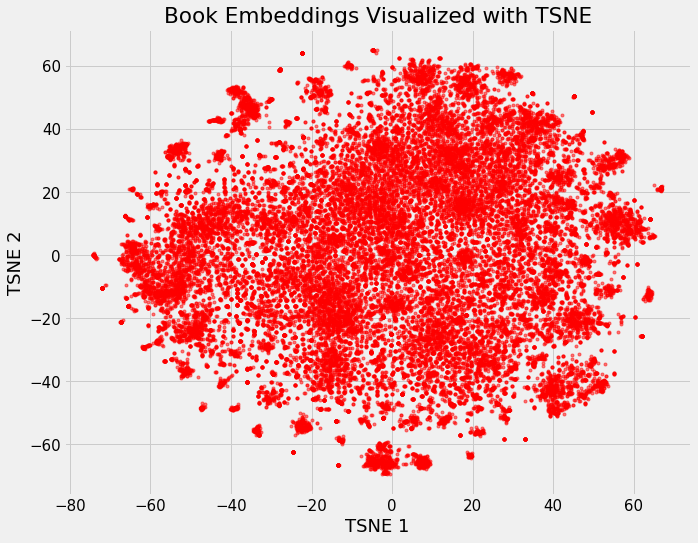
a machine learning algorithm for visualization developed by Laurens van der Maaten and Geoffrey Hinton. It is a nonlinear dimensionality reduction technique well-suited for embedding high-dimensional data for visualization in a low-dimensional space of two or three dimensions. Specifically, it models each high-dimensional object by a two- or three-dimensional point in such a way that similar objects are modeled by nearby points and dissimilar objects are modeled by distant points with high probability. Wikipedia