Difference between revisions of "Continuous Bag-of-Words (CBoW)"
(Created page with "{{#seo: |title=PRIMO.ai |titlemode=append |keywords=artificial, intelligence, machine, learning, models, algorithms, data, singularity, moonshot, Tensorflow, Google, Nvidia, M...") |
m |
||
| (7 intermediate revisions by the same user not shown) | |||
| Line 5: | Line 5: | ||
|description=Helpful resources for your journey with artificial intelligence; videos, articles, techniques, courses, profiles, and tools | |description=Helpful resources for your journey with artificial intelligence; videos, articles, techniques, courses, profiles, and tools | ||
}} | }} | ||
| − | [ | + | [https://www.youtube.com/results?search_query=Continuous+Bag+Words+cbow+nlp+natural+language YouTube search...] |
| − | [ | + | [https://www.google.com/search?q=Continuous+Bag+Words+cbow+nlp+natural+language ...Google search] |
| − | * [[Bag-of-Words ( | + | * [[Bag-of-Words (BoW)]] |
| − | * [[Natural Language Processing (NLP)]] | + | * [[Large Language Model (LLM)]] ... [[Natural Language Processing (NLP)]] ...[[Natural Language Generation (NLG)|Generation]] ... [[Natural Language Classification (NLC)|Classification]] ... [[Natural Language Processing (NLP)#Natural Language Understanding (NLU)|Understanding]] ... [[Language Translation|Translation]] ... [[Natural Language Tools & Services|Tools & Services]] |
| − | |||
| − | |||
* [[Word2Vec]] | * [[Word2Vec]] | ||
| − | |||
* [[Skip-Gram]] | * [[Skip-Gram]] | ||
| − | |||
| − | |||
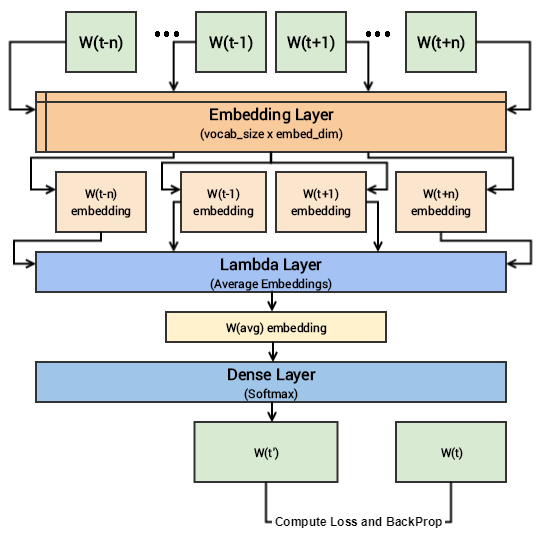
| − | + | The CBOW model architecture tries to predict the current target word (the center word) based on the source [[context]] words (surrounding words). Considering a simple sentence, “the quick brown fox jumps over the lazy dog”, this can be pairs of ([[context]]_window, target_word) where if we consider a [[context]] window of size 2, we have examples like ([quick, fox], brown), ([the, brown], quick), ([the, dog], lazy) and so on. Thus the model tries to predict the target_word based on the [[context]]_window words. [https://towardsdatascience.com/understanding-feature-engineering-part-4-deep-learning-methods-for-text-data-96c44370bbfa A hands-on intuitive approach to Deep Learning Methods for Text Data — Word2Vec, GloVe and FastText | Dipanjan Sarkar - Towards Data Science] | |
| − | + | https://miro.medium.com/max/542/1*d66FyqIMWtDCtOuJ_GcqAg.png | |
| − | <youtube> | + | <youtube>yBmtXtVya9A</youtube> |
| − | <youtube> | + | <youtube>UqRCEmrv1gQ</youtube> |
| − | <youtube> | + | <youtube>uskth3b6H_A</youtube> |
| − | <youtube> | + | <youtube>cNnqdz_L-eE</youtube> |
Latest revision as of 21:37, 17 May 2023
YouTube search... ...Google search
- Bag-of-Words (BoW)
- Large Language Model (LLM) ... Natural Language Processing (NLP) ...Generation ... Classification ... Understanding ... Translation ... Tools & Services
- Word2Vec
- Skip-Gram
The CBOW model architecture tries to predict the current target word (the center word) based on the source context words (surrounding words). Considering a simple sentence, “the quick brown fox jumps over the lazy dog”, this can be pairs of (context_window, target_word) where if we consider a context window of size 2, we have examples like ([quick, fox], brown), ([the, brown], quick), ([the, dog], lazy) and so on. Thus the model tries to predict the target_word based on the context_window words. A hands-on intuitive approach to Deep Learning Methods for Text Data — Word2Vec, GloVe and FastText | Dipanjan Sarkar - Towards Data Science