Difference between revisions of "Neural Structured Learning (NSL)"
(Created page with "{{#seo: |title=PRIMO.ai |titlemode=append |keywords=artificial, intelligence, machine, learning, models, algorithms, data, singularity, moonshot, Tensorflow, Google, Nvidia, M...") |
|||
| (5 intermediate revisions by the same user not shown) | |||
| Line 8: | Line 8: | ||
[http://www.google.com/search?q=Neural+Structured+Learning+NSL+Graph ...Google search] | [http://www.google.com/search?q=Neural+Structured+Learning+NSL+Graph ...Google search] | ||
| − | * [[ | + | * [[Learning Techniques]] |
| − | * [[ | + | * [[Graph Convolutional Network (GCN), Graph Neural Networks (Graph Nets), Geometric Deep Learning]] |
| + | * [http://medium.com/tensorflow/introducing-neural-structured-learning-in-tensorflow-5a802efd7afd Introducing Neural Structured Learning in TensorFlow | Da-Cheng Juan and Sujith Ravi - Medium] | ||
| + | * [http://cs.stanford.edu/people/esteva/nature/ Skin Cancer Classification With Deep Learning | Andre Esteva, B. Kuprel, R. Novoa, J. Ko, S. Swetter, H. Blau & S.Thrun] | ||
| + | * [http://blog.tensorflow.org/2019/09/introducing-neural-structured-learning.html Introducing Neural Structured Learning in TensorFlow | Google] | ||
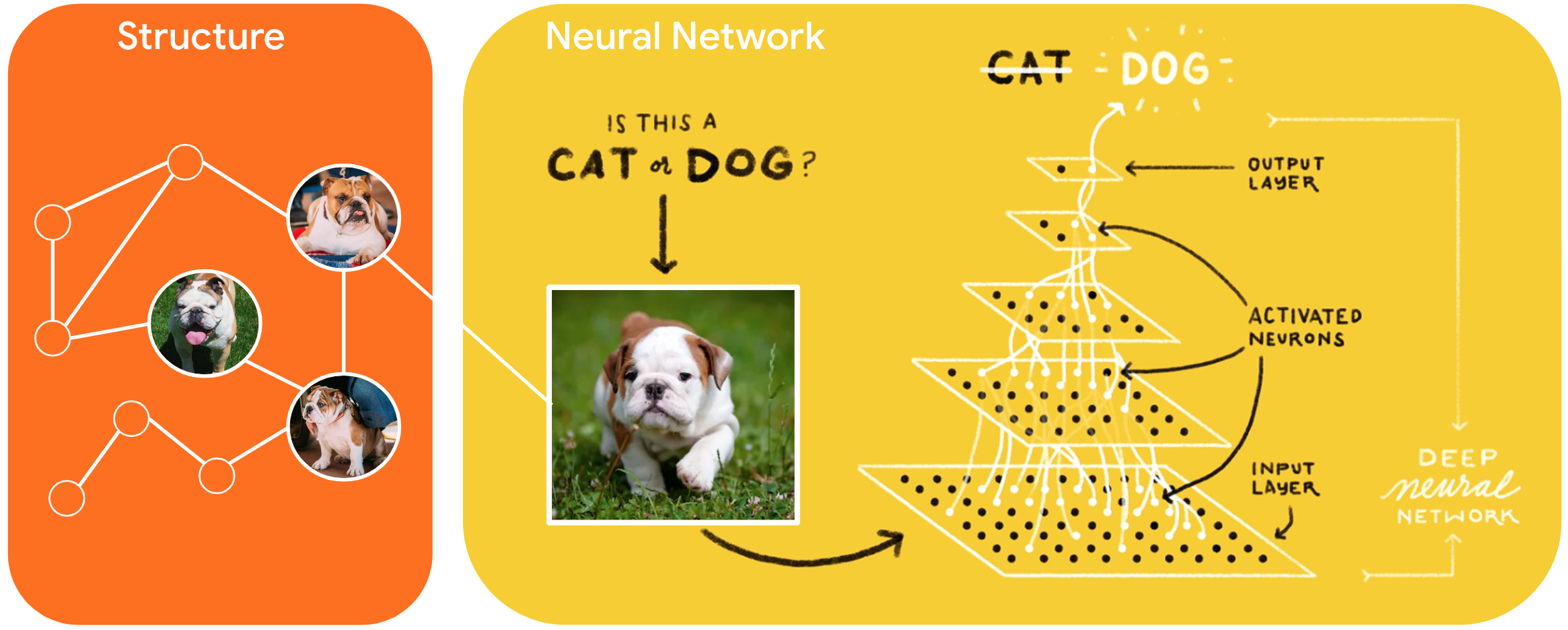
| + | a new learning paradigm to train neural networks by leveraging structured signals in addition to feature inputs. Structure can be explicit as represented by a graph or implicit as induced by adversarial perturbation. Structured signals are commonly used to represent relations or similarity among samples that may be labeled or unlabeled. Therefore, leveraging these signals during neural network training harnesses both labeled and unlabeled data, which can improve model accuracy, particularly when the amount of labeled data is relatively small. Additionally, models trained with samples that are generated by adding adversarial perturbation have been shown to be robust against malicious attacks, which are designed to mislead a model's prediction or classification. [http://www.tensorflow.org/neural_structured_learning Neural Structured Learning | TensorFlow.org] | ||
| − | <img src="http:// | + | <img src="http://www.tensorflow.org/neural_structured_learning/images/nsl_overview.png" width="700" height="350"> |
| + | |||
| + | <img src="http://miro.medium.com/max/1600/0*WnRpPeVuEu3TpL8X" width="1000" height="550"> | ||
<youtube>2Ucq7a8CY94</youtube> | <youtube>2Ucq7a8CY94</youtube> | ||
| − | |||
Latest revision as of 10:20, 23 February 2020
Youtube search... ...Google search
- Learning Techniques
- Graph Convolutional Network (GCN), Graph Neural Networks (Graph Nets), Geometric Deep Learning
- Introducing Neural Structured Learning in TensorFlow | Da-Cheng Juan and Sujith Ravi - Medium
- Skin Cancer Classification With Deep Learning | Andre Esteva, B. Kuprel, R. Novoa, J. Ko, S. Swetter, H. Blau & S.Thrun
- Introducing Neural Structured Learning in TensorFlow | Google
a new learning paradigm to train neural networks by leveraging structured signals in addition to feature inputs. Structure can be explicit as represented by a graph or implicit as induced by adversarial perturbation. Structured signals are commonly used to represent relations or similarity among samples that may be labeled or unlabeled. Therefore, leveraging these signals during neural network training harnesses both labeled and unlabeled data, which can improve model accuracy, particularly when the amount of labeled data is relatively small. Additionally, models trained with samples that are generated by adding adversarial perturbation have been shown to be robust against malicious attacks, which are designed to mislead a model's prediction or classification. Neural Structured Learning | TensorFlow.org